Monday, 23 June 2025
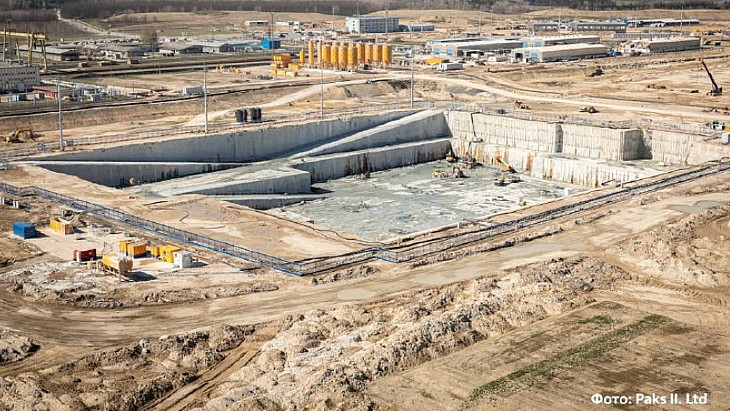
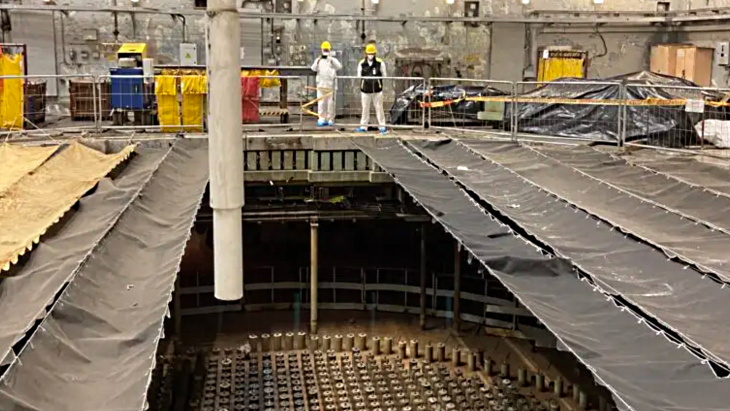
The halt to work to ensure the stability of the walls of the working pit followed an incident on 30 January in which, Paks II told a parliamentary session in March, “two corners on the prominent ‘peninsula’ in the southern section broke off, affecting half a percent of the more than 700-metre perimeter wall”.
Hungary’s Atomic Energy Authority (HAEA) immediately prohibited Paks II from further work on the southern wall affected by the collapse and required “Paks II to review the stability of the walls in the entire working pit and to reinforce the stability in the parts considered potentially dangerous. It also required Paks II to detail the methods and activities that would allow for the prediction of similar situations that endanger life and work safety after the irregular condition has been eliminated, when submitting documents to the HAEA on the review and verification of the stability of the walls delimiting the working area”.
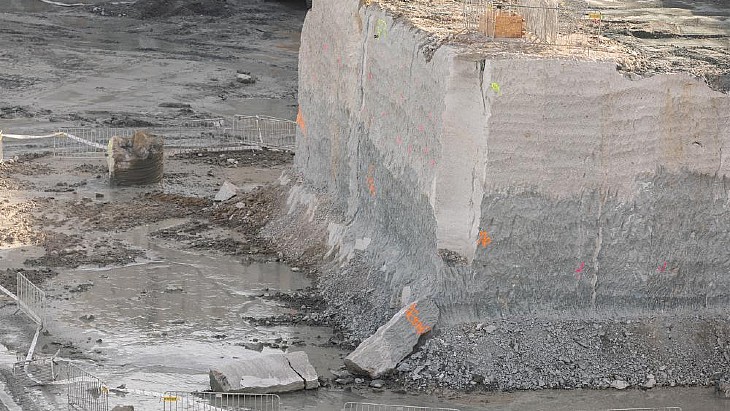
A picture of the affected section, posted as part of the report on the parliamentary session (Image: Paks II Ltd)
The authority said that Paks II had reviewed the condition of all the pit boundary walls and “identified potentially dangerous zones, and removed damaged, unstable parts where similar risks of block separation and collapse had arisen”.
HAEA said that after reviewing submitted documents and carrying out a site inspection it lifted the work ban subject to the installation of “a slope protection network on the affected sections of the internal boundary walls” and said that “during the construction activity, continuous monitoring must be carried out in order to track and document the movements of the groundwater level, the internal boundary walls of the working pit, and the surrounding buildings”.
It added: “In order to predict similar movements more accurately in the future and to implement possible preventive measures in a timely manner, the HAEA also required a review of the intervention and notification levels of the monitoring system. Other works, such as the first concrete pouring, may only be continued after the requirements and retention points specified in other HAEA permits have been met and accepted. The HAEA is examining the suitability of the soil consolidation in a separate procedure.”
First concrete has been scheduled for the current year, but Hungary’s Foreign Affairs and Trade Minister Péter Szijjártó told Russia’s RIA Novosti last week that first concrete was now likely to be poured next year. Their report did not include a reason given for the delay although he is reported to have said “the political circumstances in the world are not healthy at all”.
The Paks II project
The Paks plant, 100 kilometres south of Budapest, currently comprises four Russian-supplied VVER-440 pressurised water reactors, which started up between 1982 and 1987. An inter-governmental agreement was signed in early 2014 for Russian enterprises and their international sub-contractors to supply two VVER-1200 reactors at Paks as well as a Russian state loan of up to EUR10.0 billion (USD10.5 billion) to finance 80% of the project.
The construction licence application was submitted in July 2020, the construction licence was issued in August 2022 and a construction timetable agreed in 2023, including first concrete this year, with a target to connect the new units to the grid at the beginning of the 2030s.