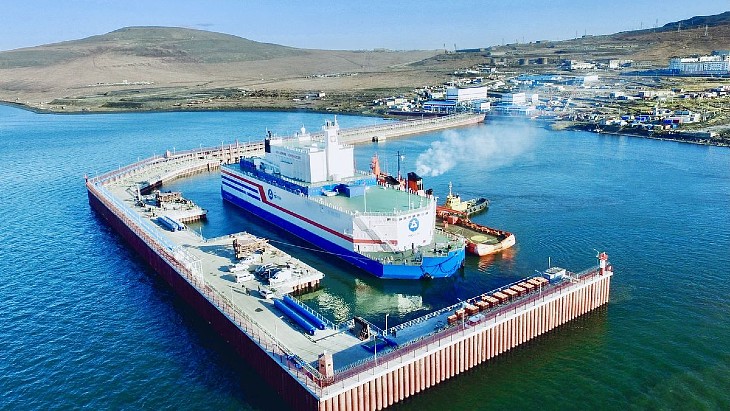
According to a report by the Strana Rosatom in-house publication, Director General Alexei Likhachev said the idea for a site to complete construction – which might cost “tens of billions of rubles” (10 billion rubles is about USD114.55 million) – was a response to the scale of future orders for floating nuclear power units.
A long-term key partner for Rosatom has been the Baltic Shipyard, which is part of the state-owned United Shipbuilding Corporation. According to Strana Rosatom most of the shipyard’s capacity is taken up with Rosatom orders.
But Likhachev said that the workload was set to increase on two fronts: “The first is the serial construction of 22220 [nuclear-powered] icebreakers, because the need for them will only grow. The second is the order for floating nuclear power units, which we have not yet … fully calculated. One thing is for sure: there will be dozens of floating power units. Therefore, where it is effective to work with a partner, we will work with a partner. And where it is necessary to create our own production link, we will create it. It is for this reason that we are considering the possibility of creating facilities near Murmansk for the completion of floating nuclear power units.”
He said that the reason for the choice of Murmansk, which is in north west Russia near to the Finland and Sweden borders, was that Atomflot – which maintains the nuclear-powered icebreaker fleet – is nearby, as well as port infrastructure, a large city.
There had been previous talks about the Baltic Shipyard becoming part of Rosatom, but the talks ended after its management opted to stay as part of the United Shipbuilding Corporation.
Likhachev said: “We agreed with this. At the same time, Rosatom not only did not reduce its presence at the plant, but also continues to ensure its harmonious and long-term development due to the growth of orders. For us in shipbuilding, it is not possession for the sake of possession that is important, but timing, quality and competence.”
Background
Russia has the world’s first operating floating nuclear power, the Akademik Lomonosov, whichbegan commercial operation in May 2020. It is based, with its coastal infrastructure, by the city of Pevek – population 5,000 – to which it supplies heat and power in Russia’s Arctic Chukotka region.
The Akademik Lomonosov has two KLT-40S reactors generating 35 MWe each, which are similar to those used in a previous generation of nuclear-powered icebreakers. It is also providing energy for the development of mining of the Baimskaya ore zone. It has the capacity to provide electricity to a city with a population of up to 100,000 people.
Rosatom is in the process of constructing four floating power units to power a new port as well as the Baimskaya copper and gold mine. Short deadlines and a lack of a capacity at Russian shipyards in 2022 meant those barges are being built in China. Russia is also targeting the export market for floating nuclear power plants with capacity of at least 100 MWe and an assigned service life of up to 60 years featuring RITM-200M reactors, derived from those used on Russia’s latest nuclear-powered icebreakers.
There are currently a series of Project 22220 nuclear-powered icebreakers operating – the Arktika, Sibir, Ural, the Yakutia, plus the Chukotka, which has been undergoing mooring tests – and two under construction, the Leningrad and the Stalingrad at the Baltic Shipyard.
Within Rosatom’s machine-building division, Afrikantov OKBM is the designer, complete supplier, and manufacturer of the reactor internals for the RITM-200 and RITM-400 reactor units. Reactor vessel fabrication and test assembly are performed at ZiO-Podolsk. Fifteen RITM-200 reactors have so far been completed, with 13 more under construction.