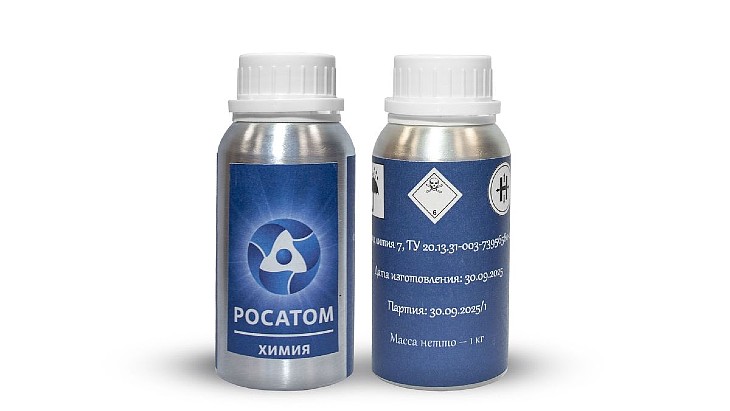
There is currently no industrial production of lithium-7 (Li-7) fluoride in Russia, although the Novosibirsk Chemical Concentrates Plant, part of Rosatom, produces lithium-7 hydroxide, which is the raw material for lithium-7 fluoride.
Rosatom says that the process which has been developed, using solid-phase synthesis, “eliminates the loss of valuable lithium isotope and minimises the amount of fluorine-containing waste, making production environmentally friendly”. Lithium-7 fluoride is to be used in the coolant for molten salt reactors.
Mikhail Metelkin, Director General of Rosatom Chemistry, said that developing the technology was “an important step toward addressing the industry’s ambitious goal of creating molten salt reactors and a significant milestone on the path to a sustainable and secure energy future. In the future, our research and development centre can scale up the technology to create a facility with a capacity of up to a tonne per year”.
In July this year, Rosatom said that the first stage of design work for a molten salt reactor had been completed. It said the design stage was due to last until 2027 – and would include the creation of technical designs for the reactor installation and the initial fuel preparation complex.
The project plans to use circulating molten salt fuel. And the intention is to continue research and developent work to justify the technological solutions in the design documentation with scaling of the technology expected to continue following the launch of the prototype reactor, which is targeted for 2031.
It is part of the wider Russian federal project to develop “new materials and technologies for advanced energy systems” and part of the country’s goal of closing the fuel cycle.
Background
According to World Nuclear Association’s , Li-7 has two important uses in nuclear power due to its relative transparency to neutrons. As a hydroxide it is necessary in small quantities for safe operation in pressurised water reactor (PWR) cooling systems as a pH stabiliser, to reduce corrosion in the primary circuit. As a fluoride, it is expected to come into much greater demand for molten salt reactors. For both purposes it must be very pure Li-7, otherwise tritium is formed by neutron capture.
The information paper says: “As a fluoride, Li-7 is used in the lithium fluoride and the lithium-beryllium fluoride that comprise the coolant salt in most MSRs that are the focus of intensive development. Very high levels of purity are required, up to 99.995% Li-7. In most cases the coolant salt also has the fuel dissolved in it. Such fluoride salts have very low vapour pressure even at red heat, carry more heat than the same volume of water, have good heat transfer properties, have low neutron absorbtion, are not damaged by radiation, do not react violently with air or water, and some are inert to some common structural metals.
“World demand for Li-7 in pressurised water reactor cooling systems is about one tonne per year, including about 400 kg annually for 65 US PWRs. When MSRs are built … demand for Li-7 could readily reach 250 t per year with the kind of construction programme envisaged by some.”
can “burn” minor actinides, such as americium, curium, and neptunium, some of the most dangerous and long-lived radioactive components found in irradiated nuclear fuel. This has the potential to significantly reduce the generation and activity of nuclear waste, as well as simplifying its ultimate disposal.