RWE Commits to Ambitious Emission Reductions Achieving Net Zero by 2040

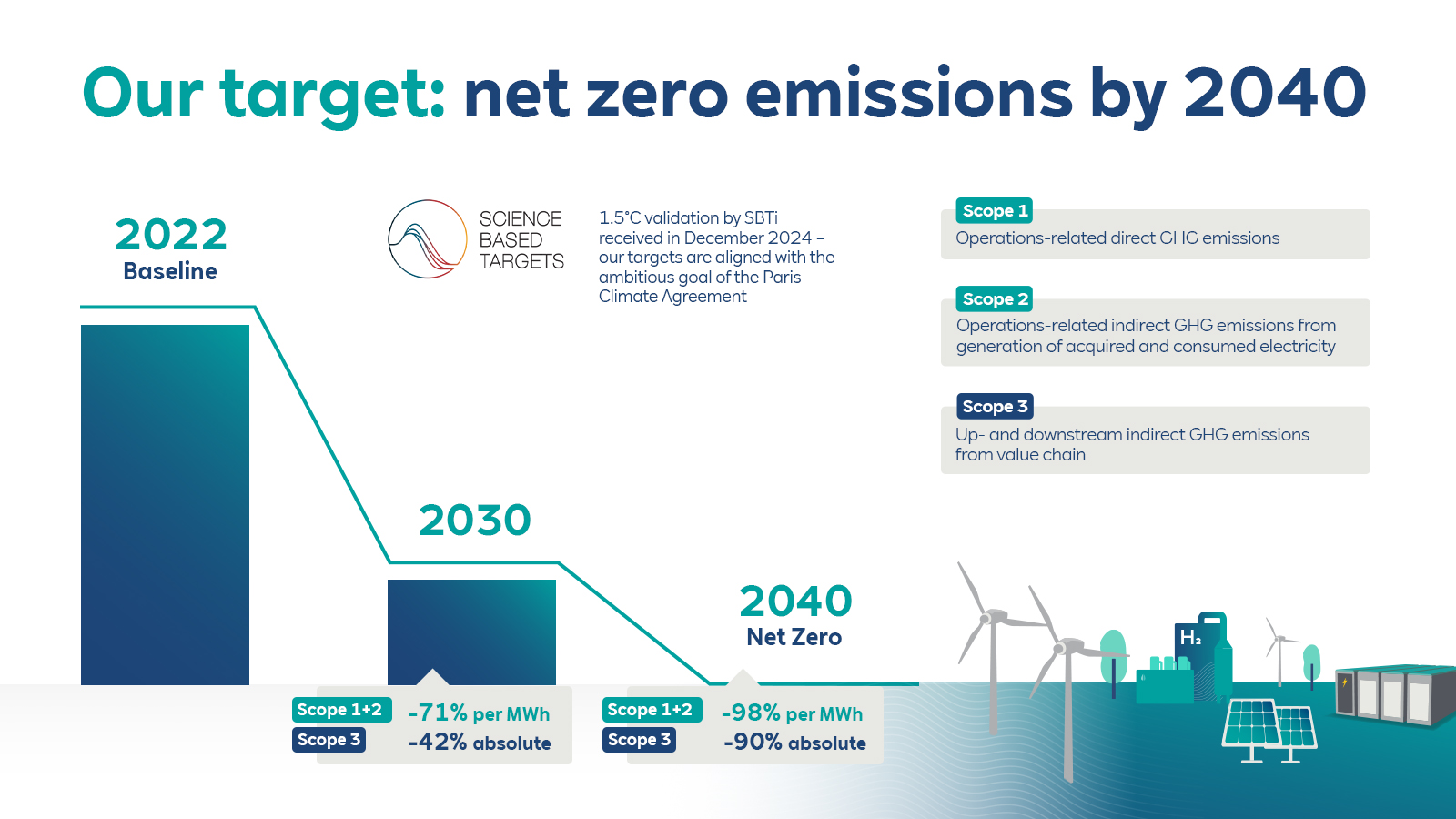
We achieve net zero emissions by 2040

After a comprehensive review, the Science Based Targets initiative (SBTi) has validated RWE’s climate targets, confirming they align with the Paris Agreement’s 1.5-degree global warming limit. The targets encompass emissions across all corporate activities (Scope 1, 2, and 3) and all greenhouse gases (GHG), including RWE’s commitment to achieving net zero by 2040.RWE has set ambitious climate targets for 2030 and 2040 to significantly reduce greenhouse gas (GHG) emissions. By 2030, the company aims to cut Scope 1 and Scope 2 GHG emissions by 71.1% per MWh compared to the 2022 baseline. Similarly, Scope 1 and Scope 3 GHG emissions from all electricity sold are targeted for a 71.1% reduction per MWh, while absolute Scope 3 GHG emissions will decrease by 42%.

By 2040, RWE plans to achieve a 98.3% reduction in Scope 1 and Scope 2 GHG emissions per MWh, with Scope 1 and Scope 3 emissions from electricity sold also decreasing by 98.3% compared to 2022. Absolute Scope 3 GHG emissions will be reduced by 90%, and any residual emissions will be neutralised using carbon credits, ensuring net-zero GHG emissions across the value chain by 2040.

This marks the second SBTi validation for RWE, following the approval of its previous targets in 2020. SBTi, an international climate action initiative, provides rigorous standards for companies to align their goals with global temperature limits. The initiative collaborates with CDP, the United Nations Global Compact, the We Mean Business Coalition, the World Resources Institute, and WWF.Kunal Chandra, Director Strategy & Sustainability, RWE AG: “I’m very proud of the confirmation from the Science Based Targets initiative that our 2030 climate targets are in line with a 1.5-degree pathway and that our target of achieving net zero by 2040 has been validated. This is recognition of the great work done by the RWE team to advance towards a sustainable energy world.”
 

  • Related Posts

    India Daily: India Power Capacity Tops 550 GW, CEA Sets New Cybersecurity Rules, CSPDCL Advances 500 MWh BESS, India Accelerates Smart Meters, Kerala Rejects KINESCO Licence and More…

    India’s installed power capacity reached around 552 GW by July 2026, with non-fossil sources contributing more than 300 GW, or over 54% of the total. Solar has emerged as a…

    CERC Approves GNA Milestone Extensions With New Charges For Renewable Energy Projects

    The Central Electricity Regulatory Commission (CERC) has approved a uniform framework allowing renewable power developers additional time to meet key operational milestones under the General Network Access (GNA) Regulations. The…

    Have You Seen?

    Kazakhstan Accuses Big Oil of $10.7 Billion Corruption in Kashagan Oil Project

    • August 15, 2026
    Kazakhstan Accuses Big Oil of $10.7 Billion Corruption in Kashagan Oil Project

    Hormuz Tanker Traffic Slumps as U.S.-Iran Standoff Drags On

    • August 14, 2026
    Hormuz Tanker Traffic Slumps as U.S.-Iran Standoff Drags On

    Vance Says Cheap Oil and Gas Is Top U.S. Priority in Iran War

    • August 14, 2026
    Vance Says Cheap Oil and Gas Is Top U.S. Priority in Iran War

    Middle East Oil Tankers Are Going Dark for Longer

    • August 14, 2026
    Middle East Oil Tankers Are Going Dark for Longer

    Drone Strike Sparks Blaze at Key Russian Oil and Fuel Terminal

    • August 14, 2026
    Drone Strike Sparks Blaze at Key Russian Oil and Fuel Terminal

    Hormuz Crisis Pushes Asian Refiners Toward U.S. Oil

    • August 14, 2026
    Hormuz Crisis Pushes Asian Refiners Toward U.S. Oil

    India’s Coal Demand Set to Hit 1.6 Billion Tons by 2030

    • August 14, 2026
    India’s Coal Demand Set to Hit 1.6 Billion Tons by 2030

    Holcim UAE starts cement carbon capture pilot project

    • August 14, 2026
    Holcim UAE starts cement carbon capture pilot project

    Qatar Ras Laffan train five ‘goes offline’

    • August 14, 2026
    Qatar Ras Laffan train five ‘goes offline’

    Vietnam’s Bac Ninh semiconductor investment hits $2.7bn

    • August 14, 2026
    Vietnam’s Bac Ninh semiconductor investment hits $2.7bn