

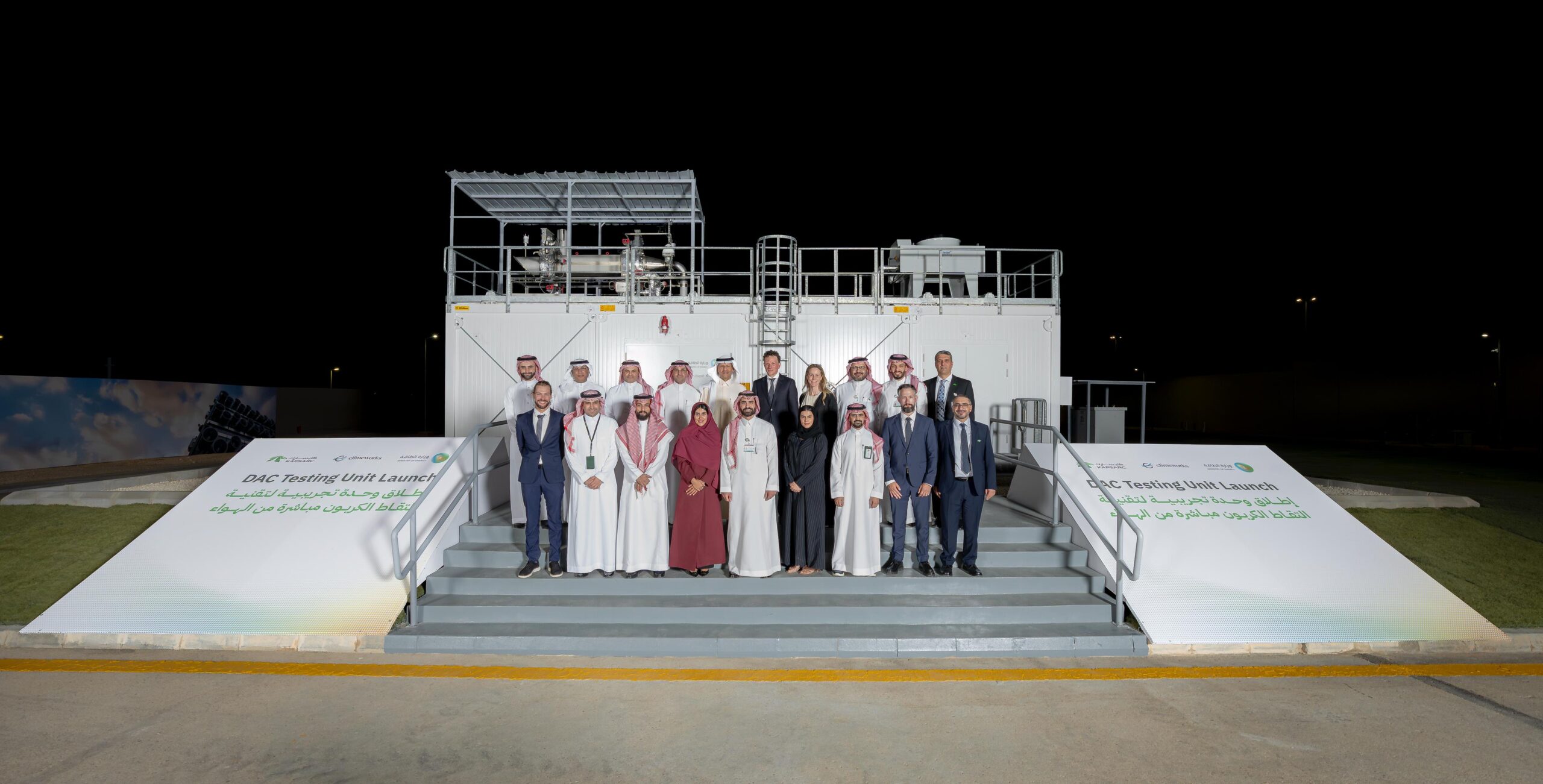
His Royal Highness Prince Abdulaziz bin Salman bin Abdulaziz, Minister of Energy, has officially launched the operation of Saudi Arabia’s first pilot unit for Direct Air Capture (DAC) of carbon dioxide at the King Abdullah Petroleum Studies and Research Center (KAPSARC) in Riyadh. The unit was developed in partnership with Swiss climate technology company Climeworks.
The mobile DAC unit, now operational, extracts CO₂ directly from the atmosphere and is being tested under the Kingdom’s harsh and arid climate conditions — marking a key milestone for evaluating the technology’s viability outside its typical cooler deployment zones, such as Iceland.
According to the Ministry, the launch reflects Saudi Arabia’s leadership in advancing the Circular Carbon Economy and highlights the nation’s commitment to climate solutions aligned with Vision 2030 and its national strategies for decarbonization.
The deployment is part of a broader feasibility study under a Memorandum of Understanding signed during the 2024 Saudi Green Initiative Forum. It aims to expand the use of carbon capture technologies in support of Saudi Arabia’s net-zero ambitions.
KAPSARC, known for its thought leadership in the energy sector, plays a key role in the initiative. With extensive experience in carbon capture research, climate policy analysis, and techno-economic modeling, the center serves as a strategic partner for piloting and scaling such technologies.
The unit’s successful installation also reinforces Saudi Arabia’s strategic positioning as a global hub for carbon removal solutions. The country benefits from abundant renewable energy resources, world-class infrastructure, and a geographic advantage — enabling the scaling of DAC technologies at commercially viable costs.
The DAC project is a stepping stone toward the Kingdom’s broader carbon management goals. Saudi Arabia has announced plans to capture and utilize up to 44 million tonnes of CO₂ annually by 2035 through major Carbon Capture, Utilization, and Storage (CCUS) hubs in both its eastern and western regions. These hubs will focus on aggregating industrial emissions for conversion into high-value products.
Ongoing evaluation of DAC deployment also includes assessing the potential for localizing key materials and components, which could pave the way for building a domestic supply chain for carbon capture technologies.
This initiative underscores the Kingdom’s growing role in deploying industrial-scale decarbonization solutions, fostering climate innovation, and supporting economic diversification through sustainable technology leadership.









)