The new phase of the plant – known as Leningrad II – features two VVER-1200 units, commissioned in 2018 and 2021 respectively, with a third and fourth new unit currently under construction. Together, they will replace the four RBMK-1000 units from the original 1970s phase of the Leningrad nuclear power plant.
There are currently 1,500 people from the general contractor, Titan-2 Holding, working on the construction site for the two units – Leningrad II’s units 3 and 4, or the seventh and eighth units if the older four units are included.
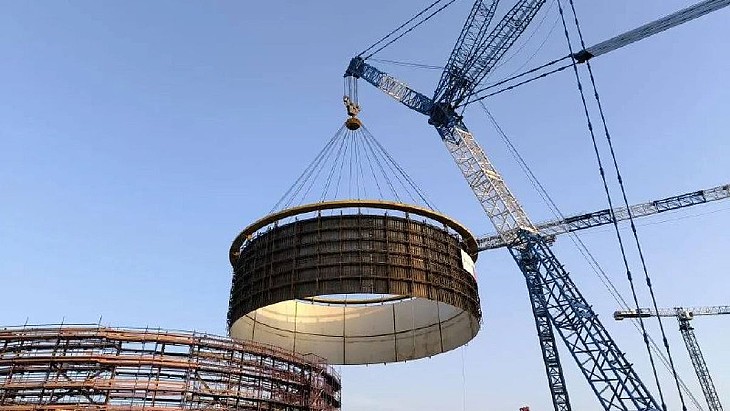
Rosatom said that there is considerable work still ahead on the already installed tiers, and the tiers yet to be installed – including reinforcement and concreting and installation of the prestressing system.
(Image: Rosatom)
VVER-1200 reactors have two containment buildings – an inner one and an outer one – which provide extra safety and protection from external impacts. Both containments are being worked on – the aim is for this new unit’s double containment shell to be ready in 2028.
Rosatom Director General Alexei Likhachev attended the event and said: “The Northwest region of our country is traditionally energy-intensive, with industrial and port infrastructure actively developing here. Two of our nuclear power plants operate in the region – the Leningrad and Kola Nuclear Power Plants – with a combined capacity of over 6,000 MW. Together, they provide over 35% of the region’s electricity generation. Both plants have been operating for over 50 years, and each is currently receiving a second lease of life – replacement capacity that will last for at least another 60 years.”
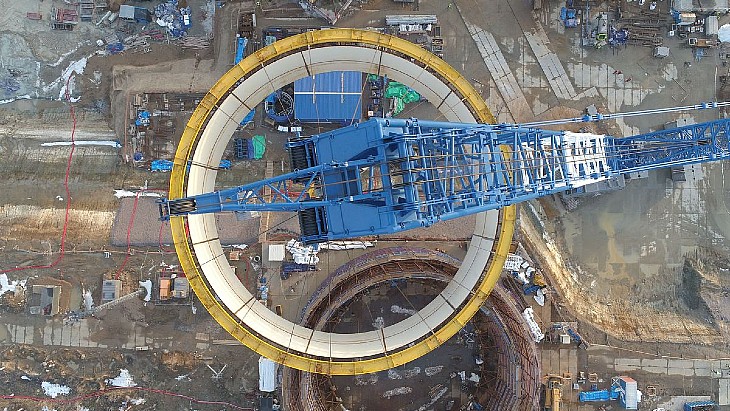
The inner and outer containments are being built simultaneously (Image: Rosatom)
Regional Governor, Alexander Drozdenko, said: “Today, we have confirmed that construction of the replacement capacity at the Leningrad Nuclear Power Plant is proceeding at a good pace. We are confident that the new power units will be commissioned on schedule and will guarantee electricity for millions of our households and hundreds of industries, as well as healthcare, cultural, and sports institutions.”
Background
The Leningrad nuclear power plant is one of the largest in Russia, with an installed capacity of 4,400 MWe, and provides more than 55% of the electricity demand of St Petersburg and the Leningrad region, or 30% of all the electricity in northwest Russia.
Leningrad 1 shut down in 2018 after 45 years of operation. Leningrad 2, also a 1,000 MWe RBMK unit, started up in 1975 and was permanently shut down in November 2020. As the first two of the plant’s four RBMK-1000 units shut down, new VVER-1200 units started up at the neighbouring Leningrad II plant. The 60-year service life of these fifth and sixth units (also known as Leningrad II-1 and Leningrad II-2) secures power supply until the 2080s. Units 7 and 8 (also known as Leningrad II-3 and Leningrad II-4) will replace units 3 and 4 as they are shut in the coming years.
The pouring of the first concrete for unit 7 in March 2024 marked the start of the main phase of construction of the new power unit, which is expected to generate power for 60 years, with the possibility of a 20-year extension. First concrete was poured for the eighth unit in March 2025.