The event was attended by of the Russian State Corporation Rosatom Director General Alexey Likhachev, Chairman of the Agency of the Republic of Kazakhstan for Atomic Energy Almasadam Satkaliyev, and Akim of Almaty Region Marat Sultangaziyev.
During the ceremony, specialists from Rosatom’s Engineering Division started drilling the first exploratory borehole and soil sampling. These studies will assess seismic stability, hydrogeological features, and other parameters of the area, which are essential for the safety and reliability of the future plant. A total of at least 50 boreholes, each between 30 and 120 metres deep, will be drilled during this stage. A final decision on the nuclear power plant’s exact location will be made based on the survey results.
“The surveys ensure the project complies with both international and national standards, minimises environmental and technological risks, and creates a foundation for efficient design of the future nuclear power plant,” Rosatom said.
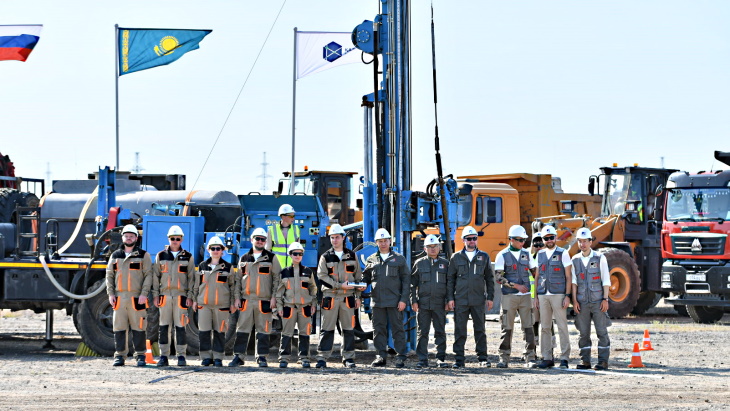
(Image: Rosatom)
The engineering surveys are scheduled to take 18 months, Asset Makhkambetov, deputy chairman of the Kazakh Atomic Energy Agency said, according to a Kazinform News Agency report. He said that three potential areas will be selected as part of exploratory studies, at each of which complex engineering surveys will be carried out.
“The launch of engineering surveys in Ulken marks the beginning of the journey toward the first high-capacity nuclear power plant in Kazakhstan’s modern history,” Likhachev said. “At this stage, we are focusing on a thorough study of the site to be fully confident in its suitability for a future nuclear plant. Rosatom is ready to apply all its accumulated experience to implement this strategically important project for Kazakhstan’s development.”
“Today is only the first step, but it determines Kazakhstan’s path toward establishing a new high-tech sector in the national economy,” Satkaliyev said. “We are confident that the nuclear power plant will provide a powerful boost to the region’s development – from the creation of modern infrastructure to new schools, kindergartens, and social facilities. This project is Kazakhstan’s strategic choice and a driver of long-term regional and national economic growth.”
In June, Rosatom was selected as the leader of an international consortium to build Kazakhstan’s first planned nuclear power plant, with China being lined up to build a second one. The Atomic Energy Agency of Kazakhstan had earlier held negotiations with leading global manufacturers and had drawn up a shortlist of potential suppliers: Rosatom with its VVER-1200 reactors, China National Nuclear Corporation (CNNC) with its HPR-1000, France’s EDF with its EPR1200 and Korea Hydro & Nuclear Power with its APR-1000/APR-1400.
On 31 July, First Deputy Prime Minister Roman Sklyar announced that CNNC will build Kazakhstan’s second and third nuclear power plants, Kazinform News Agency reported. He noted the locations for those plants will be announced later this year.
Background
Kazakhstan is the world’s leading producer of uranium. Although it does not currently use nuclear energy, it is not without nuclear experience: it has three operating research reactors, and a Russian-designed BN-350 sodium-cooled fast reactor operated near Aktau for 26 years, until 1999.
Kazakhstan has been preparing for a possible nuclear power programme to reduce its reliance on fossil fuels, diversify its energy mix and reduce CO2 emissions for some time. Kazakhstan Nuclear Power Plant (KNPP), a subsidiary of Kazakhstan’s Samruk-Kazyna National Welfare Fund JSC, was set up in 2014. As well as being designated as the owner/operator of a future plant, KNPP has been tasked with pre-project work including a feasibility study to justify the need for nuclear power – carried out in 2018 – and locating a site.
In a referendum last year more than 70% of the 7.8 million people who voted answered ‘yes’ to the question: “Do you agree with the construction of a nuclear power plant in Kazakhstan?”
As well as the proposed first nuclear power plant, there are also options for using small modular reactors to replace retiring coal plants in the years to come. The government’s target is for nuclear to produce a 5% share of the national generation mix by 2035.