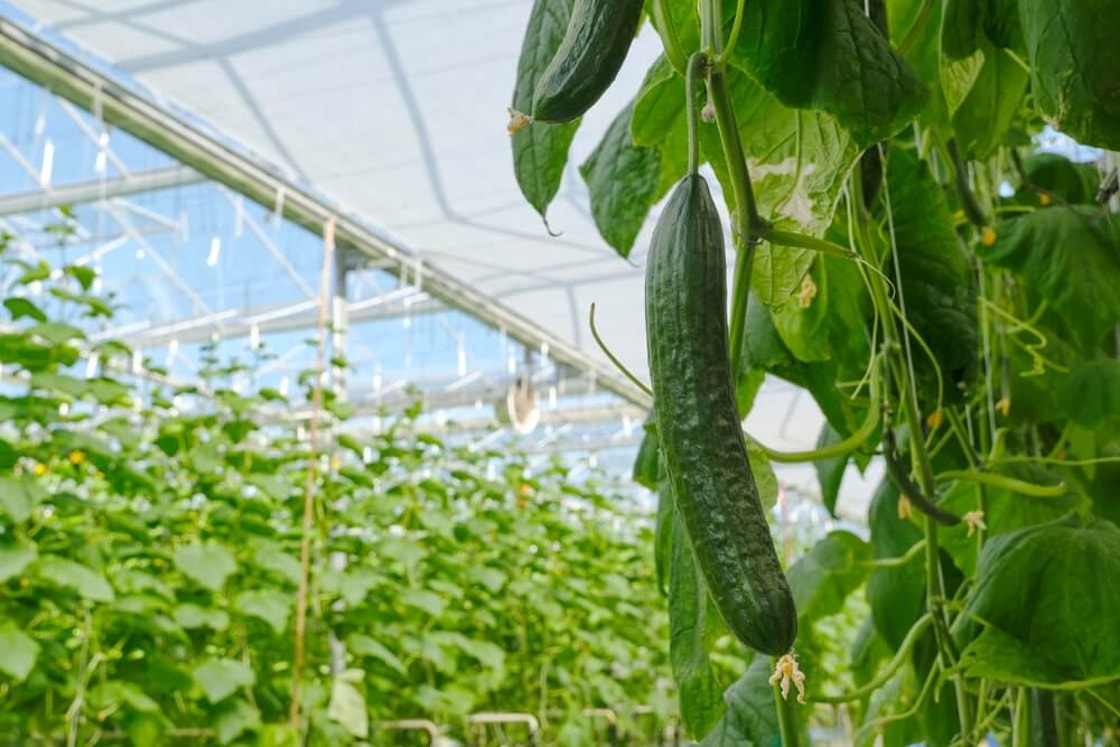
Direct air captured CO2 has been previously been used by Skytree to help grow cucumbers ©Shutterstock
Netherlands-based cleantech firm Skytree will deploy a direct air capture (DAC) system at the site of Dutch energy company Lingezegen Energy, capturing CO2 for supply to a cluster of nearby greenhouses.
Slated to begin operations this year, the system is expected to capture 900 tonnes of CO2 per year directly from the air before being scaled to 7,200 tonnes per year by 2027.
The captured CO2 will supply 10 greenhouses across 80 hectares as a form of enrichment, which is vital for maximising crop yields and quality.
The partners see the project as a way to build a decentralised supply chain that delivers CO2 at the point of use while safeguarding against the volatility and cost of traditional industrial sources.
The project also fits with efforts across the greenhouse sector to reduce emissions and meet longer-term sustainability targets.
“By decoupling CO2 supply from fossil fuel combustion, we help solve the CO2 crisis for the Dutch greenhouse sector and help growers reduce their carbon footprint,” said Rob van Straten, CEO of Skytree.
According to Skytree, the reduces energy requirements by moving the sorbent material between separate cold and hot chambers, meaning only the CO2-capturing material is heated rather than the entire unit.
“This allows us to utilise low-grade heat and reduce electricity consumption to as low as 0.9 MWh per tonne: a figure that finally makes onsite CO2 capture financially viable for many customers,” said Wojciech Glazek, CTO at Skytree.
While DAC remains one of the most expensive sources of CO2, with current costs often estimated in the hundreds of dollars per tonne, developers are pursuing lower energy consumption and modular designs to improve economics as projects scale.
The International Energy Agency has estimated current DAC costs at between $500 and $1,900 per tonne of CO2, although technology improvements and larger-scale deployment could reduce costs considerably over time.
The project comes as Dutch greenhouse growers seek alternative sources of CO2 as the sector decarbonises.
A recent study by consultancy CE Delft for the Dutch government warned that supplies of sustainable CO2 are likely to remain scarce in both the short and long term, creating a challenge for greenhouse operators that rely on CO2 enrichment to maximise crop yields.