The Energy and Resources Institute (TERI) and the Skill Council for Green Jobs (SCGJ) have entered into a strategic partnership to support the development of a future-ready green workforce in India. The two organizations signed a Memorandum of Understanding (MoU) during the India Energy Storage Week (IESW) 2025, with the aim of working together to build human resource capacity through joint efforts focused on skill development, training, and knowledge sharing in the clean energy and environmental sectors.
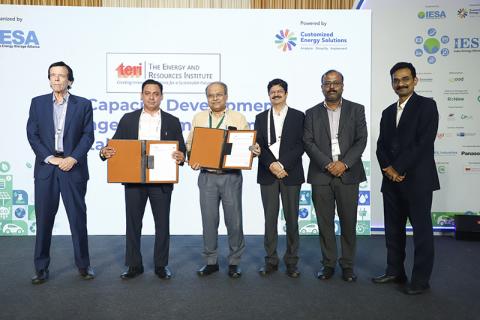
The MoU was formalized during a high-level roundtable session on skill development for Battery Energy Storage Systems (BESS), held in New Delhi. The signing took place in the presence of key stakeholders from across the energy ecosystem. The session began with opening remarks by Dr. PK Bhattacharya, Director at TERI, followed by a special address from Mr. Arpit Sharma, CEO of SCGJ.
This collaboration will involve a wide range of activities, including identifying skill gaps, assessing training needs, developing standardized training frameworks, designing relevant curricula and learning resources, engaging stakeholders, and supporting certification and accreditation processes. The MoU also provides the flexibility to expand the scope of the partnership over time, depending on mutual interests and evolving industry needs.
Dr PK Bhattacharya mentioned, “Recent policy boosts like 2nd tranche Viability Gap Funding in June 2025 which lowering of upfront battery storage costs in grid-scale tenders supports such aspirations. However, in order to reach the goal, there is also a need to strengthen institutional capacity and address skill gaps in the workforce to manage technology integration and business growth. In this context, under the StoRein project, one of the key components is to assess skill gaps, map institutional capabilities, propose actionable strategies, development of training courses for capacity building and development of workforce aligning to the industry requirements.”
Mr Arpit Sharma, said, “As India has an ambitious target of achieving 500 GW of RE by 2030, aims at 50% of energy requirements to be met by non – fossil fuels and a need for round the clock (RTC) power. The skill in BESS sector still remains untapped, and the need to create nationally approved job roles in order to meet the mission and creation of skilled workforce, Skill Council Green Jobs has joined hand with TERI to carry out a skill gap assessment study, identify potential job roles, development of curriculum and imparting training programs in the BESS ecosystem. This will give a big thrust to the industry in terms of upskilling.”
The partnership aligns with the goals of the ongoing StoREin (Scaling up Storage in Renewable Energy Integration) project. This Indo-German development cooperation initiative is being implemented by Deutsche Gesellschaft für Internationale Zusammenarbeit (GIZ) GmbH on behalf of the Federal Ministry for Economic Affairs and Climate Action (BMWK), under the International Climate Initiative (IKI). The project works in close coordination with the Ministry of New and Renewable Energy (MNRE), Government of India, and focuses on strengthening institutional and human capacity in support of India’s growing energy storage ecosystem.
With India’s National Electricity Plan projecting a need for 47.24 GW of battery energy storage by 2031-32, the TERI-SCGJ collaboration addresses the growing demand for a skilled and industry-aligned workforce to meet the country’s clean energy targets. The roundtable discussion at IESW brought together senior representatives from government agencies, renewable energy companies, battery manufacturers, system integrators, distribution companies (DISCOMs), academic and training institutions, philanthropic organizations, consulting firms, and financial institutions.
The participants discussed existing skill shortages, the relevance of current training content, availability of hands-on learning infrastructure, and strategies to build a high-quality, inclusive workforce. The session also included discussions around conducting a national survey to assess workforce readiness in the energy storage sector. This partnership represents a significant step toward advancing India’s clean energy transition. By focusing on the development of skilled professionals and bridging current gaps in workforce readiness, TERI and SCGJ aim to support the country’s energy goals and contribute to the growth of a resilient and innovative green economy.
Subscribe to get the latest posts sent to your email.