TerraPower submitted its Generic Design Assessment (GDA) application in October, the first regulatory filing for Natrium technology in a market outside the USA.
Chris Levesque, President and CEO of Terrapower, said: “We are incredibly pleased to have our application accepted … TerraPower prides itself on its technical rigour, and we will bring our industry-leading team and robust regulatory experience to support this review. We look forward to working with the Department for Energy Security and Net Zero, Office for Nuclear Regulation, and Environment Agency in the coming months, and ultimately advancing our efforts to bring a Natrium reactor to the United Kingdom.”
The UK’s Office for Nuclear Regulation (ONR) said that it, the Environment Agency and Natural Resources Wales had been asked to begin the GDA for the Natrium reactor design after the Department for Energy Security and Net Zero’s review of TerraPower’s application concluded that the design was ready to enter the process.
The ONR said: “The assessment will begin once the necessary arrangements around timescales and resources have been put in place.”
A Generic Design Assessment is the process to assess nuclear power plant designs, notably the safety, security and environmental implications. It looks at this aspect separately from applications to build them at specific sites.
The ONR says that by assessing at the design stage, any potential safety, security or environmental concerns can be identified and highlighted so “they can be addressed before commitments are made to construct any reactors based on that design. GDA is also designed to be generic, allowing the results of the regulators’ assessment to potentially be applied to multiple sites where that design is subsequently constructed”.
Background
In terms of small modular reactors (SMRs), Rolls-Royce SMR Limited’s SMR design entered the GDA process in 2022 and is currently in Step 3 – the final step – of the process; Holtec’s SMR-300 entered the GDA process in December 2023 and is currently in Step 2; and GE Vernova Hitachi’s BWRX-300 entered the process in January 2024 and completed Step 2 in December 2025.
Microsoft co-founder Bill Gates has been chairman of TerraPower since 2006. The firm’s molten salt-based energy storage system means the Natrium plant can temporarily boost output to 500 MWe when needed, enabling the plant to follow daily electric load changes and integrate seamlessly with fluctuating renewable resources.
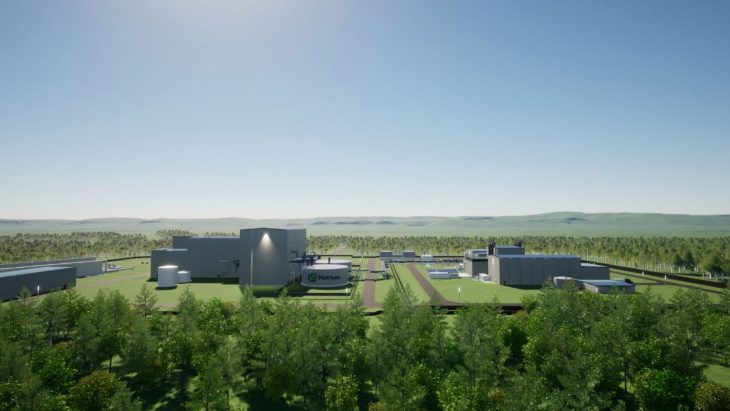
TerraPower began non-nuclear construction for its first Natrium plant, in Kemmerer, Wyoming, in June 2024, and expects construction of the plant – which it says will be the first commercial-scale, advanced nuclear project in the USA – to be complete in 2030. The first Natrium project is being developed through the US Department of Energy’s Advanced Reactor Demonstration Program.
Last month, social media giant Meta announced that its future nuclear energy plans included funding to support the development in the USA of up to eight Natrium sodium fast reactors – two new units capable of generating up to 690 MW of firm power with delivery as early as 2032, plus the rights for energy from up to six other Natrium units capable of producing 2.1 GW and targeted for delivery by 2035.
The Natrium reactor is a TerraPower and GE Vernova Hitachi Nuclear Energy technology.