(Reuters) – The Strait of Hormuz has emerged as the central battleground of the Iran conflict. The passage of a handful of oil and gas tankers in recent days, apparently with Tehran’s consent, hints at tacit acceptance of its control. This foreshadows a more dangerous phase in what is fast turning into a Hormuz war. Tehran’s near-complete closure of the vital trade artery since the joint Israeli-U.S. airstrikes on February 28 and the reciprocal U.S. naval blockade imposed last month have sent shockwaves through global energy markets. Countries, particularly in Asia, have struggled with the sudden loss of more than 13% of global oil supply and roughly a fifth of liquefied natural gas flows.
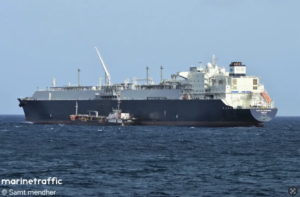
Thus, many welcomed the news that three very large crude carriers (VLCCs), each hauling around 2 million barrels of Iraqi oil headed for Asia, slipped through last week with their tracking systems switched off, according to Kpler shipping data, with some indications the transits were coordinated with Tehran. Qatar also shipped its first two LNG cargoes since the war began. The LNG is being sold to Pakistan – the primary mediator in U.S.-Iran negotiations – under a government-to-government deal, according to sources familiar with the matter.They said Iran had approved the shipment to help build confidence with Qatar and Pakistan. There are also signs that other vessels, including oil tankers, have transited the strait in recent weeks with their transponders switched off. It remains unclear whether those passages were sanctioned by Iran or whether shipowners paid informal tolls to secure safe passage. Several, however, appeared to have travelled along shipping lanes close to Iran’s coastline.
Get the Latest US Focused Energy News Delivered to You! It’s FREE:
While this trickle of cargoes offers badly needed relief to import-dependent economies, it is not a signal that the global energy system is returning to normal – quite the opposite.
The movements represent a mere fraction of the roughly 140 vessels that crossed Hormuz daily before the conflict, meaning global markets remain tight and vulnerable. More importantly, they point to an emerging new order. Iran is beginning to dictate not whether Hormuz is open or closed, but who gets to use it – an arrangement that could outlast the current conflict and sow the seeds of the next.
CHANGING PATTERNS
Gulf exporters like Saudi Arabia, the United Arab Emirates, Qatar, Kuwait, Bahrain and Iraq – whose economies depend on the unhindered flow of hydrocarbons – will be alarmed by any system in which Tehran determines which cargoes reach global markets and on what terms.
Buyers will be equally uneasy. Asian importers, already reeling from supply disruptions, will likely resist any framework that gives Tehran a direct lever over their energy security and economic stability. Above all, the U.S. is unlikely to tolerate a settlement that cedes Tehran such sweeping political and economic leverage. President Donald Trump has insisted that transit return to its pre-war status as a condition for any permanent ceasefire. Allowing Iran to manage access to the strait would undermine Washington’s stated war aims and make any claim of victory hollow. Iran, for its part, will not be eager to relinquish its control over the chokepoint – and, by extension, the global economy. It is by far Tehran’s most powerful weapon. With the U.S. blockade having reportedly cost Iran roughly $3 billion so far, it will also need the revenue that selective transit fees can generate.
STASIS TURNS INTO CONFLICT
The logic points to a bleak conclusion. If this selective, Iran-mediated transit pattern becomes entrenched, it risks hardening into a new normal that may persist even if a ceasefire is hammered out. Tehran may agree to reopen the strait to secure U.S. concessions, but restoring full, unconditional freedom of navigation looks unlikely.
Such a stasis would be inherently unstable – institutionalising disruption rather than resolving it. Renewed confrontation between Tehran and Washington – and potentially with Gulf states – would become increasingly likely, as all sides tested the limits of who controls the flow of energy through the strait.
U.S. war aims have shifted repeatedly in recent months. Yet the conflict has essentially coalesced around a single defining question: who controls the Strait of Hormuz? That answer will likely shape the future of the Gulf.
The opinions expressed here are those of Ron Bousso, a columnist for Reuters.
Ron Bousso Editing by Marguerita Choy
Share This:
Next Article
More News Articles