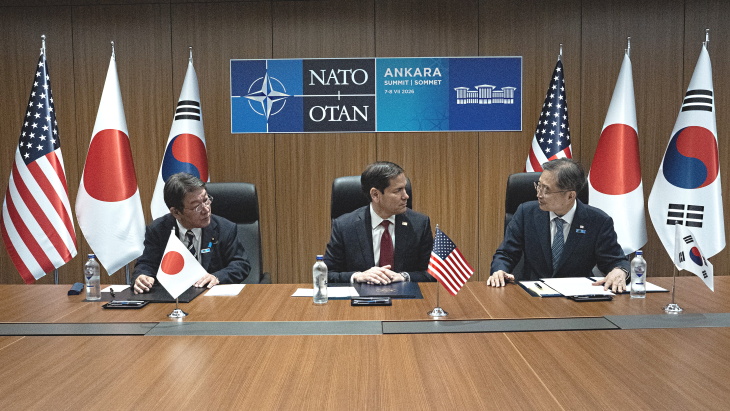
The memorandum was signed on Tuesday on the margins of the NATO Summit in Ankara, Turkey, by US Secretary of State Marco Rubio, Japan’s Foreign Minister Motegi Toshimitsu, and South Korea’s Foreign Minister Cho Hyun.
The memorandum “outlines opportunities for our three countries, which have complementary advantages in the civil nuclear field, to encourage mutually beneficial cooperation among their respective nuclear industries”, the US Department of State said. “This framework aims to foster fleet deployment models that de-risk project development, achieve economies of scale, catalyse private investment, streamline licensing processes, and optimise supply chains.
“A coordinated trilateral approach positions American, Japanese, and Korean firms to provide partners in the region with more competitive alternatives to meet their growing energy demands and to uphold the highest standards of nuclear safety, security, and non-proliferation as new reactor technology increasingly comes online.”
Under the memorandum, the three countries will identify third-party countries that are interested in small modular reactors (SMRs) in the Indo-Pacific region and will support the construction of multiple SMRs through a standard fleet and simplified contracting procedures. For that purpose, the partners will encourage the formation of consortiums by their respective nuclear industries and foster project development through mobilising financing and investment.
In support of this initiative, the USA is committing more than USD10 million in new funding for the Department of State’s Foundational Infrastructure for Responsible Use of Small Modular Reactor Technology (FIRST) programme to provide technical support to countries in the Indo-Pacific region for the deployment of safe, secure, and reliable nuclear energy. It said the funds would advance SMR project development activities and establish an SMR Regional Training Hub for workforce development.
European BWRX-300 deployment
The USA also announced an industry initiative agreed upon by GE Vernova of the USA, Japan’s Hitachi, Samsung C&T of South Korea, and Poland’s SGE to advance deployment of the BWRX-300 SMR design across Europe. “This initiative will help achieve the ambitions set forth in the memorandum signed today and deepen government-industry partnerships to strengthen global energy security,” the Department of State said.
The BWRX-300 is a 300 MWe water-cooled, natural circulation SMR with passive safety systems that leverages the design and licensing basis of GE Vernova Hitachi Nuclear Energy’s (GVH’s) US Nuclear Regulatory Commission-certified ESBWR boiling water reactor design and its existing, licensed GNF2 fuel design. GVH’s first BWRX-300 is under construction at Ontario Power Generation’s Darlington site in Canada, with completion expected by the end of the decade.
SGE – part of the MS Galleon Group – is a co-investor in the standard design for the BWRX-300 and is in the process of establishing SMR partnerships and projects in a number of Central and Eastern European countries, including the Czech Republic, Hungary, Bulgaria and Romania. Its flagship project is being implemented in Poland in collaboration with Orlen, with work under way at three sites and the first unit expected to be commissioned in 2032.
Last week, SGE and a deployment team including Samsung C&T, Laing O’Rourke, Aecon Group and Google Cloud outlined plans for the privately financed deployment of 14 BWRX-300 SMRs across three sites in the UK. SGE submitted the application under the UK’s Advanced Nuclear Framework for reactors which could provide 4.2 GW of capacity, equivalent to 11% of current UK power demand.