By Will Kubzansky
A federal gasoline tax holiday as proposed by U.S. President Donald Trump would result in billions of dollars in lost tax revenue each month, independent budget analysts say.
Get the Latest US Focused Energy News Delivered to You! It’s FREE:
Trump told reporters at the White House on Monday that he’d seek to suspend the federal 18.4 cents U.S. a gallon tax on gasoline “until it’s appropriate,” though it’s unclear how much of the cut would reach consumers at the pump. Pausing the tax would require an act of Congress.
The president made the announcement months before midterm elections in November as his Republican Party tries to reassure voters who were already anxious about prices even before the war with Iran touched off an international energy crisis. The president was poised to sign executive orders Monday intended to reduce beef prices, a White House official said.
Senator Josh Hawley, a Missouri Republican, said Monday that he would introduce legislation to suspend the gas tax and diesel tax for 90 days, with the option for Trump to extend that for another three months if the president — at his sole discretion — decided “that economic conditions merit an additional suspension.”
“President Trump has proposed to suspend the federal gas tax and he’s exactly right,” Hawley said in a statement. “American workers and families deserve immediate relief and this legislation will do just that.”
Yet doing so would cost the federal government about US$3.5 billion a month in lost gasoline and diesel tax revenue, according to a March estimate from the Committee for a Responsible Federal Budget.
Some portion of that — about US$1 billion a month — would be offset by increased taxes elsewhere in the economy as a result of the stimulus. However that would be more than offset by the additional debt service costs the government would incur from adding to the deficit, the committee said.
A separate analysis from the Bipartisan Policy Center showed the government would lose out on an average of US$2.5 billion a month in gasoline tax revenues and roughly US$900 million a month in diesel tax revenues.
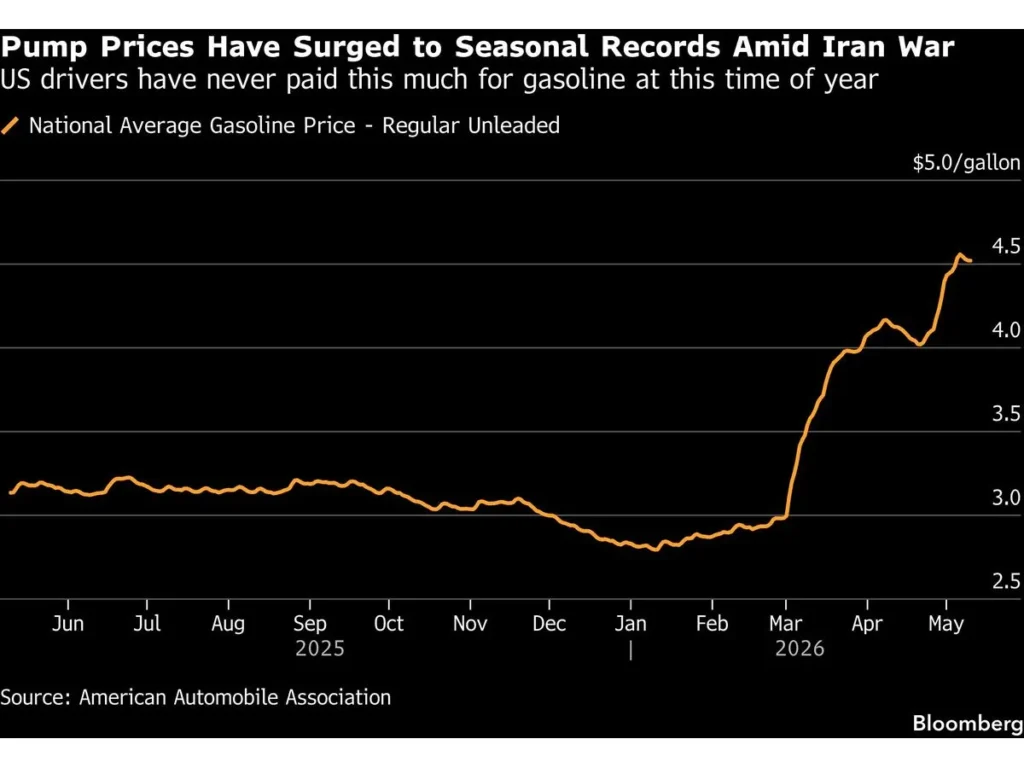
Andrew Lautz, director of tax policy at the Bipartisan Policy Center, questioned how much relief American families would actually get. Filling a sedan at average U.S. prices costs US$18 to US$25 more now than it did before Trump launched the war, he said, while the gas tax holiday would save about US$2 per fill-up.
Trump on Monday acknowledged the savings to consumers would be a fraction of the runup in prices related to the conflict. “It’s a small percentage but it’s still money,” he said.
Federal road funding runs on a user fee model, with the idea being that motorists would pay for the costs of the roads they use. The gas tax functions as a proxy for road usage, financing the U.S. Highway Trust Fund, which in turn pays for the construction and repair of interstate highways, roads and bridges.
It’s not a perfect system — the tax itself hasn’t been increased since the 1990s, and drivers of fuel-efficient cars like electric vehicles are essentially exempt from the levy. So now about 80 per cent of the Highway Trust Fund’s money comes from the gas tax and a 24.4 cents-per-gallon levy on diesel, according to the Tax Policy Center, and Congress adds to the fund every few years with other revenue, adding to the deficit.
“When you combine the multi-billion dollar costs of a gas tax holiday with the impacts on federal finances and perhaps less-than-meaningful relief at the pump, we think policymakers would be right to be skeptical of this idea,” Lautz said in an interview.
With assistance from Caitlin Reilly, Ari Natter and Steven T. Dennis
Share This:
More News Articles