Friday, 27 June 2025
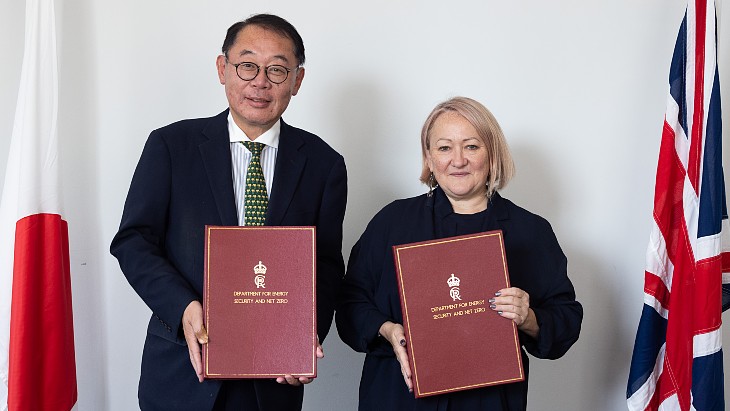
The memorandum of cooperation was signed by UK Climate Minister Kerry McCarthy and Japan’s Education, Culture, Sport, Science and Technology Minister Hiroshi Masuko and aims to “further collaboration in key fusion areas including research and development, regulation and skills and workforce”.
McCarthy, said: “The UK is optimally positioned for global fusion investment. Global partnerships such as this one will advance technological developments and help unlock limitless clean fusion power, bringing a fusion energy future closer to a reality.”
Separately there has been a memorandum of understanding signed between the UK’s Fusion Cluster and the Japan Fusion Energy Council “to foster industrial collaboration, knowledge exchange, and workforce development”, and Kyoto Fusioneering has relocated its UK headquarters to UK Atomic Energy Authority’s Culham Campus near Oxford.
The collaboration between the Fusion Cluster and the Japan Fusion Energy Council will see them working together to “promote mutual understanding and strategic collaboration in fusion energy development; facilitate cooperation between Japanese and UK industries; and contribute to the development of a global-scale fusion energy ecosystem”.
Meanwhile Tokamak Energy, which is based close to Culham, has announced that it has agreed with Japan’s Furukawa Electric Group to establish a joint operational base in Japan for manufacturing high temperature superconducting magnet (HTS) technology. This is the method being used to create the strong magnetic fields needed to confine and control hydrogen fuel, which becomes a plasma several times hotter than the Sun, inside a tokamak.
The two companies say they will also explore uses of the technology in a range of other industries, including in medicine and for propulsion under water and in space.
Warrick Matthews, Tokamak Energy CEO, said: “Our magnet technology is an essential part of turning the promise of limitless clean fusion energy into commercial reality. This new venture with Furukawa Electric Group will ramp up our manufacturing capabilities and open a new era of superconducting performance in a range of sectors, from powering data centres to revolutionising electric zero emission motors.”
Hideya Moridaira, President, Furukawa Electric Group, said: “We are truly honoured to take this important step forward with Tokamak Energy, deepening our collaboration and initiating efforts toward manufacturing HTS magnet technology for fusion energy in Japan … by combining our HTS technology with Tokamak Energy’s innovative fusion technology, we are confident we can contribute meaningfully to the next generation of energy solutions.”
Background
Fusion research aims to copy the process which powers the sun – when light atomic nuclei fuse together to form heavier ones, a large amount of energy is released. To do this, fuel is heated to extreme temperatures, at least 10 times hotter than the centre of the sun, forming a plasma in which fusion reactions take place. A commercial power station will use the energy produced by fusion reactions to generate electricity. The fundamental challenge, being addressed in a variety of ways, is to achieve a rate of heat emitted by a fusion plasma that exceeds the rate of energy injected into the plasma.
The promise is that fusion energy will have few carbon emissions and it has abundant and widespread fuel resources.