A paper mill in Wales, UK, operated by the German-based WEPA Group has been fitted with a carbon capture system, which will capture point source biogenic carbon dioxide (CO2) emissions before being converted into biochar at a nearby facility.
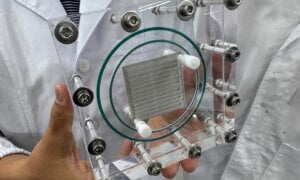
The six month pilot project will use technology supplied by carbon removal specialist Nellie Technologies (Nellie), which has been adapted for use in an industrial setting to capture CO2 emissions directly from site processes.
Once locked into biochar, the CO2 will be fed into the local agricultural supply chain where it could be used as a soil additive and biofertiliser.
While not stated, the system appears to operate as a post-combustion capture unit. This would be retrofitted to the plant – which produces toilet paper and kitchen towels – and capture CO2 from flue gas.
“We’ve already demonstrated the system in operation, and this project builds on that by integrating it directly within an industrial process,” said Stephen Milburn, CEO of Nellie.
UK paper mills reduced fossil CO2 emissions by over 70% between 1990 and 2019, from 6.6 million to 1.8 million tonnes. The sector now accounts for about 6% of UK industrial energy consumption.

The WEPA UK paper mill in Bridgend, South Wales, produces almost two million toilet rolls every day ©WEPA
According to the Confederation of Paper Industries, sector emissions have dropped not only through efficiency but also due to a reduction in the total number of operational mills.
Similar projects are also underway. In 2023, a consortium of partners including Unilever launched a £5.4m ($7.3m) project called Flue2Chem.
Led by CPI, the project has successfully produced chemicals using captured flue gas CO2, including methanol, polymer intermediates, and surfactant precursors.
A by carbon removal project developer CO280 aims to create the world’s largest network of carbon removal projects by capturing biogenic CO2 from pulp and paper mills.
Last year, the company completed a pilot project to validate the performance of liquid amine technology that captures biogenic CO2 from a pulp mill in the US.
In the same year, investment bank JPMorgan Chase signed a CO2 removal off-take deal with CO280 for 450,000 tonnes of CO2.