A series of fires at schools and a hospital has renewed attention on rooftop PV safety in the UK. The incidents do not undermine the case for solar, but they show why safety must extend beyond initial product compliance to system design, installation, maintenance and fire-spread control.
Recent fires at schools and a hospital have moved rooftop PV safety into a wider public conversation. They do not undermine the case for solar, but they show why safety must extend beyond initial product compliance to installation, maintenance and fire-spread control.
On 24 June 2026, a fire broke out at Sidegate Primary School in Ipswich. Early discussions between Suffolk County Council and the fire service indicated a possible link to rooftop panels installed in 2012. The incident followed two other fires at Suffolk primary schools within the previous 12 months. As a precaution, the council ordered solar systems at around 80 schools—mostly installed between 2011 and 2016—to be isolated while investigations continued. It stressed that the three incidents may have had different causes.
On 8 July, fire destroyed the Springwood mental health unit at Malton Hospital in North Yorkshire. All 15 patients were evacuated safely and no injuries were reported. Rooftop solar panels were identified in initial reporting as the likely cause, although a full investigation remained pending.
The incidents sit within a broader trend. QBE recorded 171 UK fires involving solar panels in 2024, 59.8% more than in 2022, while installations grew by 29.6%. This still represented only around 10 incidents per 100,000 installations. PV fires remain uncommon, but on schools, hospitals and industrial buildings, even a rare event can threaten safety, operations and high-value assets.
A ‘solar-panel fire’ does not necessarily begin in the module. A rooftop system also includes DC connectors and cabling, junction boxes, isolators, inverters, mounting structures and the roof itself. Safety depends on how these elements are specified, installed and maintained together.
UK evidence points to a combination of ageing equipment, installation quality, electrical faults and insufficient maintenance. Research cited by the Royal Institution of Chartered Surveyors found that, among 58 investigated PV-related fires, 36% were attributed to poor installation, 12% to faulty products and 5% to system-design errors; 47% remained unexplained. Loose or corroded connectors, damaged insulation and moisture ingress can lead to DC arcing and intense heat, while shading, contamination or cell damage can create hot spots.
Prevent ignition: Use compatible, certified components; control connection quality; protect DC cabling; and document torque, insulation and commissioning checks.
Control abnormal heat: Limit hot-spot formation, provide appropriate ventilation and prevent debris accumulation around modules and inverters.
Limit fire spread: Consider module materials, glass construction, mounting geometry, roof composition and the cavity beneath the array as one fire-safety system.
Protect the full lifecycle: Plan risk-based inspections, thermal checks, cleaning, post-storm reviews, accessible isolation and clear maintenance responsibilities.
Recent UK government experiments illustrate why this combined approach matters. Plastic-backed Class C modules showed significant vertical flame spread, while fire spread on glass-backed Class A modules was much less significant and did not extend beyond the first panel. The tests also showed that roof materials, mounting rails and the cavity beneath panels can alter fire behaviour. Module classification is therefore important, but it must be considered alongside the complete roof assembly.
“PV-related fires are low-frequency but high-consequence events. Safety remains fundamental to long-term power generation and project returns.”
— Charles Jiang, VP of LONGi Group
Against this background, independent fire-performance certification is becoming an important benchmark for rooftop PV.
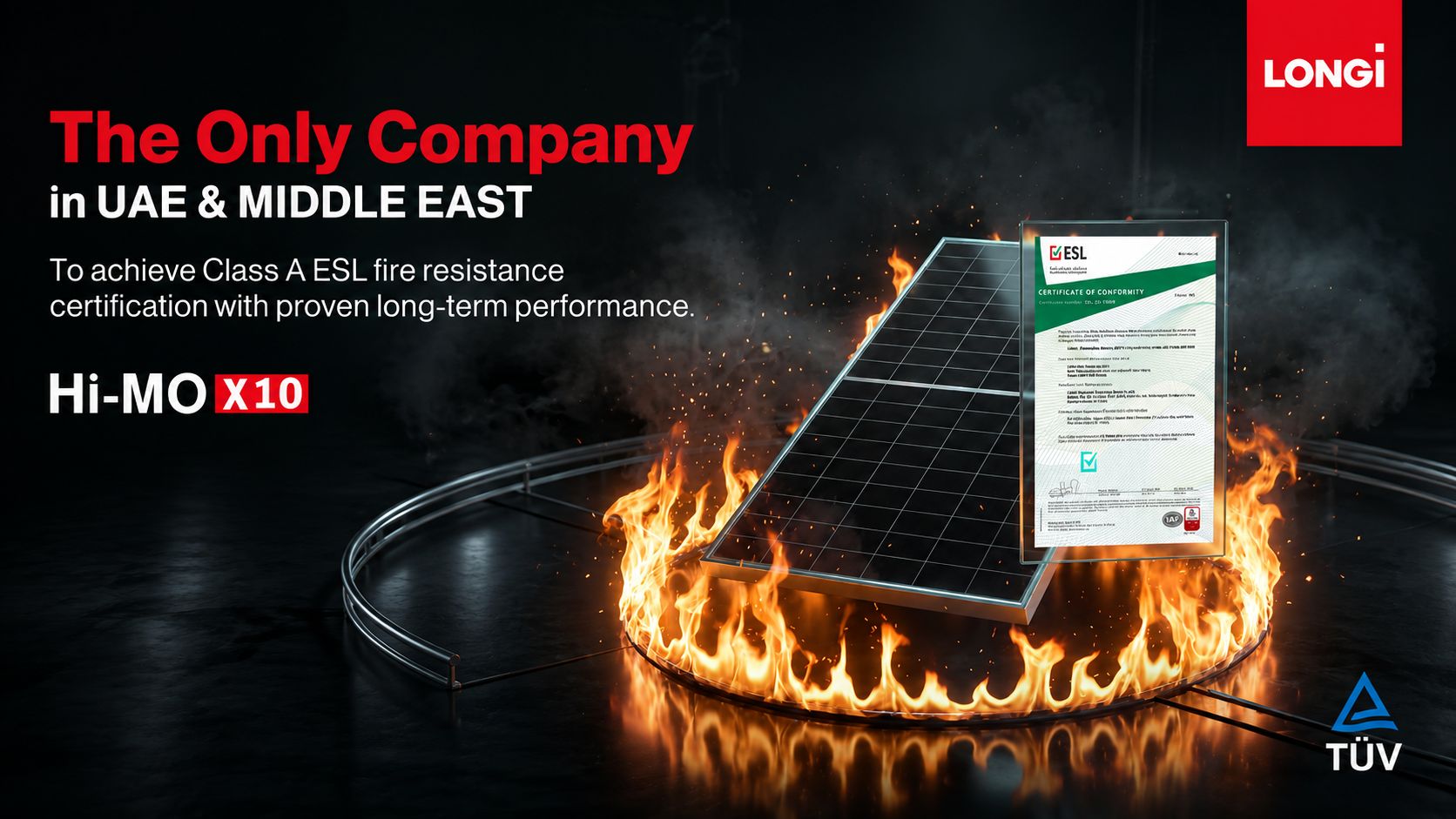
The LONGi Hi-MO X10 Fire-Resistant Module has obtained Class A fire classification from TÜV Rheinland at the full-module, mass-production level. It has also received TÜV Rheinland’s Fire Protection AAA certification for shading resistance and has been verified against IEC 61215 and IEC 61730 requirements.
Class A is the highest classification within the applicable module fire-test framework. It evaluates resistance to external fire exposure and flame spread under defined conditions. It is not a guarantee that a PV system can never ignite, and it does not replace professional installation or maintenance. Its value is independent evidence that a module offers stronger fire resistance than lower classifications.
The full-module, mass-production scope is equally important. It connects certified performance with the quality controls applied to products manufactured for the market, giving developers, EPCs, insurers and building owners greater confidence that fire resistance is a repeatable product-quality requirement rather than an optional feature.
This benchmark is particularly relevant for commercial rooftops and high-occupancy buildings. In the Middle East, LONGi’s relevant high-efficiency modules have also undergone Class A evaluation through the Emirates Safety Laboratory alongside TÜV certification. Exact certificates, module models and mounting configurations should always be matched to project requirements.
Subscribe to get the latest posts sent to your email.