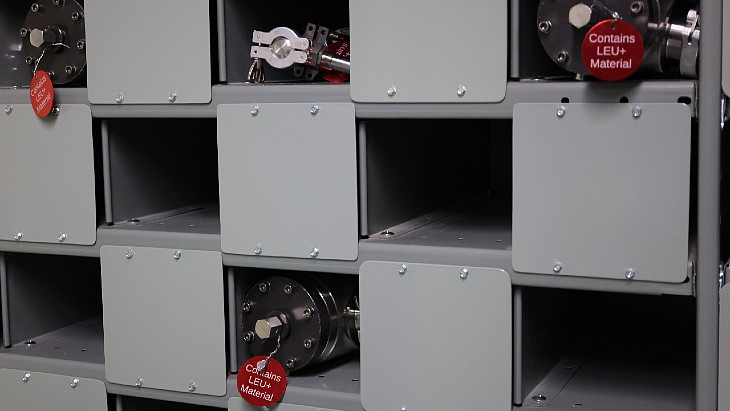
It completed the initial production run of the low-enriched uranium plus (LEU+) on 11 December. LEU+ is uranium enriched to between 5% and 10% U-235.
The company was given US Nuclear Regulatory Commission authorisation to enrich uranium up to 10% U-235 in September. Urenco USA aims to produce commercial quantities for customers from “mid-2026”.
John Kirkpatrick, managing director of Urenco USA, said: “In 2025, we have delivered on our plans to launch a new advanced fuels capability and to install new production capacity, demonstrating Urenco USA’s commitment to supporting the future needs of our customers and the US nuclear industry as the country increasingly relies on nuclear energy.
“Our employees’ efforts this year will ensure that the United States continues to have a reliable domestic supplier of enriched uranium for our current reactor fleet and for the advanced reactors preparing for deployment in the coming years.”
The nuclear fuel cycle
Unenriched, or natural, uranium contains about 0.7% of the fissile uranium-235 (U-235) isotope. (“Fissile” means it’s capable of undergoing the fission process by which energy is produced in a nuclear reactor). The rest is the non-fissile uranium-238 isotope. Most nuclear reactors need fuel containing between 3.5% and 5% U-235. This is also known as low-enriched uranium, or LEU. Advanced reactor designs that are now being developed – and many small modular reactors – will require higher enrichments still. This material, containing between 5% and 10% U-235 – is known as LEU+, with that from 10% to 20% U-235 known as high-assay low-enriched uranium, or HALEU.
Enrichment increases the concentration of the fissile isotope by passing the gaseous UF6 (uranium hexafluoride) through gas centrifuges, in which a fast-spinning rotor inside a vacuum casing makes use of the very slight difference in mass between the fissile and non-fissile isotopes to separate them. As the rotor spins, the concentration of molecules containing heavier, non-fissile, isotopes near the outer wall of the cylinder increases, with a corresponding increase in the concentration of molecules containing the lighter U-235 isotope towards the centre.
Enriched uranium is then reconverted from the fluoride to the oxide – a powder – for fabrication into nuclear fuel assemblies.
Urenco USA’s new capacity
In another “December milestone”, the company announced that this year’s third new cascade of centrifuges began production of LEU on 16 December.
The new centrifuge cascades are part of a programme to install 700,000 separative work units (SWU) of capacity by 2027 at Urenco USA’s New Mexico uranium enrichment plant.
Urenco USA says it “is the only company to have licensed, built, operated, and expanded a commercial uranium enrichment plant in the United States” and says the new capacity is required to meet the growing demand in the country and end reliance on Russian imports.