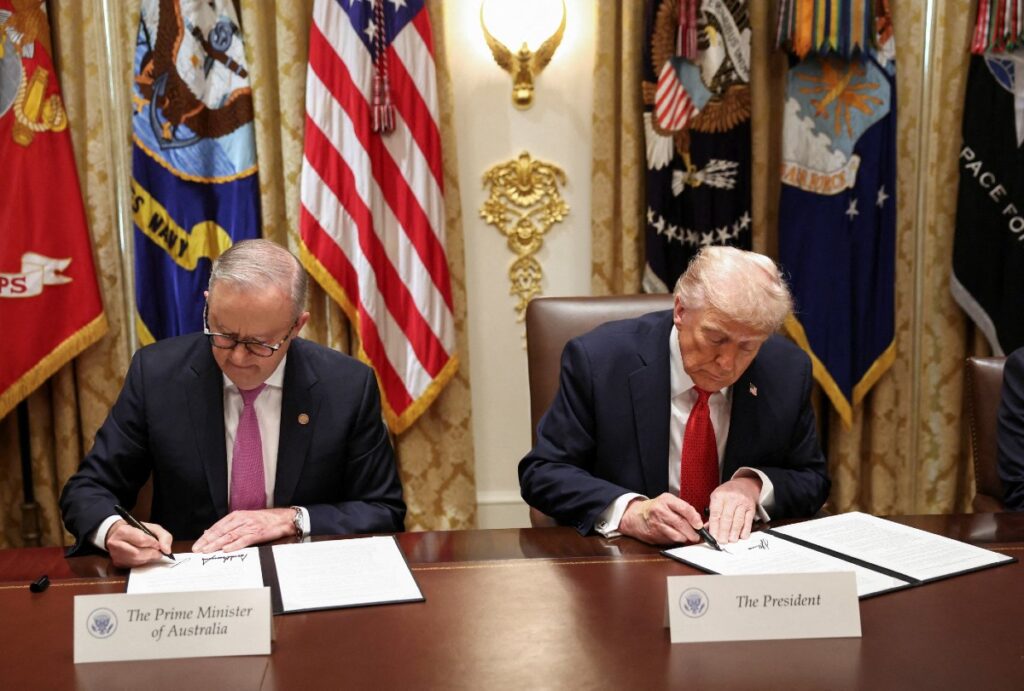
MELBOURNE, Oct 21 (Reuters Breakingviews) – China’s President Xi Jinping won’t exactly be quaking in his boots after reading the terms of a critical minerals pact by his U.S. and Australian counterparts on Monday. Donald Trump and Anthony Albanese between them pledged roughly $4 billion of their taxpayers’ money to bulk up mining and processing of rare earths and other ores that are often small but essential elements for making renewables, semiconductors and high-end weapons. That won’t remove the lock China has on the sector any time soon. And there are a number of hurdles to jump. But it’s worth doing.
Australia is an obvious place to give it a go. The country is home to the world’s fourth-largest reserves of rare earths, per the U.S. Geological Survey, and has plenty of other critical minerals like lithium, magnesium and antimony. It boasts a big mining industry and a government that’s keen to see the sector expand from mostly extraction into value-added upstream services like refining and processing. And as a large end-customer and traditionally strong ally for Australia, the U.S. is a sensible partner with which to share the financial burden.
Get the Latest US Focused Energy News Delivered to You! It’s FREE:
So Washington and Canberra are each willing to invest $1 billion in various projects. In addition, the U.S. Export-Import Bank is issuing letters of interest worth $2.2 billion to seven mining companies Down Under. But it’s not going to suddenly result in a flood of new ore, despite Trump’s assertion on Monday that in a year’s time “we’ll have so much critical mineral and rare earths that you won’t know what to do with them”.
The Australian government’s first two equity investments, for example, are for existing projects already in early stages of development: $200 million is going to support Alcoa’s plan for a gallium refinery that could account for 10% of the world’s supply; Arafura Rare Earths, whose largest shareholder is the country’s richest person, Gina Rinehart, is getting $100 million – on top of more than $500 million in government loans and grants it received last year. Neither will be up and running for a couple of years at least.
The other projects still barely on the drawing board will take much longer. Securing environmental approvals will be a hurdle; those rules are currently under review in Australia. Plus there’s a relative dearth of talent given most of the post-extraction experts for critical minerals are Chinese. What’s more, government support is no guarantee of a business being able to start up its diggers and factories. Even if it is successful, future administrations might not be willing to subsidise production at the price floors the current political leaders have committed to set.
Monday’s pact, though, sends a strong signal that rich countries are up for the challenge. That ought, at least, to get some competitive juices flowing.
Share This:
More News Articles