In a departmental statement, following Rubio’s trips to the two countries, it was announced that the recently-signed US-Slovakia intergovernmental agreement will begin with US funding for the Front-End Engineering and Design (FEED) study for a “new Westinghouse large reactor build”.
It said: “The FEED work will be carried out under the Department of State’s Foundational Infrastructure for Responsible Use of Small Modular Reactor Technology Program, which helps countries build safe, secure, responsible nuclear energy programmes.”
The US Department of Energy said last month that the project to build a new “state-owned American 1,200 MWe nuclear unit” at the Bohunice Nuclear Power Plant in the Slovak Republic would “create thousands of American jobs across engineering, advanced manufacturing, construction, nuclear fuel services, and project management, while reinforcing US supply chains and expanding access to global markets for American-made nuclear technology”.
The Slovakian government has said its aim is to put the proposed new unit into operation in 2040 or 2041.
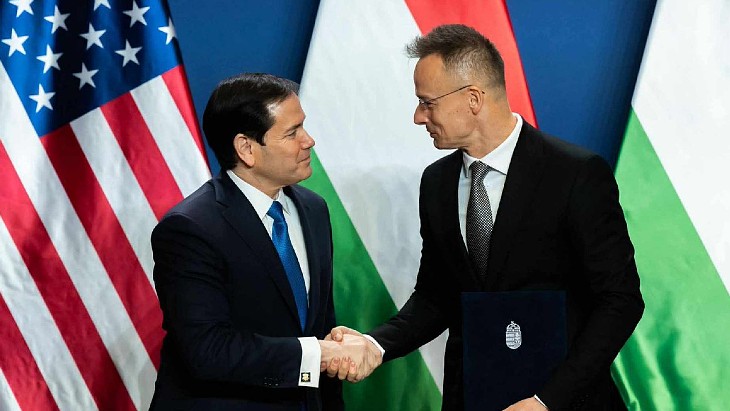
In a separate part of his European trip, to Budapest, Rubio signed the US-Hungary Civil Nuclear Intergovernmental Agreement which the department said “underscores US commitment to making Hungary a hub for regional small modular reactor (SMR) development, and encouraged Hungary to select US SMR technology, and reaffirmed that US firm Holtec International is ready to help Hungary handle spent nuclear fuel storage – a dry cask storage system that boasts maximum security, safety, and flexibility – subject to parliamentary action”.
Like Slovakia, Hungary has existing nuclear capacity. The Paks plant, 100 kilometres south of Budapest, currently comprises four Russian-supplied VVER-440 pressurised water reactors, which started up between 1982 and 1987.
It is also in the process of adding new capacity with the Paks II project – an inter-governmental agreement was signed in early 2014 for Russian enterprises and their international subcontractors to supply two VVER-1200 reactors at Paks as well as a Russian state loan of up to EUR10.0 billion (USD10.5 billion) to finance 80% of the project. First concrete on the first new unit was poured earlier this month.
Hungary is also looking at the deployment of SMRs. Hungarian nuclear energy development firm Hunatom signed a letter of intent in August with Poland’s Synthos Green Energy to establish a pre-framework for joint activities relating to project development for up to 10 GE Vernova Hitachi BWRX-300 small modular reactors.
And the US State Department said, after talks between the two countries’ leaders in November, that “Hungary signalled it intends to support construction of up to 10 SMRs with a potential value of up to USD20 billion”. In December Holtec International announced a memorandum of understanding with Hungary’s energy giant MVM to explore the deployment of Holtec’s SMR-300 small modular reactor technology.
Following this week’s visit, Hungary’s Foreign Affairs and Trade Minister Péter Szijjártó said they had “now entered into an alliance with the Americans in the field of nuclear energy”, with the official government website reporting that he noted that “new and previously unknown technologies are being developed in the United States, and the agreement will allow Hungary to benefit from these advancements as quickly as possible”.