Thursday, 12 June 2025
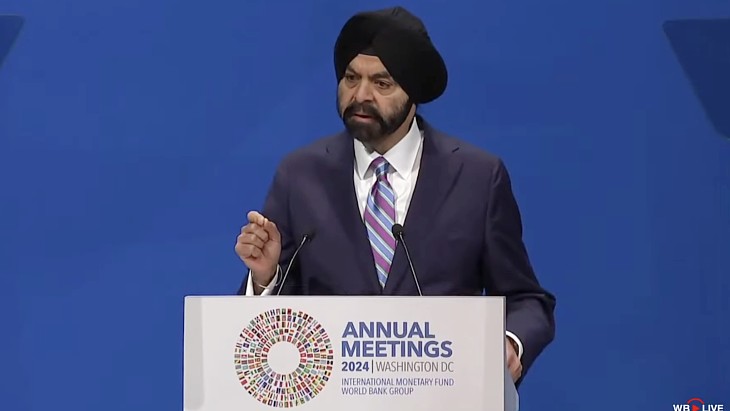
The change was made at the World Bank’s board meeting on Tuesday and confirmed in an email sent to the organisation’s staff by World Bank President Ajay Banga, which has been seen by World Nuclear News.
In it he set out the rationale for change, saying that “electricity is a fundamental human right and the foundation of development. Jobs require electricity – as do health systems, education, clean water, public safety, and so much more. And demand will only grow as populations expand, economies industrialise, and digitalisation accelerates”.
The goal is to give countries the flexibility to choose how to deliver the reliable energy needed to meet their development goals, especially with electricity demand in developing countries expected to more than double by 2035, which the World Bank thinks will require “investment in generation, grids, and storage to rise from USD280 billion today to roughly USD630 billion”.
Banga says in the email that “what’s new is that, for the first time in decades, the World Bank Group will begin to reenter the nuclear energy space”. Working in partnership with the International Atomic Energy Agency (IAEA) and other partners “we will support efforts to extend the life of existing reactors in countries that already have them, and help support grid upgrades and related infrastructure. We will also work to accelerate the potential of Small Modular Reactors – so they can become a viable option for more countries over time”.
Countries would be in the driving seat to select the means that best fits their context and resources – “some may choose to invest in solar, wind, geothermal, or hydro where those make the most sense. In a number of others, the best path forward may include natural gas – or, over time, nuclear”.
He said that there was not yet agreement on the World Bank board about engaging with upstream gas and “we’ll organise deep dives where we need a better understanding of evolving technologies like nuclear, carbon capture, and ocean energy”.
Banga said that the constructive discussions meant “we’ve made real progress toward a clear path forward on delivering electricity as a driver of development”.
The World Bank’s decision was welcomed by Sama Bilbao y León, Director General of World Nuclear Association, who said: “This is a momentous shift for international energy policy, that comes after years of engagement with World Bank on the sustainability of nuclear energy. Access to finance is critical for extending the benefits of clean and reliable nuclear energy to all. World Nuclear Association is ready for further collaboration with World Bank and other multilateral development banks to support them in capacity building for decision making on nuclear financing.”
Background
The World Bank Group, whose largest shareholder is the USA at 17%, is a multilateral lending organisation whose mission “is to end extreme poverty and boost shared prosperity on a livable planet. This is threatened by multiple, intertwined crises. Time is of the essence”. In 2024 the World Bank Group says it facilitated USD117.5 billion “in loans, grants, equity investments and guarantees to partner countries and private businesses”.
Although some multinational development banks have provided lending for decommissioning or upgrades to existing nuclear plants, they do not contribute to the financing of new-build projects – the World Bank’s only loan for new nuclear capacity was for Italy’s first nuclear power plant.
The pledge to aim for a tripling of nuclear energy capacity, originally unveiled at COP28 and backed by more than 30 countries, included inviting “shareholders of the World Bank, international financial institutions, and regional development banks to encourage the inclusion of nuclear energy in their organisations’ energy lending policies as needed, and to actively support nuclear power when they have such a mandate, and encourage regional bodies that have the mandate to do so to consider providing financial support to nuclear energy”.
At the moment there are about 440 nuclear power reactors operating in 31 countries with at least 70 power reactors under construction. The IAEA says there are about 30 countries considering, or embarking on, nuclear power, with about two-thirds of them in the developing world and financing remains a major hurdle for many.