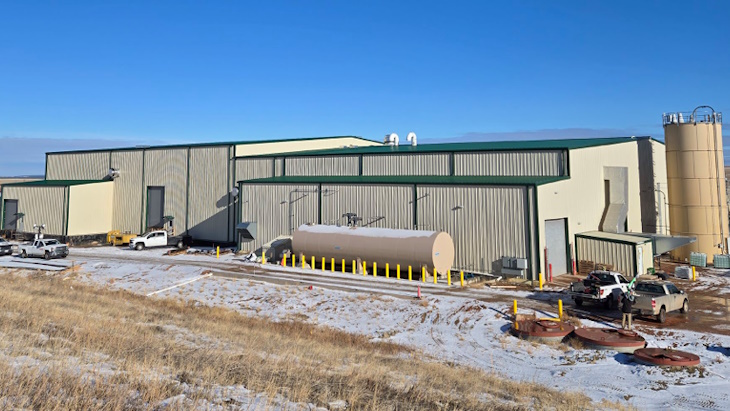
Production ramp-up at the project, which returned to operation as a low-pH in-situ recovery (ISR) operation in 2024 after a five-year hiatus, has progressed more slowly than originally anticipated, Peninsula said, “and, as a result, the Company’s previously announced CY2026 (calendar year) production guidance of 400,000 to 500,000 pounds of U3O8 will not be achieved and is therefore withdrawn”.
ISR – also known as solution mining, or in situ leach (ISL) – involves recovering minerals from a suitable orebody by dissolving them and pumping the pregnant solution to the surface where the minerals can be recovered. The choice of leaching solution – acidic or alkaline – depends on the geology of the ore: an acidic (low-pH) solution gives higher uranium recovery with lower operating costs than an alkaline leach, but cannot be used if significant quantities of acid-consuming minerals such as gypsum and limestone are present in the host aquifers.
Until operations were suspended in 2019, Lance – like other ISR operations in the USA – had used the high-pH method, but this was delivering lower than expected recoveries of uranium. Following studies and field trials, the company decided in 2022 that it would return to operations using a low-pH recovery process.
As Lance is the first commercial-scale application of low-pH ISR uranium recovery in the USA, there has been “minimal domestic operating experience, established workforce capability or industry knowledge on which to draw”, the company said. Although “meaningful operational progress has been achieved”, the company said it “continues to encounter a number of operational challenges, including resolution of gas generation within sections of the wellfield taking longer than expected, resulting in lower-than expected solution flow rates, and the ongoing optimisation of wellfield chemistry”.
Peninsula Energy Managing Director and CEO George Bauk said the company is “naturally disappointed” by the slower-than-exepected ramp-up and the decision to withdraw its production guidance, but added that the year has delivered valuable operating experience and important insights as Lance transitions into a large-scale low-pH ISR operation. “While the transition has presented a steeper operational learning curve than we originally anticipated, the challenges we have encountered relate primarily to the wellfield hydraulics, solution flow and chemistry optimisation – not the quality of the uranium resource or the effectiveness of the low-pH recovery process itself,” he said. “The encouraging aspect is that the underlying fundamentals continue to validate our long-term strategy.”
Wellfield and uranium capture operations at the project resumed in December 2024, with the first dried yellowcake from the expanded Lance Central Processing Plant produced the following September.