

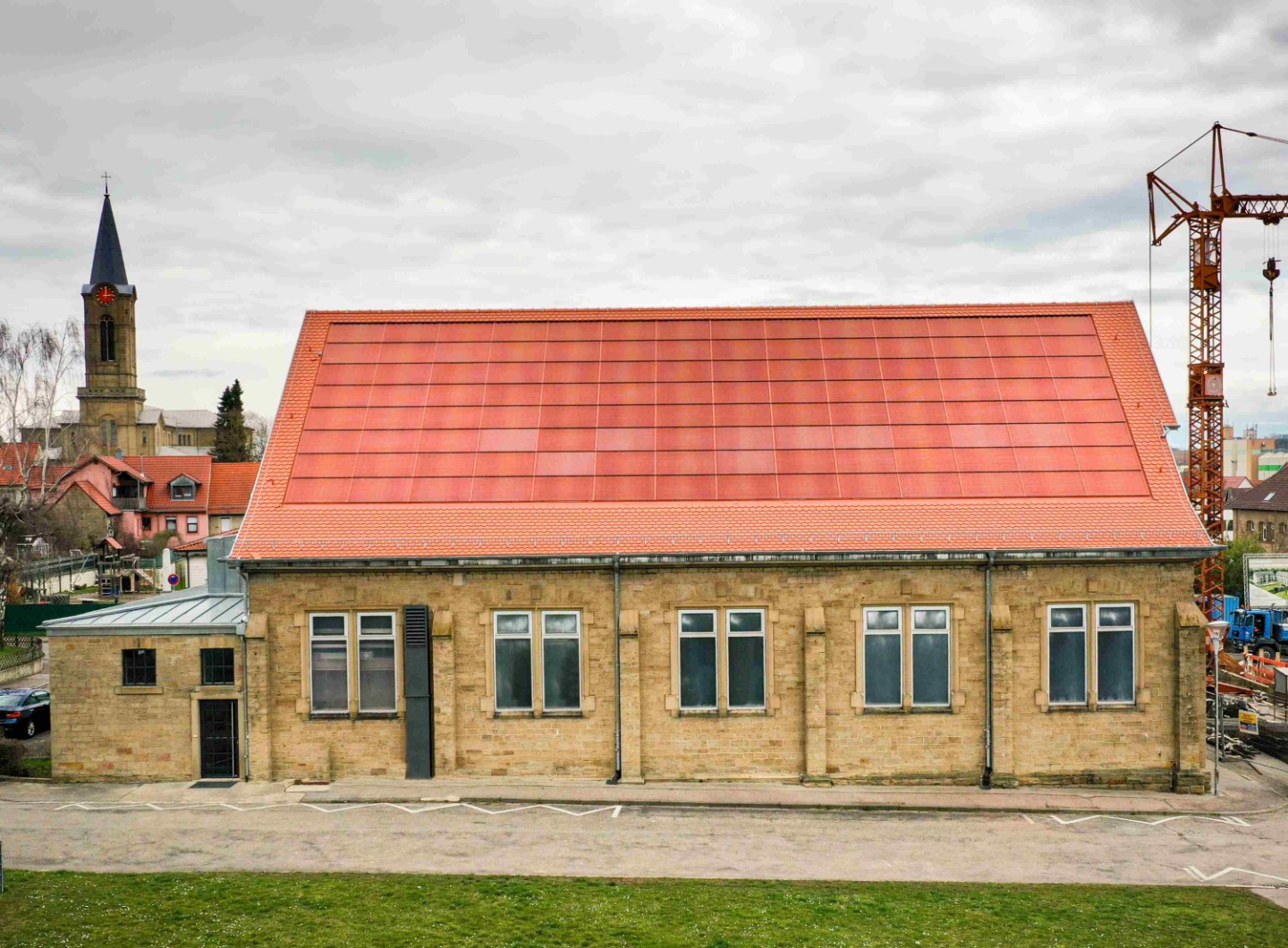
Historic building in Eppingen with a red roof-integrated PV system. It has been shown that a homogeneous PV integration increases their acceptance.
A joint study conducted by the Institute of Psychology at the University of Freiburg and the Fraunhofer Institute for Solar Energy Systems ISE has revealed that social acceptance of building-integrated photovoltaics (BIPV) in urban areas is overwhelmingly positive. The study highlights a stronger preference for integrating solar technology into modern buildings compared to historic structures. However, this gap narrows significantly when the photovoltaic (PV) modules are designed to blend seamlessly with building facades or roofs.
Key findings from the study, carried out as part of the livMatS Cluster of Excellence at the University of Freiburg, indicate that visually harmonious PV modules—particularly those using innovative MorphoColor® technology—boost public acceptance across all building types. This approach is especially effective for historic buildings, where inconspicuous designs eliminate aesthetic concerns.
Lead researcher Angela Zhou, a master’s student at the University of Freiburg, noted, “Social acceptance of PV systems is heavily influenced by the type of building and its visual integration. These factors are far more impactful than personal variables like political views or environmental beliefs.”
Co-author Andreas Wessels, a PhD student at Fraunhofer ISE, emphasized the practical implications: “The findings confirm that aesthetic integration, such as using colored modules, is critical to increasing acceptance, particularly for older, historic structures.”
The study utilized two methods: an online photo-based survey and an in-person evaluation of colored PV modules. Results demonstrated that homogeneous PV integration—such as matching the module’s color to the building’s design—significantly enhances acceptance.
The researchers conclude that for existing structures, aesthetic considerations are paramount, with a preference for PV modules that blend rather than stand out as architectural features. While the study focused on existing buildings, the conclusions may not apply to new construction, which often provides more design flexibility.
Currently, approximately 75% of installed PV systems are on buildings, a sector with vast growth potential. To meet Germany’s energy transition goals, an estimated 400 gigawatts-peak (GWp) of installed PV power will be required by 2045. With a technical potential of around 1,000 GWp, building-integrated photovoltaics are poised to play a crucial role in decarbonizing the built environment while conserving valuable land resources.









)
