By , , and
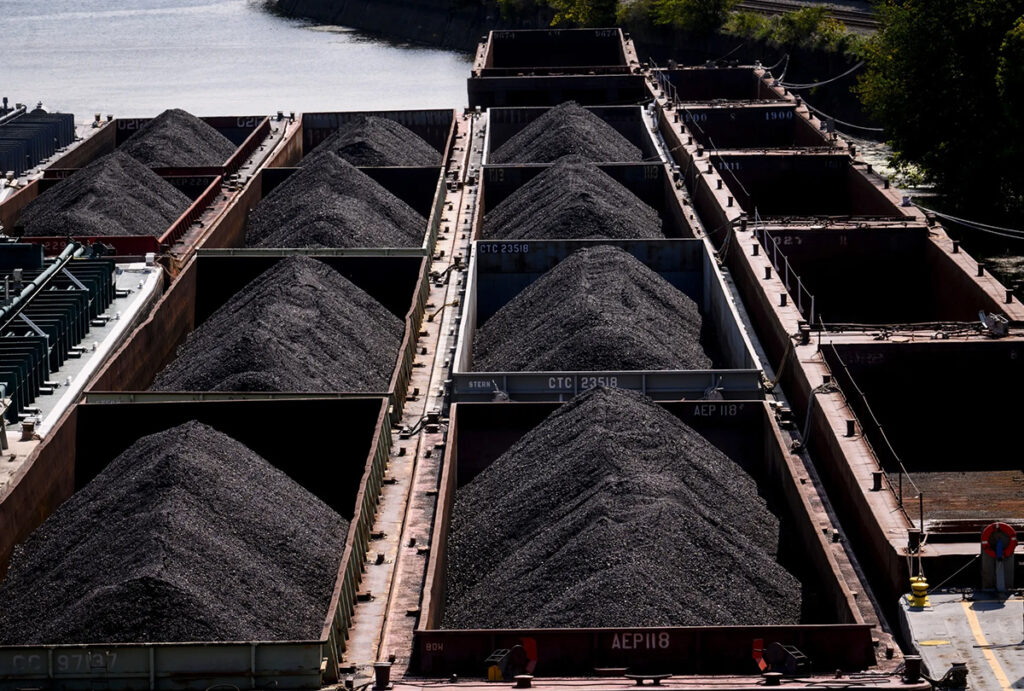
Coal on barges in Pittsburgh. Photographer: Justin Merriman/Bloomberg
Get the Latest US Focused Energy News Delivered to You! It’s FREE:
The world’s largest asset managers urged a federal judge in Texas to dismiss a lawsuit brought by Republican state attorneys general claiming they colluded to reduce coal output, in a case that threatens how US firms oversee trillions of dollars.
Lawyers for BlackRock Inc., Vanguard Group Inc. and the asset management arm of State Street Corp. argued at a hearing Monday that the lawsuit lacked sufficient evidence and that the firms did nothing to attempt to influence coal companies.
“The antitrust claims in this case are unprecedented, they’re unsound and they’re unsupported,” said Gregg Costa, a lawyer representing BlackRock. “The claims just don’t add up.”
The lawsuit, led by Texas Attorney General Ken Paxton, alleges the firms coordinated to pressure coal producers to reduce output. The asset managers hold large stakes in coal producers and profited when energy prices soared, according to the suit, which claims the firms used environmental goals as cover.
The case brought by the 13 states “spins a farfetched theory” that would rewrite antitrust law, the firms said in a court filing. Separately, the Investment Company Institute, a trade group for money managers, said the case “could harm millions of American investors, companies and capital markets.”
Brian Barnes, an attorney representing the states, told the judge there was no question that the firms “individually and certainly collectively, have enough of a stake in the publicly traded coal companies in order to influence management decisions.”
‘Jawboning’ Companies
“When management gets a call from one of the largest, if not the largest, shareholder in the company, management listens,” Barnes said. “Jawboning by these defendants as to decisions about market strategy just very clearly have the potential to influence output decisions at the coal companies.”
US District Judge Jeremy Kernodle, appointed by President Donald Trump during his first term, is presiding over the case. At the hearing Monday, Kernodle disclosed that he owns shares in three Vanguard index funds and one BlackRock fund. He said he doesn’t plan to recuse himself from the case.
If the court rules that the companies colluded, it could spur more antitrust litigation and prompt dramatic changes to their businesses. The firms may also have to exit billions of dollars worth of investments in coal companies.
A victory for the companies would remove a major source of legal and political pressure.
The asset managers have spent the past several years defending against allegations that they use their size — about $25 trillion in combined assets and top holdings in almost every company in the S&P 500 — to influence corporate America through environmental, social investing goals and votes at shareholder meetings.
In their complaint, Texas and other Republican-led states accused the companies of colluding to pressure coal producers to reduce production based on ESG strategies. The states point to the investment firms’ participation in carbon-reduction alliances as evidence of a “syndicate.”
The stakes were raised after Trump administration officials at the Justice Department and Federal Trade Commission said last month that the case should move forward. DOJ Lawyer David Lawrence participated in Monday’s arguments and said the asset management firms should not be exempt from antitrust scrutiny.
Republican state politicians have pulled billions of dollars from BlackRock investment funds, while conservative activists have repeatedly criticized the firms for their voting and investment policies. More recently, the firms have retreated from ESG in the US as well as international climate-change organizations like Climate Action 100+ and Net Zero Asset Managers Initiative. This month, Texas removed BlackRock from its blacklist of companies that boycott fossil fuels.
Still, the lawsuit filed in November said that formal withdrawal from Climate 100+ “does not change the reality that defendants’ holdings threaten to substantially reduce competition in violation” of US antitrust law.
The three firms have argued that the suit is an improper use of antitrust laws because they’re passive investors who don’t exercise any control over the coal companies. The government’s claims “defy economic reality,” Costa said Monday.
“No case has ever alleged that institutional investors, by acquiring minority shares in companies across the entire economy, may lessen competition,” the BlackRock lawyer said.
Robert Wick, a lawyer representing Vanguard, said the firm shared its preferences for disclosures related to climate commitments with coal companies, but never applied any pressure to management about what those commitments should be.
“In fact, Vanguard was essentially a rubber stamp for coal company management,” he said.
After a brief recess, Wick returned and said his comment was rhetorical. “I would not want the news media to report that Vanguard was a rubber stamp for coal companies,” he said.
Common Ownership
The case highlights an antitrust theory known as common ownership that percolated for more than a decade but remains untested in court. Institutional shareholders such as the three defendants own large chunks of stock in the biggest players in industries across the economy. And while the firms maintain their holdings are passive, some enforcers, academics and other observers say the investments could be used to facilitate illegal coordination between companies that should be competing.
“Based on what’s public it seems worth investigating,” said Florian Ederer, an economics professor at Boston University’s business school who has studied whether asset managers’ investments across competing companies raise antitrust concerns. “Was there a network of investors that coordinated in any way?”
The three asset managers argued that the lawsuit contains no evidence that they coordinated investment decisions or that the firms told any coal producer to cut output. They also said they weren’t committed to any policies by participating in the climate groups and that coal output rose in the years covered by the lawsuit.
A study released this month by the Committee on Capital Markets Regulation, whose members include executives from BlackRock and Vanguard, said there’s no impact on prices from competing companies with common shareholders. A Bloomberg LP representative is a member of the CCMR.
At this early stage in the case, Texas and the other states don’t need to prove their allegations. They must only convince a judge they are plausible. But if Kernodle signs off on the underlying legal theory, it could open the door to litigation in any industry in which one of the investment firms owns equity stakes in multiple competitors.
A win by the states “would embolden and encourage others to bring similar lawsuits,” Ederer said.
The case is State of Texas et al v. BlackRock Inc. et al, 24-cv-00437, US District Court, Eastern District of Texas (Tyler).
Share This:
More News Articles