By Erik Wasson, Steven T. Dennis and Maeve Sheehey (BGOV)
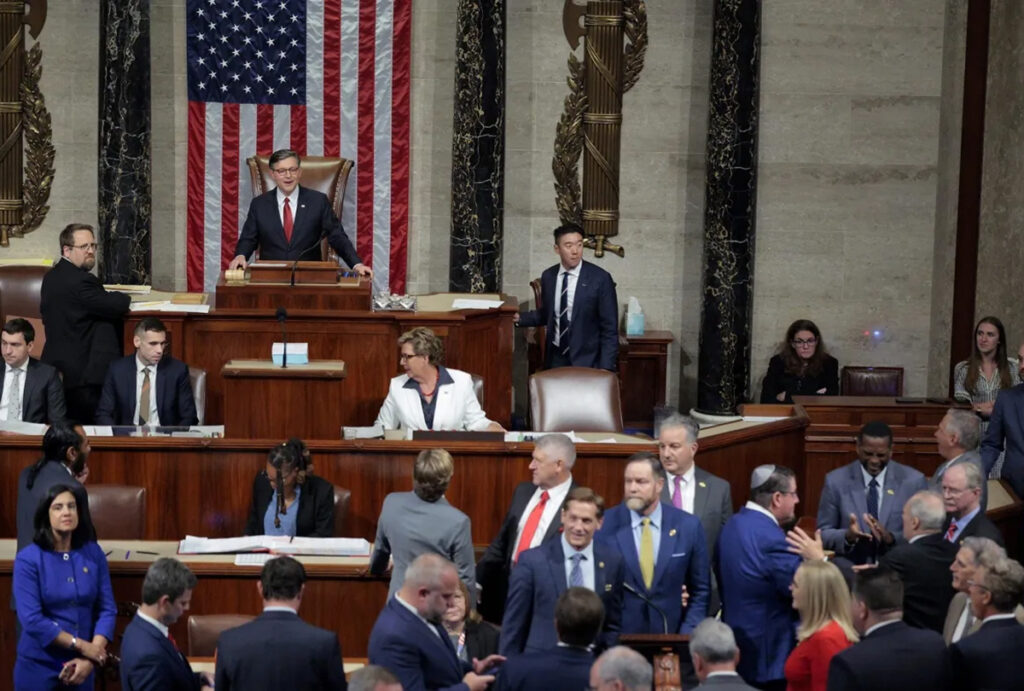
US Speaker of the House Mike Johnson presides over the vote for H.R. 1, the One, Big, Beautiful Bill Act in the House of Representatives at the US Capitol in Washington, DC, on July 3.
Photographer: Chip Somodevilla/Getty Images
Get the Latest US Focused Energy News Delivered to You! It’s FREE:
President Donald Trump secured a sweeping shift in US domestic policy as the House passed a $3.4 trillion fiscal package that cuts taxes, curtails spending on safety-net programs and reversed much of Joe Biden’s efforts to move the country toward a clean-energy economy.
The 218-214 vote in the House Thursday sends the legislation to Trump, in time for a July 4 deadline he set. House leaders had to keep earlier procedural votes open for hours to convince a small band of holdouts to support the legislation.
The president leveraged his sway over the Republican party through threats of primary challenges, White House lobbying sessions and golf-course socializing to overcome resistance from both conservative hardliners concerned about the measure’s debt impact and swing-state GOP moderates worried about the scale of Medicaid cuts.
In the end, only two Republicans, Thomas Massie of Kentucky and Brian Fitzpatrick of Pennsylvania, joined with Democrats to oppose the bill.
Read more:
Earlier in the week, Vice President JD Vance had to break a tie vote to get the massive tax and spending package through the Senate.
Trump’s victory followed an all-night vote wrangling session in the House, beset by numerous delays as the president railed on social media against Republican lawmakers who declined to quickly back the legislation.
House Republican Leader Steve Scalise credited Trump with breaking the logjam, impressing upon holdouts overnight that there would be no further changes to the bill.
“When the president is done negotiating, the game is up — it’s time to vote,” he said.
House Ways and Means Chairman Jason Smith extolled the bill for its populist appeal, calling it legislation for “people who don’t have lobbyists” in Washington.
“It’s about restoring sanity in a town that’s lost it, cutting waste and reining in reckless spending,” Smith said. “It demands that if you’re able to work, you should. It stops asking working families to foot the bill for Washington’s bad decisions.”
Democrats, in contrast, say the bill will strip health care for millions of people who depend on Medicaid to fund tax cuts for the wealthy.
Political Clash
The fierce partisan battle to shape public perceptions of the measure is likely to intensify in the coming months, with Democrats hoping a voter backlash will return them to power in next year’s midterm elections. They portray the president’s signature legislation as a Robin Hood-in-reverse scheme to take safety-net benefits away from the poor to pay for tax cuts skewed toward the rich.
Read more:
“This legislation will end Medicaid as we know it,” House Democratic Leader Hakeem Jeffries said Thursday during a marathon speech right before bill passage. “Rural hospitals will close, nursing homes will close.”
It will “provide tax breaks for the wealthy, well-off, well-connected,” he added, during a speech that ran for more than eight hours and broke a record for the longest House floor address in history.
Trump and his Republican allies are counting on the measure’s $4.5 trillion in tax cuts to bolster economic growth. The legislation delays many of the spending reductions while front-loading levy reductions with populist appeal, including a permanent increase in the child tax credit and temporary four-year tax breaks for the elderly and for tip and overtime pay that Trump promised in his presidential campaign.
Early Reviews
Democrats start with an advantage in polls. A Pew Research survey last month found 49% of Americans opposed the bill, while just 29% supported it. Some 21% weren’t sure.
The nonpartisan Congressional Budget Office projects the legislation will add $3.4 trillion to US deficits over the next decade, adding to investors’ concerns about the US fiscal trajectory. DoubleLine Capital’s Jeffrey Gundlach, one of the most high-profile names in the bond market, warned last month that the federal debt burden has become “untenable” and the US dollar has dropped about 9% in part on those concerns this year against major world currencies.
But a $5 trillion increase in the US debt limit in the package eliminates the risk of a market-rattling payment default the Treasury had forecast could come as soon as mid-August without congressional action.
Read more:
The final legislation is more costly than an earlier version the House passed primarily because Senate Republicans decided to make permanent a series of business tax breaks covering interest expensing, research and development spending and bonus depreciation of certain assets, including machinery and factories. The tax breaks had been temporary in the earlier version.
Medicaid Cuts
The Senate also imposed deeper cuts in Medicaid health insurance for the poor and disabled, reducing spending on the program by nearly $1 trillion over the next decade, according to the CBO. That includes restraints on federal funding matches for state Medicaid programs, new work requirements for able-bodied recipients without children under 14 years old, and new cost-sharing requirements for beneficiaries who received coverage through President Barack Obama’s Affordable Care Act.
The package also cuts spending for federal food stamps and college student loans.
Most clean-energy tax breaks passed under Biden are phased out and a popular $7,500 consumer tax credit for electric vehicles is eliminated for purchases made after Sept. 30.
The core of the bill is an extension of 2017 Trump tax cuts for individuals and pass-through businesses that were set to expire at the end of 2025. It also provides new resources for Trump’s crackdown on illegal immigration and for military spending including the president’s “Golden Dome” missile defense plan.
A group of House Republicans from high-tax states such as New York, New Jersey and California won a temporary increase in the limit on the state and local tax deduction to $40,000. After five years, the cap will snap back to the current $10,000 limit originally imposed under Trump’s 2017 tax law.
— With assistance from Cam Kettles, Jarrell Dillard, Yash Roy, Jamie Tarabay, Alicia Diaz, Ken Tran, Chris Cioffi, Jack Fitzpatrick, and María Paula Mijares Torres
(Updates to add Republican members who opposed the bill.)
Share This:
More News Articles