Chinese solar giant partners with TÜV NORD and CTC to launch a white paper detailing advance in TOPCon technology and commercial performance of its latest Tiger Neo 3.0 modules.
White Paper Launch Highlights TOPCon Progress
JinkoSolar, in collaboration with TÜV NORD Group and China General Certification Center (CGC), has published a white paper detailing the technological evolution and commercial roadmap of its TOPCon-based Tiger Neo 3.0 modules. Released on June 10, the document outlines the structure, efficiency improvements, and system integration strengths of the company’s latest photovoltaic (PV) offerings.
With PERC cells approaching their theoretical efficiency limits, n-type TOPCon has emerged as the preferred next-generation architecture. The paper explains that TOPCon’s “tunnelling oxide + doped polysilicon” configuration significantly reduces recombination losses, leading to higher open-circuit voltage and conversion efficiency, as well as improved temperature coefficients and degradation rates.
Performance Gains and Efficiency Roadmap
JinkoSolar reports that since 2022, its TOPCon mass production cell efficiency has climbed from 25.1% to 26.5%, with 2025 targets of 26.7–27%.
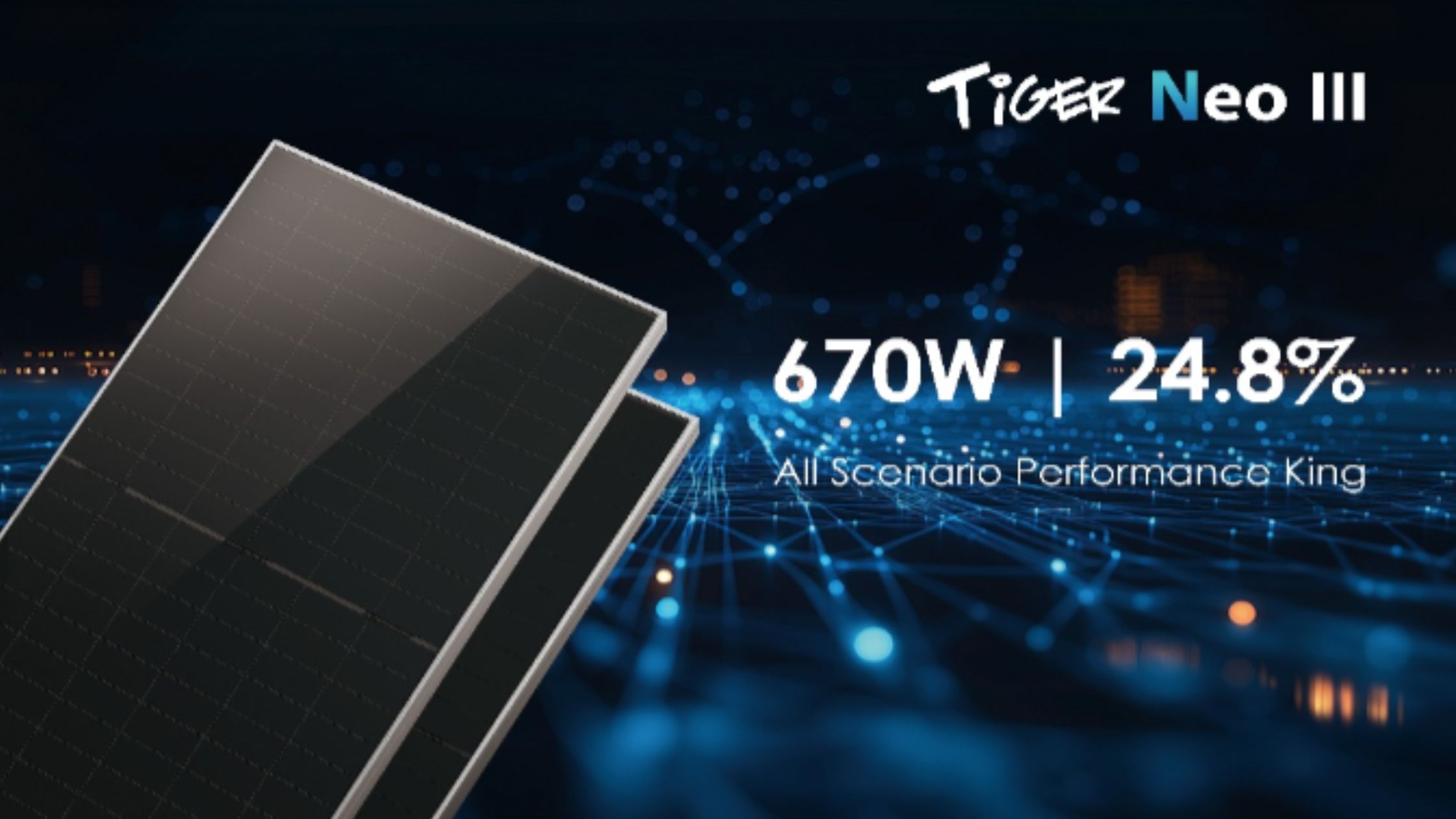
Built on this platform, the Tiger Neo 3.0 module integrates innovations in materials, electrode design and process control, achieving a rated output of 670W—among the highest in its class.
Superior Bifaciality and Field-Tested Advantages
According to the white paper, Tiger Neo 3.0 offers three key advantages:
- High bifacial factor: averaging over 85%, significantly above mainstream BC modules (~70%), making it suitable for high-albedo surfaces such as deserts and rooftops.
- Low degradation: first-year power loss below 1%, outperforming industry norms.
- Improved low-light performance: under IEC 61215-2:2021, modules deliver a 2.26–2.49% gain in morning and evening generation.
Real-world data from Japan, Italy, and China demonstrate the module’s robust performance in hot, humid, and high-irradiance conditions. Notably, in Kagoshima, Japan, TOPCon modules produced 7.1% more power per watt than n-type BC modules, showcasing bifacial efficiency in reflective environments.
Economic Benefits and System Compatibility
Beyond performance, the Tiger Neo 3.0 offers cost advantages. The paper states that Jinko has reduced system-level capital and O&M expenses through material savings and design optimization. In high-temperature Saudi environments, BOS cost per watt fell by RMB 0.048, and LCOE dropped 4.73% for a 100MW plant.
The module is compatible with mainstream inverters and O&M platforms and features anti-dust and sand-resistant frame designs, potentially reducing maintenance costs by 5–10% in MENA regions.
Prospects and Industry Impact
Looking ahead, Jinko plans further enhancements via low-temperature passivation, fine-line electrodes, and advanced doping. When paired with tandem cell architectures, the theoretical efficiency ceiling could exceed 32.5%.
Industry experts note the white paper’s comprehensive data and scenario-based analysis offer valuable insights for technology selection and project investment, reinforcing TOPCon’s position as a leading platform for the next phase of solar industry development.