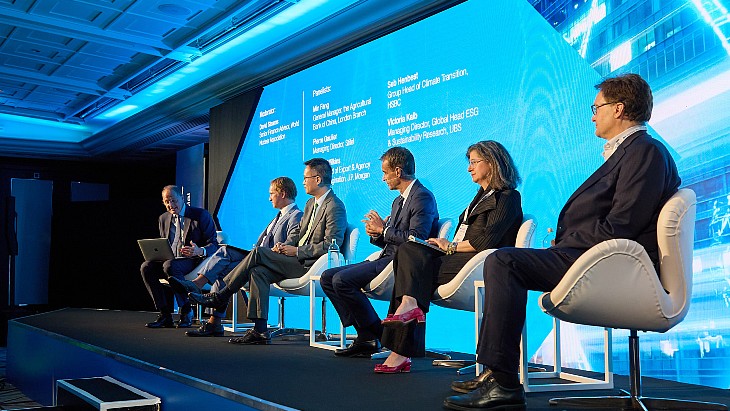
Victoria Kalb, Managing Director, Global Head ESG & Sustainability Research, for UBS, said “the demand from the institutional investors that we speak to on nuclear – it’s difficult to overstate how strong that is. We spend hours and hours and hours speaking to people, listed equity investors, infrastructure funds, looking for a way to be involved”.
She said that “interest level is increasing as we get more and more noise around” the industry on the predicted future electricity demand growth, led by AI in particular, as well as energy security issues.
However, along with other speakers, she said that there was a complex choice to be made to make the investments, with issues cited being the high capital expenditure, the long-term nature of investments, uncertainty over project costs and timelines, and the associated allocation of risks.
Seb Henbest, Group Head of Climate Transition at HSBC, said that investing in nuclear aligned with environmental missions but cautioned against the energy industry and finance industry “talking past each other” and said that large-scale nuclear was essentially like any other large-scale infrastructure project and should not be proposed as if it was a science project – “the industry’s got to present the proposition to commercial financial institutions as something that looks really, really attractive”.
The risks to be managed included whether there was offtake, the technology design risk, the construction risk and the reputational risk – “these are the same with any other project”, he said. But given the long-term nature of returns from investing in new nuclear capacity – compared with renewables – the role of government becomes more important. And he cited HSBC’s role at Sizewell C, where risks on design were reduced by it echoing the Hinkley Point C units on the technology design side, and also the Regulated Asset Base financing model which mitigates the risk of cost overruns.
Mark Muldowney, Managing Director, Energy, Resources and Infrastructure, at BNP Paribas, said they wanted to deploy “very large amounts of our capital to the energy transition, and to us, nuclear is a key part of that”. He said that new GW-scale projects were “so large and so significant, they are inherently political projects” and he said that, with the uncertainty over the cost and time to build new nuclear, “the risks in building new large-scale nuclear are not going to be taken by the private sector”.
He said the risks could also not be taken on by contractors, so the answer would be governments or the electricity consumers in a country, with utilities maybe involved in some places, or some combination of those parties. A key role of government was to take measures to drive down the cost of capital by taking on the “appropriate level of risks”.
Jake Jurewicz, CEO and Co-Founder, Blue Energy, said the demand was now greater than it had been for 70 years and said the issue was to create a new financiable product for new nuclear capacity. He said that looking at the data on cost overruns, it was not from the reactor, but rather from the construction, where a new workforce has to be trained and infrastructure built in new areas. He said the experience of offshore oil and gas and offshore wind showed the benefits of modular construction – mass production at a site and moving it to the project, rather than having to move 10,000 workers from site to site.
In her closing remarks to the day-long summit, which came at the start of World Nuclear Symposium, World Nuclear Association Director General Sama Bilbao y León said that the key messages were that financing needs to be thought about from the start of a project “and not be an afterthought”. She said there needed to be further conversations “about sharing benefits, costs and risks in all these projects”. She said that there was a “massive appetite for nuclear investment” in the banking and finance industry alongside government support, and there was work ahead to develop financing frameworks.
She stressed that opportunities exist throughout the nuclear value chain, and added “there is nothing inherently unique about nuclear projects … so let’s demystify them”, adding that World Nuclear Association was planning to launch a Nuclear Investment Guide which would “take many of the themes we discussed today and boil them together into something that is digestible and actionable to move forward”.