Zizamele Mbambo, Deputy Director General responsible for Nuclear Energy, Department of Mineral Resources and Energy, South Africa, said South Africa’s policy objective was to ensure the country “becomes self-sufficient in all the nuclear value chain”, noting the country’s long nuclear experience and the recent lifetime extension for the Koeberg 1 unit. He said that a decision was expected in November on the life extension of the plant’s second unit.
Outlining the “ambitious programme” he referred to the decision to provide environmental authorisation for a site near Koeberg capable of hosting about 4.6 GW of capacity. He said the country was looking at both conventional and small modular reactors, with a goal of a 10 GW expansion of capacity “over the next 10 to 15 years”. Socio-economic and cost-benefit studies are in progress “to ensure that we could deploy this programme at a pace and scale that our country can afford”.
On the fuel cycle, he said the government had declared uranium as a strategic mineral as part of moves towards the “re-establishment of the full nuclear fuel cycle in South Africa”.
Mbambo noted that it had been globally accepted that to achieve net zero there was a need to accelerate nuclear as part of the clean energy solution and said that South Africa’s plans fitted with this goal, and it was looking at how this can be achieved in both power and non-power applications.
South Africa had been world leader in the development of pebble bed modular reactor technology before that programme was put under care and maintenance more than three decades ago and, he said, “we have taken a decision to re-establish our pebble bed modular reactor programme” and aim to establish South Africa among the leading nations in small modular reactor development.
He also referred to the Safari research reactor, which is a source of medical isotopes, and said work was taking place to extend its life, while also starting work on a new multi-purpose reactor “which will ensure that South Africa will remain on the cutting edge of nuclear development and ensure that we are continuing to remain a leader in the supply of radioisotopes, that we supply to more than 60 countries to provide life-saving cancer treatments”.
Mbambo, speaking at the event attended by more than 1,000 people, said the country was open to various finance solutions for its new capacity including private finance and collaboration. He also stressed its support for the training of specialists from other countries in Africa.
Africa’s nuclear capacity
In a separate session, entitled Africa’s Nuclear Future: Unlocking Opportunity, Unleashing Potential Mohamed Saad Dwiddar,Director, El Dabaa NPP Construction Project, outlined the progress being made on the four-unit El Dabaa Nuclear Power Plant, where 25,000 people are working on-site on the construction project. He said that the arrival and installation of the reactor pressure vessel for the first unit would take place in the fourth quarter of this year, with the timeline being for the last unit, unit 4, to come online in 2030.
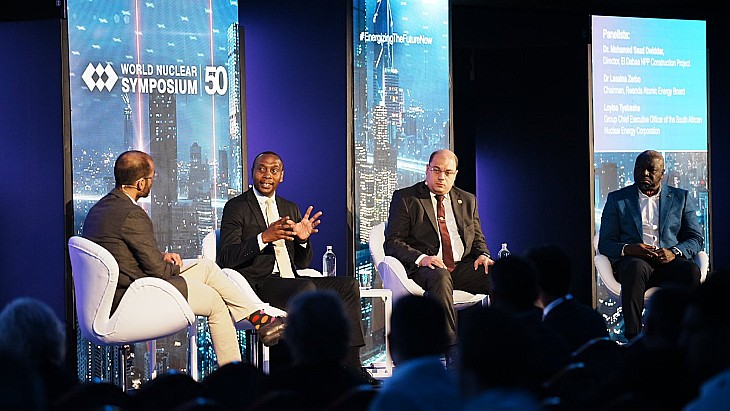
From right: Lassina Zerbo, Mohamed Saad Dwiddar and Loyiso Tyabashe (Image: World Nuclear Association)
Lassina Zerbo, Chairman, Rwanda Atomic Energy Board, said that the country had completed the pre-feasibility study and had a site for the proposed new nuclear capacity and was moving on to consider which technology to use. He said: “The choice is to be made. It’s mainly based on financing. Where we are, what they are offering, and how could they help us implement the project that the president wants to be ready by 2030?”
Each was asked what they thought were the “bottlenecks” or challenges they had faced or were facing. Zerbo said that the initial issue was public acceptance of nuclear energy in countries where there had not been any in the past and getting people to differentiate nuclear energy from a bomb. He said things had changed on that front, and added that a lot effort and discussion was also being put into explaining why the cost of such projects would be worth it.
Loyiso Tyabashe, CEO,South African Nuclear Energy Corporation, agreed that an advocacy information drive stressing the benefits was important, especially the socio-economic benefits of new nuclear in terms of jobs, both direct and secondary.
All three said that ensuring there was a trained and skilled workforce was crucial. In Egypt’s case there had been more than 10 years of training already after establishing a nuclear technical school for undergraduates, to give the country’s “excellent engineers, excellent technicians in different disciplines” the nuclear knowledge they need. Rwanda has also been training up specialists ready for its upcoming nuclear power project. South Africa has a slightly different issue, Tyabashe said, in that South Africa’s established nuclear energy history means it has a well-trained and skilled workforce, but the lack of new projects has seen them moving away to new projects in other parts of the world as they seek to develop skills and careers.
Another topic raised was the issue of a perceived risk premium for financing projects in Africa. Tyabashe said the risk premium was a “systemic issue” and said that advocacy at events like the World Nuclear Symposium gathering was crucial because people attending knew how countries like South Africa had successfully managed their nuclear power industry, and know there is “less risk, less real risk than is probably perceived by a banker who probably doesn’t know the landscape”.
“The other best way to undo that risk systemic thinking is actually to have programmes and projects that are being implemented, knowing the very first ones will suffer because they will have to pay that premium, but to prove those things wrong, by doing projects on time and operating plants safely,” he added.
In the case of Egypt, the governmental agreement between Egypt and Russia had tackled the financing issue for the El Dabaa project. Cooperation with international agencies and the World Bank, plus exploring public-private partnerships, green bonds and the “tokenisation” of mineral reserves (including uranium) were all mentioned during the discussion. The panellists also talked about the need for, and the benefits to follow, of different countries in Africa sharing experience and knowledge.