Tritium recovery and re-use will play a fundamental role in the supply and generation of the fuel in future fusion power plants and will be crucial in making the technology increasingly efficient.
In March this year, the UK Atomic Energy Authority (UKAEA) and Italian multinational energy company Eni SpA entered into a collaboration agreement to jointly conduct research and development activities in the field of fusion energy. The collaboration primarily starts with the construction of the world’s largest and most advanced tritium fuel cycle facility. The UKAEA-Eni H3AT Tritium Loop Facility, located at its Culham Campus in Oxfordshire, England, will be completed in 2028. It is designed to serve as a world-class facility providing industry and academia with the opportunity to study how to process, store and recycle tritium.
The H3AT facilities will comprise: advanced tritium infrastructure, to feed, recover, store and recycle tritium; a flexible suite of enclosures designed to enable a wide variety of experimental work, including pure tritium science, process development, component testing and waste detritiation; computational simulations and model validation; training facilities; and materials detritiation processes and facilities. H3AT will include a prototype-scale process plant and experimental platform, which is a scaled version of the design for the International Thermonuclear Experimental Reactor.
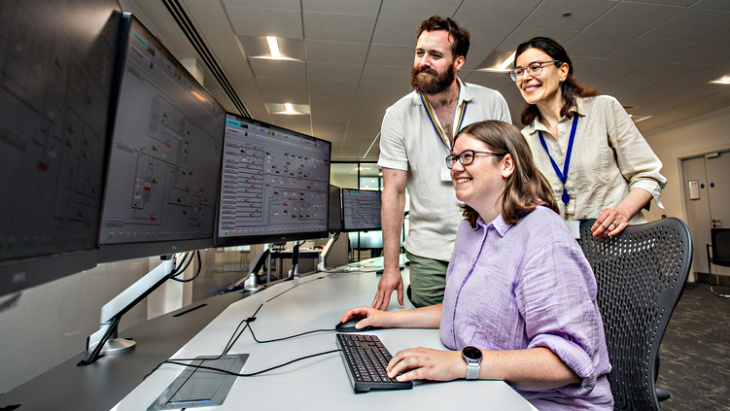
International industrial services provider Bilfinger was appointed by UKAEA as a Tier-One contractor and created a virtual control room for its tritium fuel cycle facility. In addition to providing the control system, as a Tier One contractor Bilfinger UK facilitated and co-ordinated the sub-contracting process, including to Schneider Electric, AVEVA and Siemens.
(Image: UKAEA)
This new virtual control room allows staff at the facility to undergo computer-based simulated training exercises. This enables engineers to train for a range of situations that they wouldn’t be able to practice in the real world, which in turn provides UKAEA the ability to build a digital library of training scenarios. The digital system also allows UKAEA to simulate potential changes to the plant’s operating parameters and the possible knock-on effects, allowing it to optimise processes. Furthermore, alongside the ability to demonstrate H3AT’s capabilities to visiting stakeholders, the virtual control room could be made available in the future for third parties to test their own fuel cycle management systems.
“By creating this digital control room with the support of Bilfinger, we’re increasing technical capability and supporting industry to deliver the mechanisms that will serve fusion in the future,” said Stephen Wheeler, Executive Director for Fusion Technology and Tritium Fuel Cycle at UKAEA. “The development provides an unprecedented opportunity to train the next generation of fusion engineers through cutting-edge virtual simulation technology. Using digital technology to train operators is business-as-usual across several divisions at UKAEA, so it is really pleasing that we are able to employ the same principles within the UKAEA-Eni H3AT Tritium Loop Facility. We are also delighted to have been able to support a broad supply chain through this investment.”
Darren Clement, Vice President EAP, Bilfinger Engineering and Maintenance UK, added: “The exciting research at Culham has the potential to dramatically change the world’s future energy mix – realising the potential for safe, clean and virtually limitless energy. This virtual control room gives UKAEA the ability to further improve its processes while also ensuring staff are able to learn the important skills needed to help make sure operations run smoothly and safely. We’ve supported the nuclear industry for 60 years, supporting pioneers and major operators as they safely deliver clean energy in abundance.”
The UKAEA carries out fusion energy research on behalf of the UK government, overseeing the country’s fusion programme, including the MAST Upgrade (Mega Amp Spherical Tokamak) experiment as well as hosting the recently closed Joint European Torus (JET) at Culham, which operated for scientists from around Europe. It is also developing its own fusion power plant design with plans to build a prototype known as STEP (Spherical Tokamak for Energy Production) at West Burton in Nottinghamshire, which is due to begin operating by 2040.