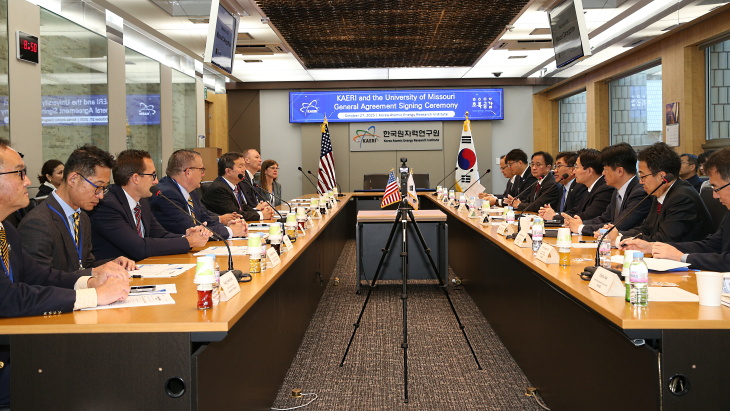
The agreement was signed on 27 October by Korea Atomic Energy Research Institute (KAERI) President Han Gyu Joo and University of Missouri (Mizzou) President Mun Choi at KAERI’s headquarters in Daejeon, South Korea.
Through this agreement, KAERI and the University of Missouri have established a framework for joint research and personnel exchanges across six key areas, including technology development for nuclear reactors, instrumentation for advanced nuclear reactors, radioisotope applications, neutron beam utilisation, materials research, and advanced computing R&D. The two organisations plan to expand practical cooperation by leveraging their respective expertise, research reactor design and operation experience, and infrastructure.
“The agreement is expected to open interdisciplinary opportunities across Mizzou’s 13 schools and colleges – and directly support the launch of the Energy Innovation Center, which will drive research into new energy solutions, including nuclear energy,” the university said.
Hyuk Chae Koo, Korea’s First Vice Minister of the Ministry of Science and ICT, emphasised that this agreement represents “a major turning point that elevates Korea-US nuclear research and development to a new, future-oriented phase”. He added that he looks forward to both countries achieving “joint innovation in science and technology and the peaceful use of nuclear energy”.
KAERI President Han Gyu Joo stated that the visit by the University of Missouri delegation “goes beyond a simple visiting exchange”, describing it as “a foundation for sustainable technological cooperation based on the existing collaboration between two institutions”. He added that KAERI will “continue to strengthen collaboration in the research reactor field and broaden the scope of Korea-US cooperation in nuclear R&D based on mutual trust.”
Mizzou President Mun Choi praised KAERI as “an institution with world-class capabilities in research reactor design and research”. He expressed excitement that “through the signing of this General Agreement, the two institutions will expand cooperation in future nuclear technologies that will benefit humankind not only in Korea and the United States but across the world.”
In April this year, a consortium led by the KAERI was awarded a USD10 million contract by the University of Missouri for the design and licensing of its planned new research reactor. The Korea-US University of Missouri Research Reactor Consortium – comprising KAERI, Hyundai Engineering Company, Hyundai Engineering America and US-based engineering firm MPR Associates – has been contracted for the design studies phase to develop the ‘roadmap’ for the new reactor.
The university’s existing MU Research Reactor (MURR) – originally constructed as a 5 MWt reactor which began operations in 1966 – is the highest-powered university research reactor in the USA and is currently the country’s only producer of certain medical radioisotopes.
The new 20+ MW NextGen MURR research reactor will expand the current capabilities of MURR and address new innovative demands such as cancer treatment. The university said the new reactor and supporting infrastructure will be the largest capital investment in its history and will “position Missouri as a national hub for innovation, investment and manufacturing in nuclear health technologies”. The conceptual design of the reactor is expected to be completed by the end of 2026. The total initiative is expected to take 8-10 years.