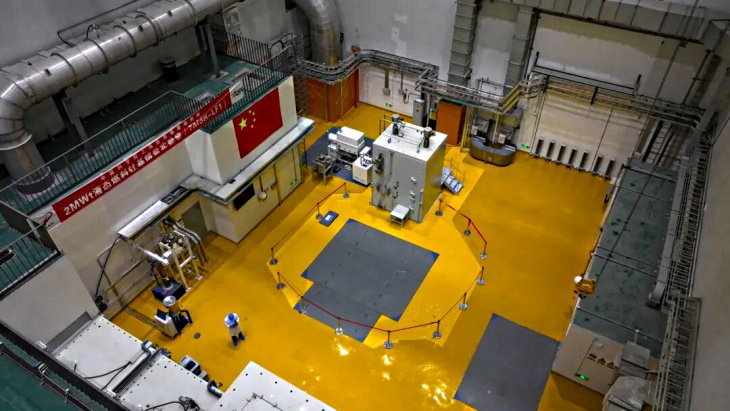
Construction of the 2 MWt TMSR-LF1 reactor began in September 2018 and was scheduled to be completed in 2024. However, it was reportedly completed in August 2021 after work was accelerated. In August 2022, the Shanghai Institute of Applied Physics (SINAP) was given approval by the Ministry of Ecology and Environment to commission the reactor. An operating licence was granted for the reactor in June 2023. It achieved first criticality – a sustained reaction – on 11 October 2023.
The TMSR-LF1 uses fuel enriched to under 20% uranium-235, has a thorium inventory of about 50 kg and conversion ratio of about 0.1. A fertile blanket of lithium-beryllium fluoride (FLiBe) with 99.95% Li-7 is used, and fueled with uranium tetrafluoride (UF4).
“In October 2024, the world’s first thorium addition to a molten salt reactor was completed, making it the first in the world to establish a unique molten salt reactor and thorium-uranium fuel cycle research platform,” the Shanghai Institute of Applied Physics said.
On 1 November, the institute announced that TMSR-LF1 achieved the first conversion of thorium and uranium nuclear fuel.
“This marks the first time international experimental data has been obtained after thorium was introduced into a molten salt reactor, making it the only operational molten salt reactor in the world to have successfully incorporated thorium fuel,” the institute said. “This milestone breakthrough provides core technological support and feasible solutions for the large-scale development and utilisation of thorium resources in China and the development of fourth-generation advanced nuclear energy systems.”
Shanghai Institute of Applied Physics Deputy Director Li Qingnuan said: “Since first reaching criticality on 11 October 2023, the thorium-based molten salt reactor has been continuously generating heat through nuclear fission.” She explained that conventional pressurised water reactors require periodic shutdowns and the opening of the pressure vessel top cover to replace the nuclear fuel when refueling is needed. However, the thorium-based molten salt reactor uses liquid fuel, with the nuclear fuel uniformly dissolved in the molten salt coolant and circulating with it, allowing for refueling without shutting down the reactor.
“This design not only improves fuel utilisation but also significantly reduces the generation of radioactive nuclear waste, which is one of the advantages of thorium-based molten salt reactors.”
The institute’s next step is to accelerate technological iteration and engineering transformation, aiming to complete a 100 MWt thorium-based molten salt reactor demonstration project and achieve demonstration applications by 2035, Shanghai Institute of Applied Physics Director Dai Zhimin said.
Molten salt reactors (MSRs) use molten fluoride salts as primary coolant, at low pressure. They may operate with epithermal or fast neutron spectrums, and with a variety of fuels. Much of the interest today in reviving the MSR concept relates to using thorium (to breed fissile uranium-233), where an initial source of fissile material such as plutonium-239 needs to be provided. There are a number of different MSR design concepts, and a number of interesting challenges in the commercialisation of many, especially with thorium.