Blast marks restart of mining operations at Kayelekera

Kayelekera first produced uranium in 2009, but when Australian-based Lotus Resources acquired the project from Paladin Energy in 2020 it had been under care-and-maintenance since 2014. Lotus announced plans for an accelerated restart of the project in 2024, and the recommissioned processing plant produced its first dried and drummed yellowcake in August 2025 using ore that was stockpiled from previous open pit mining operations.

Delivery of ore from the restarted mining operations to the run-of-mine (ROM) pad will begin in the coming weeks, Lotus said. Newly mined ore will supplement stockpiled ore in Kayelekera’s processing and production operations, with freshly mined ore being combined with ore from the existing stockpiles to support the ramp-up of production: the company is targeting a steady-state production level of 200,000 pounds U3O8 (77 tU per month) in the first quarter of 2026.

Open pit mining is a technique used when an orebody – in this case, the uranium ore – lies close to the surface. Sometimes called open cut mining, or strip mining, the technique involves the removal of topsoil and rock that lie above the uranium ore, which is then processed at a mill to recover the uranium it contains. Blasting using explosives is an integral part of open pit mining operations.
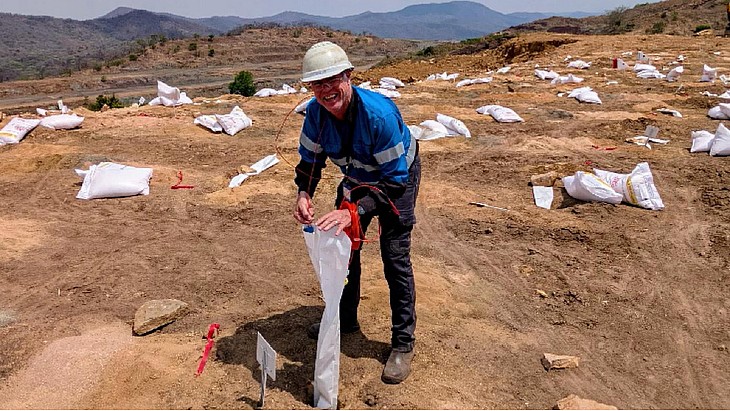

Kayelekera Mining Manager Philippus Schoeman overseeing preparations for first mining blast (Image: Lotus Resources)

“The commencement of drill and blast activities marks another major milestone for the Kayelekera uranium mine. The stockpiles we have been processing continue to outperform our expectations, and the transition to freshly mined ore will support the ramp-up trajectory,” Lotus Managing Director Greg Bittar said.

Lotus owns 85% of the project, with the Government of Malawi owning the remaining 15%.

The company has shared a on social media.
   

  • Related Posts

    Kaleidos microreactor begins journey to Idaho

    “We said we’d make a microreactor that is transportable by land, sea and air. We did. Kaleidos is traveling more than 1,000 miles on a trailer bed,” the company said. …

    Detritiation facility reopens at Culham

    In the last three years of plasma operations, the Joint European Torus’s (JET’s) deuterium-tritium experiments resulted in residual tritium being retained within the tokamak’s walls and internal components. This reflected…

    Have You Seen?

    Gulf-to-China Supertanker Rates Hit $510,000 a Day

    • August 18, 2026
    Gulf-to-China Supertanker Rates Hit $510,000 a Day

    Romania Restarts Coal Plant as Danube Drought Forces Nuclear Shutdown

    • August 18, 2026
    Romania Restarts Coal Plant as Danube Drought Forces Nuclear Shutdown

    China’s Solar Exports Fell 21.4% in July

    • August 18, 2026
    China’s Solar Exports Fell 21.4% in July

    UK researchers make MOF for capturing heavy metals from wastewater

    • August 18, 2026
    UK researchers make MOF for capturing heavy metals from wastewater

    US semiconductor investment tops $820bn since 2020

    • August 18, 2026
    US semiconductor investment tops $820bn since 2020

    UK biogas plant gets green light for CO2 capture and liquefaction

    • August 18, 2026
    UK biogas plant gets green light for CO2 capture and liquefaction

    Outlook for electronic specialty gases

    • August 18, 2026
    Outlook for electronic specialty gases

    U.S.-Iran Tensions Push Oil Prices Higher as Diesel Margins Hit Records

    • August 18, 2026
    U.S.-Iran Tensions Push Oil Prices Higher as Diesel Margins Hit Records

    Libya Seeks Up to $40 Billion to Boost Oil Output to 2 Million Bpd

    • August 18, 2026
    Libya Seeks Up to $40 Billion to Boost Oil Output to 2 Million Bpd

    China Boosts Fuel Exports as Domestic Stockpiles Swell

    • August 18, 2026
    China Boosts Fuel Exports as Domestic Stockpiles Swell