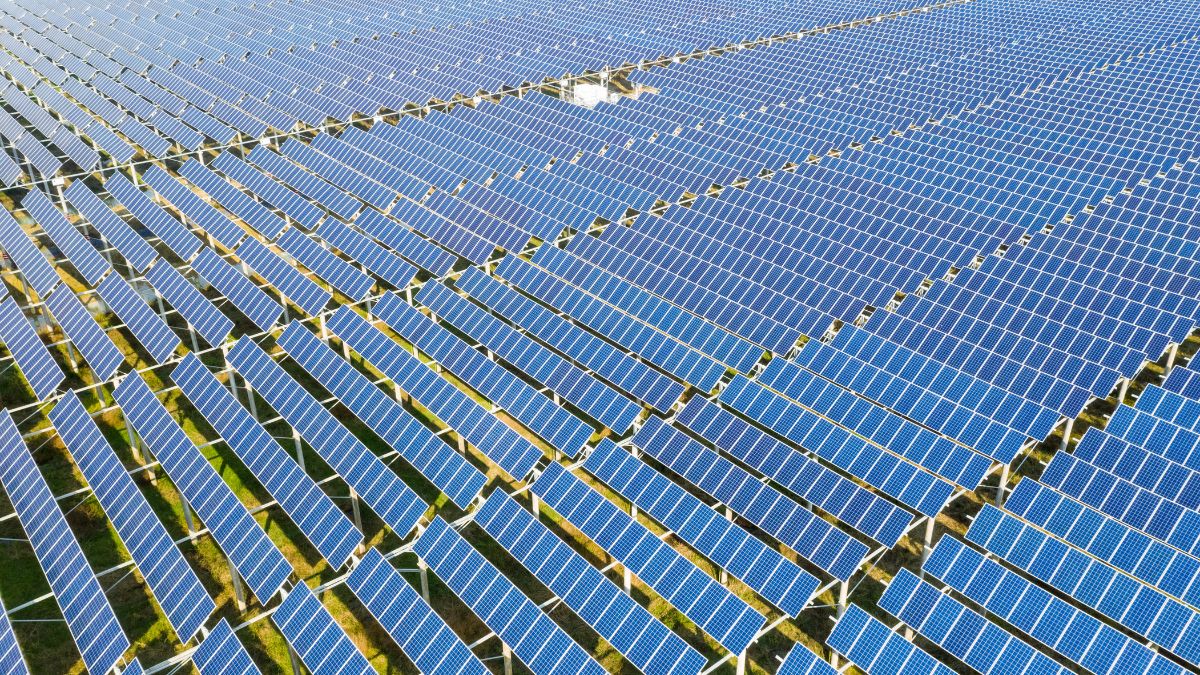
At the livestreamed launch event for Huasun’s new 760W/2000V high-efficiency HJT module, Chairman Jimmy Xu addressed a global audience and shared insights into the company’s latest technological breakthroughs. In his keynote, he outlined the strategic thinking behind the new Himalaya 760HV module and its significance for the next stage of solar innovation.
Xu began by explaining why Huasun developed a 760W module, noting that the Himalaya 760HV elevates mass-production power for HJT 210-132 modules to a new level while incorporating an industry-first 2000V system voltage. This combination of ultra-high power and ultra-high system voltage forms what Huasun calls the “7-2 solution.”
He emphasized that as TOPCon, BC, and HJT technologies advance rapidly, the industry is increasingly focused on achieving higher deliverable power to secure premium project value. With a conversion efficiency of 24.5%, the new module surpasses even mainstream BC products at similar efficiency levels. While many 24–24.5% efficient modules on the market still operate in the 650–670W range, outputs above 750W are quickly becoming the preferred choice for utility-scale projects. The Himalaya 760HV therefore represents a major breakthrough for customers seeking both high efficiency and high output.

Shifting to the second theme of the launch—“Elevation”—Xu addressed the importance of moving the industry to 2000V system voltage. The last major voltage upgrade occurred around 2016, when the standard shifted from 1000V to 1500V, enabling major system-level cost reductions. Calls for a move to 2000V have been growing, and many inverter manufacturers are already prepared for the shift. According to Huasun’s analysis, increasing system voltage from 1500V to 2000V in regions such as Xinjiang can reduce BOS costs by 1.7 US cents/W, while the 760W high-power design contributes an additional 0.4 US cents/W in savings. Over 25 years, O&M savings add another 1.4 US cents/W, meaning that a 10 GW project could reduce initial investment by around US$210 million, with an additional US$140 million in O&M savings.
Xu also addressed why the move to 2000V has been slow. Traditional encapsulation methods require significant increases in creepage distance—reducing active area and causing power losses. This has discouraged manufacturers from adopting higher system voltages despite the potential benefits. Huasun solved this challenge with a non-perforated butyl edge-sealing technology, supported by dedicated equipment and validated through IEC and TÜV Rheinland testing. This approach achieves the required creepage distance with only ~3 mm of butyl width while preserving efficiency.
Complemented by negative-spacing design and enlarged wafer dimensions, the new module gains an additional 20W of power without the complexity of tri-cut or quad-cut designs. Xu highlighted this as a timely upgrade path for utility-scale projects facing structurally low returns.
He concluded by reaffirming Huasun’s commitment to advancing HJT industrialization—from collaborative innovation platforms to tandem pilot lines and emphasized that the Himalaya 760HV will help accelerate 2000V supply-chain maturity and support global clean-energy transformation.
Subscribe to get the latest posts sent to your email.