Mapped: U.S. Oil Production by State – Visual Capitalist

By | Graphics/Design:
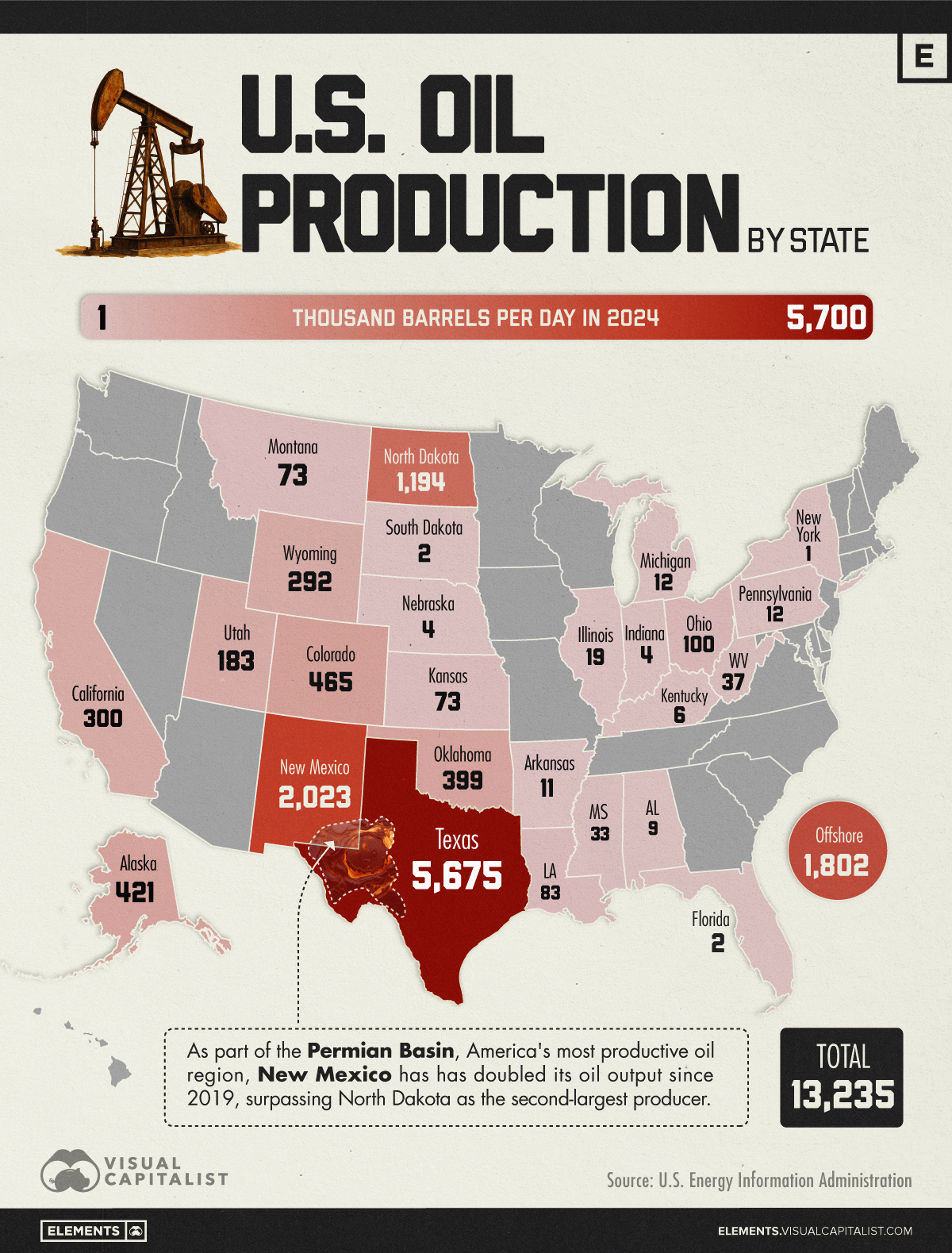
vce us oil production by state web 09222025

Key Takeaways

  • New Mexico doubled oil production from 2019 to 2024, reaching over 2M barrels/day.
  • Texas remains the top oil-producing state with 5.7M barrels/day, leading the Permian Basin output.

The U.S. is in the midst of a historic oil boom. For the past two years, the country has set oil , hitting over 13 million barrels of crude per day in 2024. This visualization maps oil production by state, highlighting where energy extraction is most concentrated. The data for this map comes from the .


Get the Latest US Focused Energy News Delivered to You! It’s FREE:


Texas and New Mexico Dominate

Texas leads the nation by a wide margin, producing 5.7 million barrels per day in 2024. Its mature oilfields and extensive infrastructure in the Permian Basin give it a major advantage. New Mexico, meanwhile, has surged into second place. The state doubled its production since 2019, thanks to aggressive development in the Delaware sub-basin.

Together, these two states produce more oil than the rest of the U.S. combined.

Offshore and Northern Oil States

Offshore production—primarily in the Gulf of Mexico—contributes 1.8 million barrels per day, making it the third-largest oil-producing region. North Dakota, a key player in the Bakken formation, remains a major contributor with 1.2 million barrels per day.

Colorado, Alaska, and Oklahoma also produce significant volumes, but at less than half the output of North Dakota.

Smaller Producers and Declining States

States like California and Wyoming still contribute, but their production has declined over the years due to stricter regulations and aging wells. Many states produce under 100,000 barrels per day, including Ohio, Louisiana, and West Virginia.

Notably, some historically active states like Pennsylvania and Illinois are now among the lowest producers, each yielding under 20,000 barrels per day.

Share This:


More News Articles

 

  • Related Posts

    Goldman Sachs Raises Q2 Brent Oil Price Forecast by $10 to $76 a Barrel

    March 4 (Reuters) – Goldman Sachs  raised on Wednesday its second-quarter 2026 average price forecast for Brent crude ​oil by $10 to $76 per barrel and for WTI by $9…

    There is Little US LNG Producers Can do to Immediately Replace Lost Qatari Cargoes

    Summary US LNG plants running near full capacity, limiting the potential for output increase amid Qatar disruptions Venture Global has the most flexibility, with higher percentage of spot market sales…

    Have You Seen?

    Trump to Meet Tech Giants on Energy Pledge Ahead of Midterms

    • March 4, 2026
    Trump to Meet Tech Giants on Energy Pledge Ahead of Midterms

    There is Little US LNG Producers Can do to Immediately Replace Lost Qatari Cargoes

    • March 4, 2026
    There is Little US LNG Producers Can do to Immediately Replace Lost Qatari Cargoes

    Goldman Sachs Raises Q2 Brent Oil Price Forecast by $10 to $76 a Barrel

    • March 4, 2026
    Goldman Sachs Raises Q2 Brent Oil Price Forecast by $10 to $76 a Barrel

    Hormuz Shutdown Worsens After US Hits Iranian Warship; Tankers Stranded for Fifth Day

    • March 4, 2026
    Hormuz Shutdown Worsens After US Hits Iranian Warship; Tankers Stranded for Fifth Day

    Asian LNG Prices Soar to Three-Year High

    • March 4, 2026
    Asian LNG Prices Soar to Three-Year High

    Goldman Sachs Hikes Q2 Brent Oil Price Forecast by $10

    • March 4, 2026
    Goldman Sachs Hikes Q2 Brent Oil Price Forecast by $10

    Barclays Warns Grid Constraints Could Strand Renewables Assets

    • March 4, 2026
    Barclays Warns Grid Constraints Could Strand Renewables Assets

    Alfa Laval to supply cryogenic tech for South Korea’s first liquid air energy storage plant

    • March 4, 2026
    Alfa Laval to supply cryogenic tech for South Korea’s first liquid air energy storage plant

    Japan studies bio-based CO2 liquefaction from waste incineration

    • March 4, 2026
    Japan studies bio-based CO2 liquefaction from waste incineration

    Solar chemistry moves NASA closer to lunar oxygen production

    • March 4, 2026
    Solar chemistry moves NASA closer to lunar oxygen production