By Yogi Schulz
Information technology continues to develop rapidly, changing what’s possible. 2025 was no exception. Here are my Top 10 developments. Undoubtedly, there are multiple opportunities to apply these technologies more widely across your energy industry organization.
Get the Latest US Focused Energy News Delivered to You! It’s FREE:
1. AI dominated every conversation
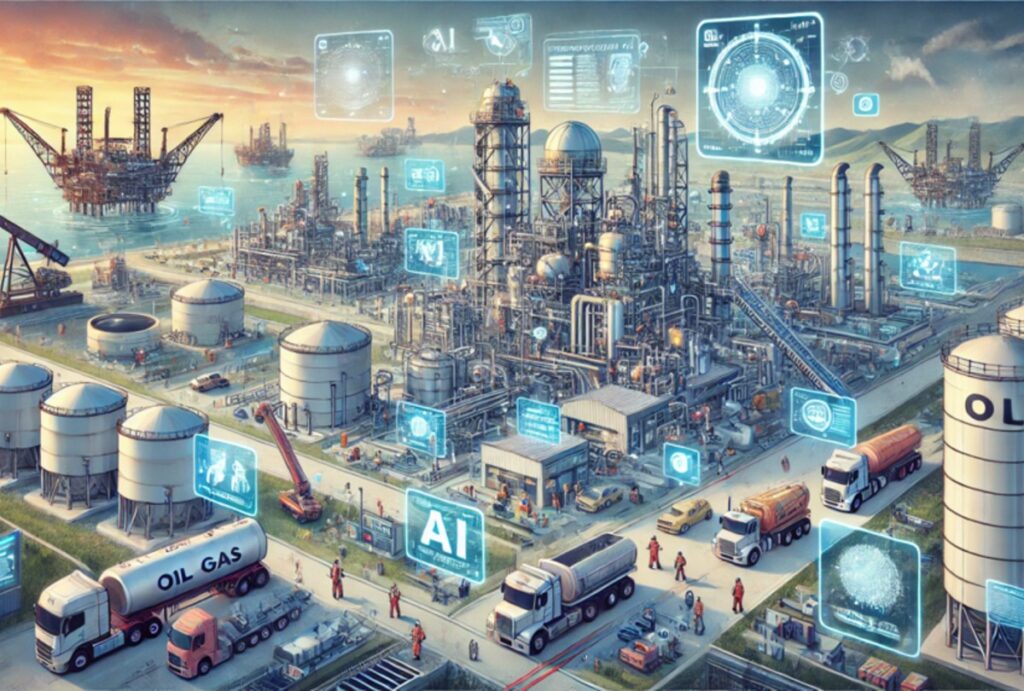
In 2025, AI concepts, experimentation with generative AI, and speculation about future adoption and significant impacts have dominated every conversation. Everyone is trying to figure out how AI will impact their organization and their oil and natural gas career path.
The rapid adoption of generative AI and the massive investments in AI models and supporting data center infrastructure indicate we’re in the middle of a technology revolution comparable to electricity, the telephone and the Internet.
2. Generative AI is advancing processes and creativity
Incredible investments in improving AI models are producing new models such as Anthropic’s Claude 3.5/3.7, Google’s Gemini 2.5, Microsoft’s Copilot, and OpenAI’s GPT-4o and future GPT-5. These AI models are:
- Transforming technical energy industry research, custom software development and software-as-a-service (SaaS) solutions.
- Improving in sophistication and performance.
- Reducing the frequency of misleading output and hallucinations.
Oil and natural gas producers are using these AI models not only for automation but also for creative ideation, personalized experiences, and advanced data analytics.
3. Massive data center expansion for AI infrastructure
The global boom in generative AI use has driven historic investments in new data center infrastructure. The tech giants and less prominent companies have poured hundreds of billions into new data centers and cloud capacity. These data centers provide capacity for workloads such as AI model development, large-scale inference, large globally distributed applications and real-time data analytics.
New AI applications and new end users in every industry are consuming all the long-running improvements in the price-performance of computing technology.
4. AI experimentation
Many producers and vendors are engaged in AI experimentation and pilots. These AI projects, formally approved or not, are building experience with the requirements and risks of AI application projects.
AI pilots are revealing:
- How poor data quality in enterprise data sources leads to hallucinations that are either funny or dangerous, and undermines trust and business value.
- How difficult it is to achieve an appealing business case for AI applications.
- Shortages in IT talent with experience in AI software.
5. Proliferation of IoT and smart devices
The scale of connected Internet of Things (IoT) devices has surged, with billions of endpoints collecting real-time data across wells, pipelines and facilities. The variety of IoT devices has exploded, their capabilities have become smarter, and their unit costs have decreased. The devices have created such an explosion in data volume that AI is needed to analyze it. The related networks and applications support facility operations, predictive maintenance, and supply chain optimization.
IoT and smart devices underpin a digital transformation that improves producer performance, reduces costs and increases safety.
6. Low-code/No-code developer platform advances
Professional software developers and end users alike have accelerated application development using low-code and no-code platforms. These platforms have taken the unreasonable pressure to deliver applications off many producer and vendor IS departments.
These platforms democratize software development and reduce time-to-completion for internal and customer-facing solutions. Many enterprises are ignoring concerns about the lack of robustness or scalability.
7. AI-infused vendor solutions
Every vendor that licenses SaaS solutions to oil and natural gas producers breathlessly announced new AI functionality in 2025. Since every customer is always looking for more functionality and better integration across their application portfolio, something new is guaranteed to spark interest. Examples of applications with AI features include subsurface modelling, field development planning, drilling, production optimization, ERP and emissions management.
The fact that AI functionality may not be helpful or applicable to some excellent SaaS solutions appears to be irrelevant.
8. Cybersecurity reinvented with AI and quantum-safe tools
Cybersecurity defence remains a top priority for producers and vendors as threats have become pervasive and increasingly sophisticated. AI-driven defence platforms, zero-trust architectures, and early adoption of post-quantum cryptography have proliferated across organizations to protect against automated attacks and future quantum decryption risks.
Cybersecurity defences have increased operating costs for many, while a surprising number of enterprises continue to ignore threats to their finances and reputations.
9. Blockchain beyond cryptocurrency
Blockchain technologies have matured to support secure decentralized ledgers for smart contracts, supply-chain integrity, and digital identity management. These applications are expanding the value of blockchain technologies beyond speculative finance into trusted enterprise systems.
Blockchain technologies offer the potential to improve productivity and reduce risk for oil and natural gas producers.
10. Explosion of cloud and edge computing integration
Edge computing has expanded rapidly in 2025, even as cloud computing remains foundational for most enterprises. Edge computing brings data processing closer to where data is generated. Examples include sensors with processing capability in production, refining and equipment manufacturing facilities.
Hybrid and multi-cloud strategies have become the norm as architectures for this integration, improving scalability and resilience while optimizing costs.
Many information technology developments made 2025 a thrilling year for the energy industry, dominated by AI. Stay tuned for more excitement in 2026.
Yogi Schulz has over 40 years of experience in information technology in various industries. He writes for , , and other trade publications. Yogi works extensively in the petroleum industry to select and implement financial, production revenue accounting, land & contracts, and geotechnical systems. He manages projects that arise from changes in business requirements, the need to leverage technology opportunities, and mergers. His specialties include IT strategy, web strategy, and systems project management.
Share This:
More News Articles