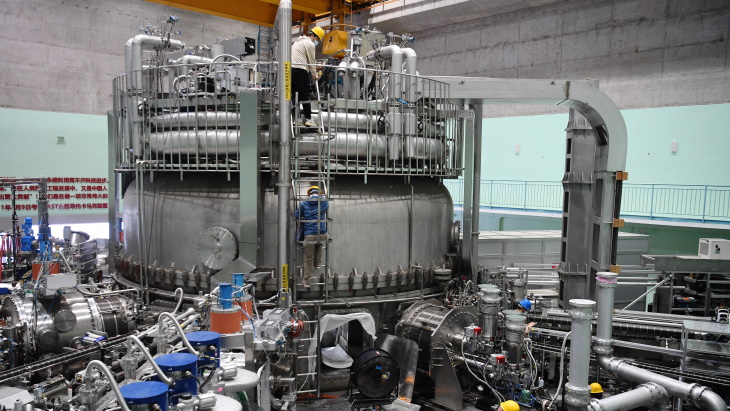
A tokamak device is a toroidal device that uses magnetic confinement to achieve controlled nuclear fusion, resembling a spiral ‘magnetic track’ that locks in high-temperature plasma to achieve nuclear fusion. Plasma density is one of the key parameters of tokamak performance, directly affecting the fusion reaction rate. In the past, researchers discovered that there is a limit to plasma density, referred to as the Greenwald density limit; once this limit is reached, the plasma breaks up and escapes the magnetic field confinement, releasing enormous energy into the inner wall of the device, affecting safe operation. Through long-term research, the international fusion community has discovered that the physical process triggering the density limit occurs in the boundary region between the plasma and the inner wall of the device, but the underlying physical mechanism is not fully understood.
A team at the Institute of Plasma Physics under the Chinese Academy of Sciences (ASIPP) in Hefei, Anhui Province, developed a theoretical model of boundary plasma-wall interaction self-organisation (PWSO), discovering the crucial role of boundary radiation in density limit triggering and revealing the triggering mechanism of the density limit. Utilising the all-metal wall operating environment of the Experimental Advanced Superconducting Tokamak (EAST) – known as the ‘artificial sun’ – they reduced boundary impurity sputtering by employing methods such as electron cyclotron resonance heating and pre-charged synergistic start-up, actively delaying the occurrence of the density limit and plasma breakup.
By controlling the physical conditions of the target plate, they reduced tungsten impurity-dominated physical sputtering, controlling the plasma to break through the density limit and guiding it into a new density-free region. The team said the experimental results highly agree with PWSO theoretical predictions, confirming for the first time the existence of the density-free region in a tokamak. This innovative work provides important clues for understanding the density limit and offers crucial physical evidence for high-density tokamak operation.
In the experiments, EAST achieved line-averaged electron density in the range of 1.3 to 1.65 Greenwald density limit.
“These results demonstrate the potential of a practical scheme for substantially increasing the density limit in tokamaks, which is also germane to the stellarator start-up … the breaking of Greenwald density limit and the successful access to the density-free regime as demonstrated in this work opens a promising path advancing toward achieving the fusion ignition condition,” the researchers said.
This work – the results of which were – was a collaborative effort by the Institute of Plasma Physics, Huazhong University of Science and Technology, and Aix-Marseille University, and was supported by the National Magnetic Confinement Fusion Project. The successful completion of this work benefited from EAST’s advanced all-metal wall experimental platform and its open collaborative proposal coordination mechanism. The precise diagnostic measurements of density, temperature, radiation, and impurities developed by the EAST device in recent years, as well as the efficient electron cyclotron resonance heating method, have provided important technical support for the work in this field.
Since starting operation in 2006, EAST has been an open test platform for Chinese and international scientists to conduct fusion-related experiments and research.