As India accelerates toward its ambitious 2030 renewable energy targets, strengthening domestic manufacturing has become a key pillar of the country’s clean energy strategy. Reinforcing this momentum, Stäubli has inaugurated a new solar connector manufacturing facility in Bengaluru, aimed at enhancing local production capabilities and supply chain resilience.
In this exclusive interaction with SolarQuarter, Matthias Mack, Vice President – Renewable Energy at Stäubli, shares insights on the company’s India expansion, technology leadership, product localization, and its role in supporting India’s renewable energy growth.
What is the significance of Stäubli inaugurating this new manufacturing facility in Bengaluru, and what does it represent for your India strategy?
This inauguration marks a very important milestone for Stäubli and reflects our long-term commitment to India’s renewable energy ecosystem. While we have been active in India’s solar market for many years, establishing a local production base was a crucial missing element. With this facility, we are strengthening our proximity to customers, enhancing responsiveness to market needs, and reinforcing our role as a trusted partner in India’s clean energy transition.
Local manufacturing also enables us to build a more resilient supply chain, reduce dependency on imports, and better manage global geopolitical challenges. Overall, this factory represents not only a strategic business expansion but also our dedication to supporting India’s ambition to become a global renewable energy leader.
What products will be manufactured at this facility, and how does localization improve customer value in India?
This facility is launching two key solar connector product lines. The first is the MC4-Evo 2 connector, which is widely used in advanced PV installations globally. The second is the MC4-India connector, which has been specifically designed to meet the technical, regulatory, and operational requirements of the Indian market.
Localization brings several critical advantages. It allows us to shorten delivery timelines, improve supply reliability, and respond more quickly to customer and project requirements. Being physically closer to our customers also helps us better understand local market dynamics, enabling more agile product development and stronger technical collaboration with EPCs, developers, and OEMs. This ultimately improves project execution speed and strengthens long-term partnerships.
How does this manufacturing initiative support India’s 2030 renewable energy goals, and what technological edge does Stäubli bring to the solar sector?
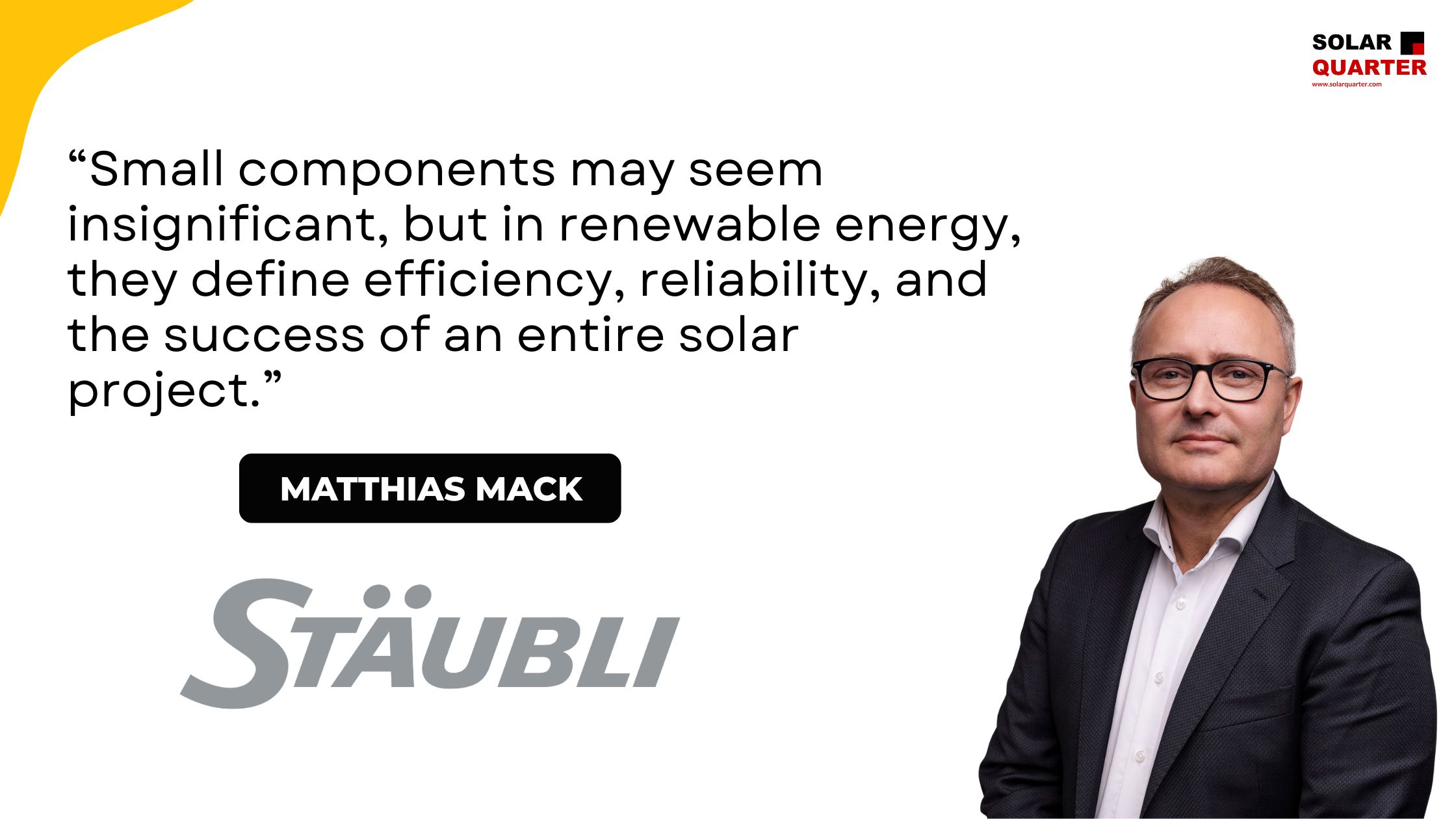
Although connectors are relatively small components within a solar system, they play a critical role in system efficiency, safety, and long-term reliability. Our connectors are engineered with very low contact resistance, which minimizes energy loss, reduces heat generation, improves system performance, and extends the overall lifespan of solar assets. This translates into higher returns, improved efficiency, and lower operational risks for asset owners.
From a manufacturing standpoint, our production technology ensures consistent high-quality output even at large-scale, million-unit volumes — a key requirement for India’s rapidly expanding solar industry. This capability supports the nation’s 2030 renewable energy targets by enabling scalable, high-performance infrastructure.
Additionally, we are proud to have a growing local workforce of approximately 100 professionals in India, contributing to domestic skill development, innovation, and industrial growth while supporting our customers’ sustainability objectives.
How does this facility support Stäubli’s India and global strategy, and what is your message to the renewable energy industry?
Our primary focus is to serve the Indian domestic market, ensuring strong customer engagement and value creation locally. However, given evolving global supply chain dynamics and international demand, we are already using this facility to support exports to regions such as the Middle East, and we see potential to expand exports further — including to the American market and other strategic regions.
And from an industry perspective, my message would be this: India has a real opportunity to become a global manufacturing hub for renewable energy components. Small components can make a big impact, and through our connector solutions, we want to play our part in India’s energy transition and the global decarbonization effort. I would really encourage more international companies to localize in India, invest here, and work together toward a greener and more sustainable renewable energy future.”
Subscribe to get the latest posts sent to your email.