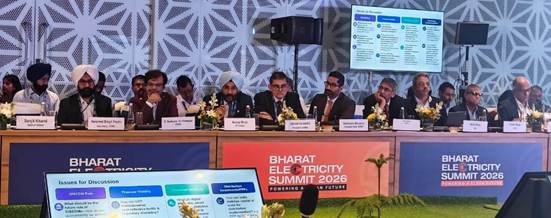
A CEO Roundtable on Power Distribution was convened at the Bharat Electricity Summit 2026 under the draft National Electricity Policy 2026 (NEP 2026), bringing together senior leadership from key power sector organizations to deliberate on strengthening India’s distribution segment and ensuring the financial sustainability of DISCOMs.
The meeting, chaired by Shri Pankaj Agarwal, Secretary, Ministry of Power, saw industry leaders endorsing the draft policy for its comprehensive and forward-looking approach. Participants highlighted that NEP 2026 provides a strategic roadmap to address emerging sectoral challenges while aligning with India’s long-term economic growth and energy transition goals.
Discussions emphasized the need for electricity supply to match the ambitions of Viksit Bharat @ 2047, which envisions a USD 30 trillion economy and energy independence. The policy sets targets to raise per capita electricity consumption to 2,000 kWh by 2030 and over 4,000 kWh by 2047, in line with India’s climate commitments, including a 45% reduction in emissions intensity by 2030 and achieving net-zero emissions by 2070.
A major focus of NEP 2026 is improving the financial health of the distribution sector. Key strategies include optimizing power procurement, reducing Aggregate Technical & Commercial (AT&C) losses, and strengthening governance frameworks. The policy aims to bring AT&C losses to single-digit levels through phased deployment of smart prepaid meters, particularly for government, commercial, and industrial consumers, supported by regular energy audits and enhanced accounting practices.
To improve operational efficiency, the draft policy proposes shared distribution networks to avoid duplication of infrastructure, alongside GIS-based asset mapping, consumer indexing, and system automation.
The policy also recognizes the increasing importance of distributed energy resources and recommends establishing a Distribution System Operator (DSO). This would enable better integration of distributed renewables, energy storage systems, and Vehicle-to-Grid (V2G) technologies, while supporting local energy markets and enhancing grid security.
In terms of service quality, NEP 2026 outlines measures to strengthen reliability, including network redundancy at key voltage levels and stricter enforcement of service standards. It proposes redundancy at the distribution transformer level in cities with populations exceeding 10 lakh by 2032 and recommends underground cabling in congested urban areas. Ensuring universal electricity access, particularly in border regions, remains a priority.
The roundtable concluded with a strong consensus on the need for sustained reforms in the distribution sector to improve DISCOM viability and support India’s broader economic and clean energy transition objectives.
Subscribe to get the latest posts sent to your email.