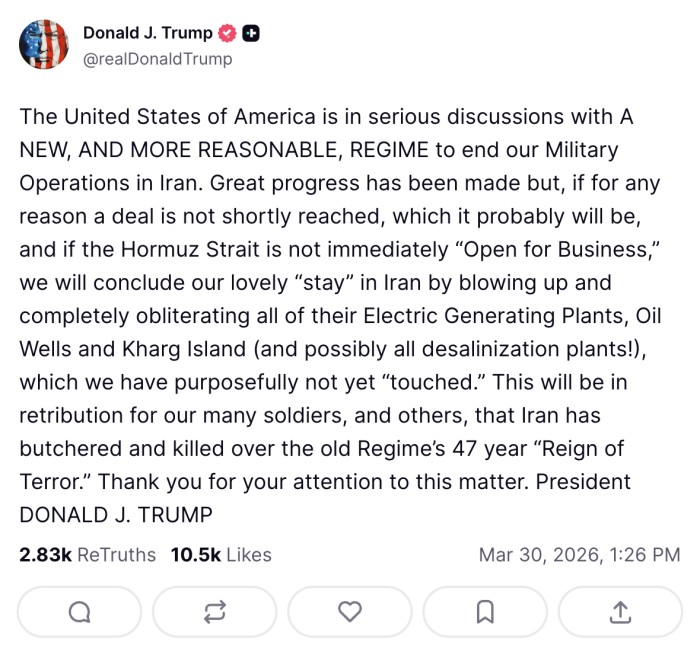
President Donald Trump on Monday threatened to destroy Iran’s power plants, oil wells, Kharg Island, and potentially its desalination infrastructure if no ceasefire deal is reached, even as he claimed talks are moving in the right direction.
“Great progress has been made but, if for any reason a deal is not shortly reached…we will conclude our lovely ‘stay’ in Iran by blowing up and completely obliterating all of their Electric Generating Plants, Oil Wells and Kharg Island (and possibly all desalinization plants!), which we have purposefully not yet ‘touched,'” Trump posted on Truth Social Monday morning.
The post came roughly 30 days into the U.S. and Israel’s joint bombing campaign against Iran, which has effectively shut down the Strait of Hormuz to most commercial traffic. About one-fifth of the world’s oil normally moves through the strait.
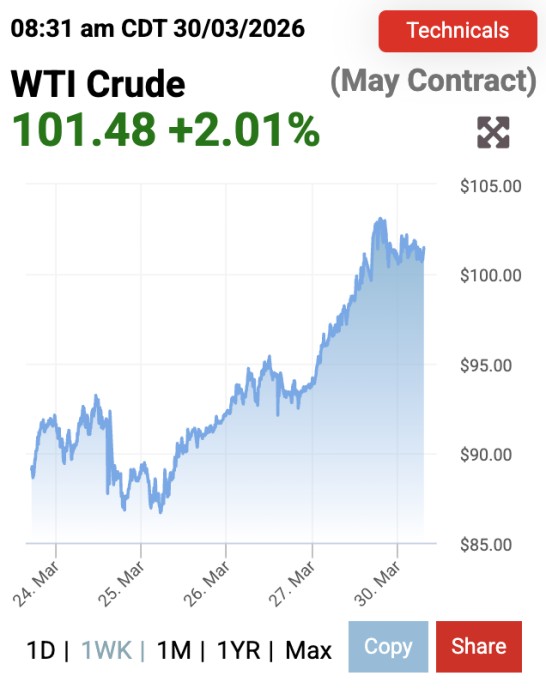
With it largely closed, global energy markets have been under sustained pressure, Brent crude has pushed back above $115 per barrel as insurers pull back and tanker routes are rerouted or abandoned.
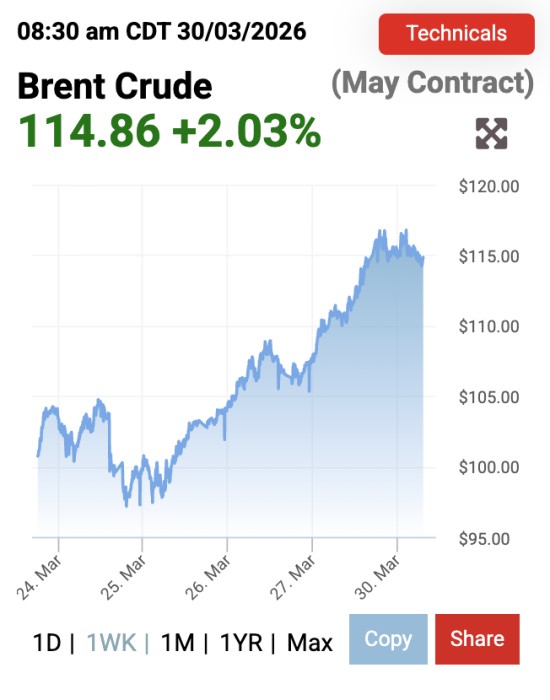
WTI, for its part, crossed the $100 mark…
Trump’s message on Monday also restated his threat to seize Kharg Island, which handles roughly 90% of Iran’s crude exports. He has floated the idea before, including in a weekend interview with the Financial Times, though he acknowledged it would mean a U.S. military presence there “for a while.” Iran has reinforced the island’s defenses in anticipation, including portable air defense systems and mines along likely landing zones.
The new threat comes a day after Trump told reporters that Tehran had agreed to “most of” a 15-point ceasefire proposal the U.S. relayed via Pakistan. Iran’s government has publicly denied that any direct negotiations are taking place. On March 25, Tehran formally rejected the U.S. proposal and put forward five conditions of its own — including sovereignty over the Strait of Hormuz, guaranteed war reparations, and a complete halt to strikes from the U.S. and Israel.
On March 26, Trump extended his deadline for Iran to reopen the strait for a second time, pushing it to April 6. He has framed each extension as a goodwill gesture toward ongoing talks. Speaking Thursday, Trump said Iranian negotiators had allowed eight oil tankers through the strait as a symbolic gesture, which he described as a sign he was “dealing with the right people.”
But by Sunday, Iran’s parliament speaker Mohammad Bagher Ghalibaf was rejecting the talks outright, saying Iran could not be forced into submission. And on the ground, the conflict continued to escalate. A March 27 Iranian missile and drone strike on Prince Sultan Air Base damaged several U.S. refueling aircraft and injured 15 soldiers, including five critically.
The Pentagon is now weighing sending up to 10,000 additional ground troops to the Middle East, according to the Wall Street Journal, on top of deployments already underway that include the 82nd Airborne Division and Marine Expeditionary Units configured for amphibious operations.
In Washington, some lawmakers on both sides of the aisle are pushing back against any ground operation inside Iran, and the Senate Armed Services Committee is preparing to examine the war next month. U.N. officials have also warned that threatening to strike civilian power and water infrastructure could constitute a war crime.
The April 6 deadline is now the focal point. If negotiations collapse before then, Trump’s options range from striking Kharg Island’s oil export infrastructure — a move JP Morgan has warned could cut Iran’s crude output in half — to a ground assault on the island itself. Either path carries significant market consequences. Destroying the terminal would remove a large share of Iranian supply immediately. Seizing it, analysts say, would likely trigger broader retaliation across Gulf energy infrastructure without necessarily resolving the standoff over the strait.
For now, the market is watching the calendar.
By Michael Kern for Oilprice.com
More Top Reads From Oilprice.com
- China Sends Fuel to Struggling Southeast Asia Despite Export Ban
- Australia Cuts Fuel Tax in Half as Middle East War Squeezes Supply
- India Leans on Coal and Renewables as War Throttles Gas Supply