Generic Design Assessment (GDA) is a process carried out by the Office for Nuclear Regulation (ONR), the Environment Agency and Natural Resources Wales to assess the safety, security, and environmental protection aspects of a nuclear power plant design that is intended to be deployed in Great Britain (Great Britain is England, Scotland and Wales). The GDA process is a voluntary, non-mandatory process. Successful completion of the three-step GDA culminates in the issue of a Design Acceptance Confirmation from the ONR and a Statement of Design Acceptability (SoDA) from the Environment Agency. In May 2021, the UK’s Department for Business, Energy and Industrial Strategy opened the GDA process to advanced nuclear technologies, including small modular reactor (SMRs).
Step 1 of the GDA of Holtec’s SMR-300 began in October 2023 and focused on agreeing the scope and schedule for Step 2. This stage was successfully completed in July 2024. Step 2 began the following month and involved a comprehensive and rigorous regulatory assessment examining the fundamental adequacy of the reactor design and its safety, security, safeguards and environmental protection documentation.
The regulators have now issued a GDA Statement, confirming that their assessments have identified no fundamental safety, security, safeguards or environmental protection shortfalls with the design that would prevent its deployment in Great Britain.
Should Holtec wish to continue its plans to build an SMR in England or Wales, a further period of detailed design assessment will be carried out by the regulators, either as part of a future Step 3 or as part of a site-specific development.
“Our assessment covered 21 technical topic areas, and we have not identified any fundamental shortfalls,” said Tim Parkes, ONR’s Head of the Holtec SMR-300 GDA. “Throughout the GDA process, Holtec has demonstrated an open-minded and constructive approach that has been instrumental in enabling us to complete our assessment across all areas. Where aspects of the design, safety case, and methodologies require further development, these have been captured in 14 regulatory observations. Holtec has engaged positively with each of these observations, demonstrating a clear commitment to resolution. We are confident that their resolution plans, if implemented effectively, will address these observations and support a future design and safety case.”
Saffron Price-Finnerty, the Environment Agency’s New Reactors Programme Manager, added: “This is an important milestone for the Holtec SMR-300 project and is a great demonstration of the effective collaboration between Holtec and the regulators. Based on our assessment across all topic areas, we have found no fundamental environmental protection shortfalls at this stage in the development of the SMR-300 that could prevent the design from being acceptable for future deployment in England or Wales.”
“Throughout Step 2 we have worked closely with the Environment Agency and Office for Nuclear Regulation towards the fundamental assessment of the Holtec International – SMR-300, resulting in the successful delivery of this two-step GDA,” said Paul Gibson, Natural Resources Wales Nuclear Team Leader.
Holtec said: “This regulatory position provides strong independent validation of the SMR-300 reactor’s safety case and its design maturity instilling confidence in its readiness for deployment.”
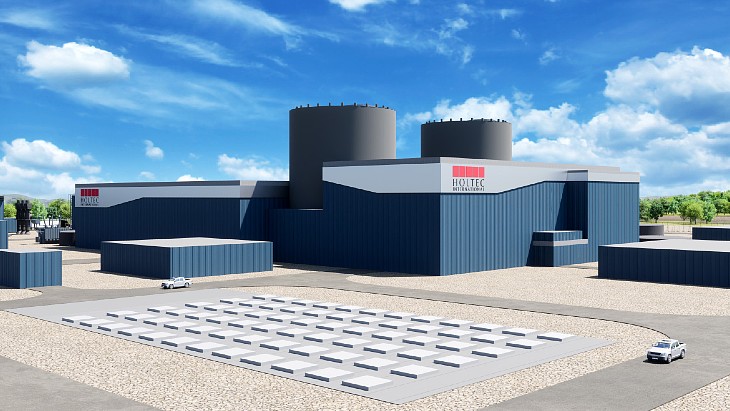
Holtec has been developing its SMR unit since 2011. The SMR-300 is a pressurised water reactor producing about 300 MW of electrical power or 1050 MW of thermal power for process applications.
UK, US deployment projects
“The positive GDA Step 2 regulatory statement is a key derisking milestone for our SMR-300 international deployment programme, demonstrating our design and safety case approach meets international regulatory expectations in addition to US Nuclear Regulatory Commission (NRC) regulatory requirements – SMR-300 is a globally deployable design,” said Richard Springman, Holtec’s President of Global Clean Energy Opportunities.
Holtec plans to deploy two SMR-300 reactors – named Pioneer 1 and 2 – at the Palisades Nuclear Generating Station site in Michigan, demonstrating viability for additional orders both domestically and abroad.
Holtec submitted the Pioneer 1 and 2 Construction Permit Application to the NRC at the end of 2025. On February 13, the NRC officially accepted the application for review and published an expected review schedule that anticipates completion of the safety evaluations and environmental impact assessment by early to mid-2027.
In September, Holtec announced it had signed a memorandum of understanding with EDF Energy and real estate partner Tritax Management to work together to develop Holtec’s SMR-300 at the former Cottam coal-fired power plant in Nottinghamshire, England, to provide power to new, advanced data centres on the site. The partners said the project will also enable foreign direct investment into the UK, including into nuclear fuel fabrication and services by Framatome and turbine manufacture by Arabelle Solutions. The 1 GW data centre project is targeted to come online by the end of the decade, with the SMR element becoming operational in the 2030s.
Jane Bowie, EDF’s SMR Development Director, said: “The opportunity to develop a new nuclear power project at the Cottam site is very exciting. This is a fantastic milestone for Holtec, and I congratulate them on the great work they have done with the regulators. This enables us to move forward jointly with the site-specific reactor design assessment phase, which is a key enabler for our small modular reactor development.”
“Holtec and EDF Energy plan to leverage the UK’s Advanced Nuclear Framework to advance the Cottam project through site-specific licensing and into deployment, benefiting from streamlined regulatory pathways and government-enabled development,” Holtec said. “This project momentum is reinforced by the growing alignment between UK and US regulators, memorialised by their renewed Memorandum of Understanding to accelerate advanced nuclear deployment which was signed in September of last year. Holtec intends to leverage inter-country regulatory accord to support efficient licensing and faster project delivery in the United Kingdom following the Pioneer 1 and 2 SMR-300 project currently under way at Holtec’s Palisades site in Michigan.”
Welcoming the completion by Holtec of Step 2 of the GDA process, Tom Greatrex, Chief Executive of the Nuclear Industry Association, said: “This is exactly the kind of momentum the UK needs to build a strong pipeline of nuclear projects that can deliver clean, reliable power, strengthen energy security, and create high-quality jobs. It is also encouraging to see UK regulators’ intention to work closely with their US counterparts on the design assessment, which will be vital in streamlining processes and speeding up the delivery of new nuclear technologies.
“To turn this progress into projects at pace, the UK must implement regulatory reforms at pace. In particular, the Government should instate a deemed justification route alongside justifying all light water reactors, ensuring technologies that have reached key milestones are recognised as justified, cutting down process and providing certainty to investors. That clarity will help unlock investment and ensure the UK can move quickly to deploy the next generation of nuclear technologies.”