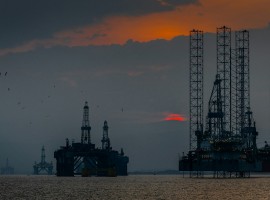
Iran said it would target all ports in and close to the Persian Gulf if its own shipping hubs are threatened, heightening the standoff over the Strait of Hormuz after the US announced plans for a blockade of Tehran-linked vessels.
The security of ports in the region is “either for everyone or for no one,” Iran’s armed forces said in a statement on Monday, according to the state-run IRIB News. The US threat to block the strait would be “an act of piracy,” it said, reiterating plans to permanently control the critical waterway even after the war.
The comments add to a game of brinkmanship over the Hormuz strait, a major transit point for energy flows that accounts for about a fifth of the world’s oil and liquefied natural gas. They signal Iran is ready to restart attacks on ports in Arab Gulf states – if the US follows through on a pledge to block all maritime traffic entering and exiting Iranian hubs from 10 a.m. New York time on Monday.
Such a move would also lead to more tension between the US and China, which buys almost all of Iran’s oil.
The strait’s effective shuttering since the start of the war has triggered a surge in oil and gas prices and become the focal point of the more than six-week conflict, which shows no sign of an imminent resolution. The US-Israeli alliance and Iran announced a two-week ceasefire on April 7, though talks over the weekend about a longer-term deal failed to yield results.
US President Donald Trump announced the blockade in response to the failure of those negotiations in Pakistan, threatening to resume US military attacks in the event of Iranian resistance. “Any Iranian who fires at us, or at peaceful vessels, will be BLOWN TO HELL!” he said.
It’s not clear where the blockade would be or how many ships would be deployed to enforce it.
The move is fraught with risk, given the potential to exacerbate a global energy-supply shock and send prices spiraling even higher. Brent crude surged after Trump’s announcement, trading almost 7 percent higher at $102 a barrel on Monday. European gas futures spiked as much as 18 percent.
“A blockade by itself is a game of chicken that I think Iran eventually wins, because they can suffer for a while,” Nouriel Roubini, the chief executive of Roubini Macro Associates, said at the Greenwich Economic Forum in Hong Kong Monday. “We’ll be in a worse world because we’ll still have higher oil prices, stock markets falling, bond yields higher.”
Around the world, there’s now a desperate effort among refiners and traders to secure immediately available crude cargoes as physical supplies tighten.
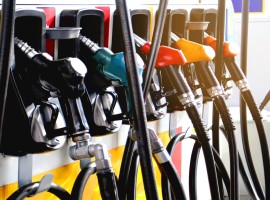
“Enjoy the current pump figures. With the so-called ‘blockade’, Soon you’ll be nostalgic for $4-$5 gas,” Iranian Parliament Speaker Mohammad Bagher Ghalibaf posted on X, referring to already inflated US gasoline prices.
Ghalibaf led the Iranian delegation during the talks in Islamabad, which broke down over differences over the future of Iran’s nuclear program. US Vice President JD Vance represented Washington.
A blockage of Iranian ships would cut off a financial lifeline for Tehran, which has maintained oil exports at prewar levels and earned millions of dollars extra in the process, given the conflict’s boost to crude prices.
Trump’s blockade could also have a major impact on China, a key trade partner of the Islamic Republic. Chinese Foreign Ministry spokesman Guo Jiakun told reporters on Monday that the move threatens global trade, and called on both sides to “remain calm and exercise restraint.”
While the US and Israel have paused the bombing of Iran – and Tehran has in turn stopped firing missiles at Gulf states – Israel has maintained its invasion of Lebanon to target Hezbollah, a Tehran-backed militant group.
On Monday, the Israeli army said it had encircled Bint Jbeil, a hilltop town about 4 km (2.5 miles) from the Israeli border, and that it will begin an attack.
Hezbollah regards Bint Jbeil as one of its main strongholds and gave it the label “the capital of the resistance and liberation.”
Israel’s ongoing offensive in Lebanon – which the Lebanese government says has killed more than 2,000 people – was a bone of contention while the terms of the US-Iran ceasefire were being ironed out. Talks between Israel and the Lebanese government – which has long pledged to disarm Hezbollah without success – are set to take place this week.
The developments around Hormuz and in Lebanon threaten to prolong and widen a war that has led to thousands of deaths, while the developing energy supply shortage is stoking fears of a global inflation crisis.
The two-week ceasefire agreement is set to expire on April 22, if the US blockade doesn’t lead to its collapse before then. Iran’s Islamic Revolutionary Guard Corps said that any military vessels attempting to approach the strait “under any pretext” would be considered a violation of the ceasefire, according to Iranian state TV.
While neither side has committed to a second round of diplomatic talks, Iran’s Foreign Ministry spokesman Esmail Baghaei said the nations reached an understanding on various issues but disagreements remained “on two or three key points.”
“It was natural that one should not have expected to reach an agreement in a single session from the outset,” he said on state television after the talks. “Diplomacy never ends” and Iran will “continue to pursue national interests under all circumstances,” he added.
An American official, who requested anonymity, said on Sunday it was clear to the US team that the Iranian delegation didn’t understand the Trump administration’s main objective, which was to guarantee the Islamic Republic would never obtain a nuclear weapon.