By
44 min ago 3 min read
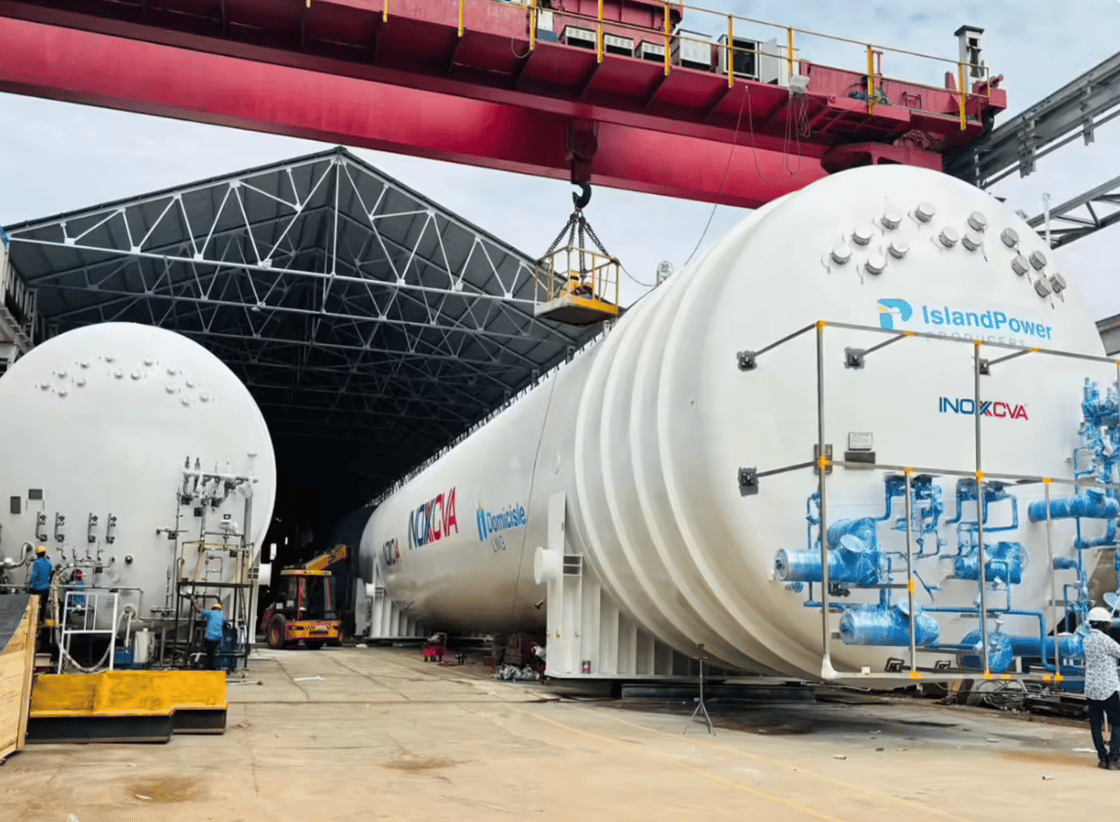
Industrial gas company INOX India has dispatched its first shipment of cryogenic tanks from Deendayal Port to a mini-liquefied natural gas (LNG) terminal project in the Bahamas.
“Kandla Port (the former name of Deendayal Port) is proud to be the gateway for yet another global milestone,” stated the port authority on social platform X. “The dispatch of LNG tanks by INOXCVA (INOX India’s cryogenics arm) for the mini-LNG terminal project at the Bahamas underscores our commitment to facilitating complex, high-value cargo.”
The 1,500 cubic metre tanks will store LNG at extremely low temperatures (around –162°C), enabling high-density storage and safe transport.
INOX India to develop the terminal in late 2024. With a total storage capacity of 15,000 cubic metres, the development is thought to be the largest installation of shop-built double-walled vacuum insulated LNG storage tanks globally.
The terminal is planned to feed natural gas to Island Power Producers’ 60MW combined cycle power plant, which in turn supplies power to cruise ships at the Nassau Cruise port.
It will also be capable of receiving LNG through smaller ships and the reloading of LNG in ISO containers for local LNG users.
The project is still in development, with the first gas turbines expected to be switched on in early 2026.
The Bahamas has been of LNG as it moves away from diesel.
Last year, Bahamas LNG Partner, a wholly owned subsidiary of the Bahamas government, signed agreements for the importation and regasification of LNG.
A terminal deal was also made between local supplier Freeport Oil Company and Dutch energy giant Shell, with the latter to supply LNG.
A separate transaction saw the Bahamas Power and Light Company and the government enter into a power purchase agreement (PPA) and a transmission interconnection agreement with Energy Bahamas Holdings.
Law firm Hogan Lovells represented the government on the PPA transaction. In 2025 the firm was advising on over a dozen PPAs for microgrid projects located on New Providence and the Family Islands.
The Bahamas aims to reduce its greenhouse gas emissions by 30% below 2010 levels by 2035, according to its NDC 3.0 submission. This goal is focused on reducing reliance on the most polluting fossil fuels, with strategies also including increasing renewable energy to 45% of the energy mix and electrifying transportation.