By
18 min ago 2 min read
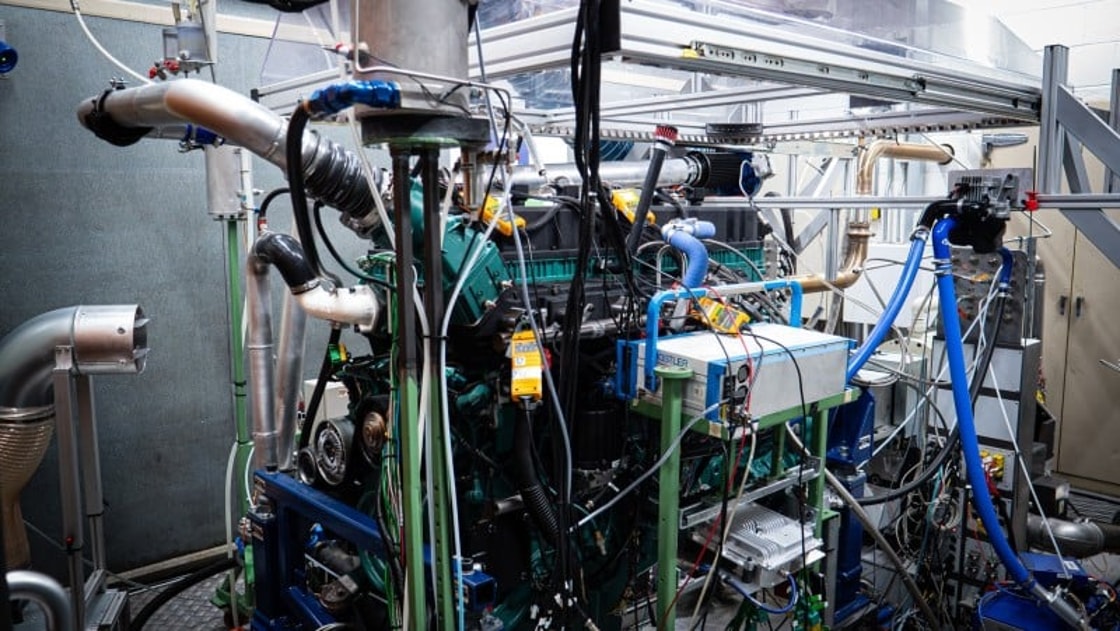
Automotive parts maker MAHLE Group has converted a heavy-duty engine to run on hydrogen while maintaining performance standards.
The UK government-funded £9.8m ($13.2m) Project Cavendish saw Mahle Powertrain adapt a 13-litre heavy-duty diesel engine to run on a hydrogen-fuelled system.
Mahle said the engine, which would typically be used in trucks or buses, continued to demonstrate torque levels equivalent to diesel operations, while nitrogen oxide (NOx) emissions were maintained below 0.2g per kilowatt hour.
With aftertreatment systems, the company said tailpipe emissions would be “significantly less” than the EU’s incoming Euro 7 emissions standard.
Mahle Powertrain’s Head of Research and Advanced Engineering, Jonathan Hall, said the project demonstrates that “hydrogen combustion has a place as a clean fuel in the heavy-duty market.”
Proponents of hydrogen engines for mobility claim that it could offer a lower-capex vehicle route for hydrogen use by using existing engine manufacturing capabilities.
But with NOx still emitted, some regulators do not treat them as zero-emission. Mahle’s project could go some way to ease those concerns.
Despite the advances, critiques remain around the overall efficiency of using hydrogen as a fuel. In absolute terms, when using electrolytic hydrogen, fuel cells offer around 30–35% well-to-wheel efficiency, while for engines, it’s around 15–20%.
However, Chief Engineer of Italian powertrain developer Dumarey, Roberto Golisano, hydrogen engines could perform better in long-haul, high-lad trucking to offer a “lower total cost of ownership” compared to other zero-carbon options.
“For long-haul trucking, where the engine is almost always at maximum power, the efficiency is at the best point – the efficiency gap between hydrogen combustion and fuel cell is reduced,” Golisano said. “This is a case where total cost of ownership can work.”
Gain access to the insights, data, and analysis trusted by hydrogen professionals worldwide.
With a H2 View subscription, you get:
- Unlimited access to 15,000+ articles
- Monthly digital magazine + H2 Review
- Exclusive interviews, webinars and reports
- Expert analysis shaping the hydrogen conversation