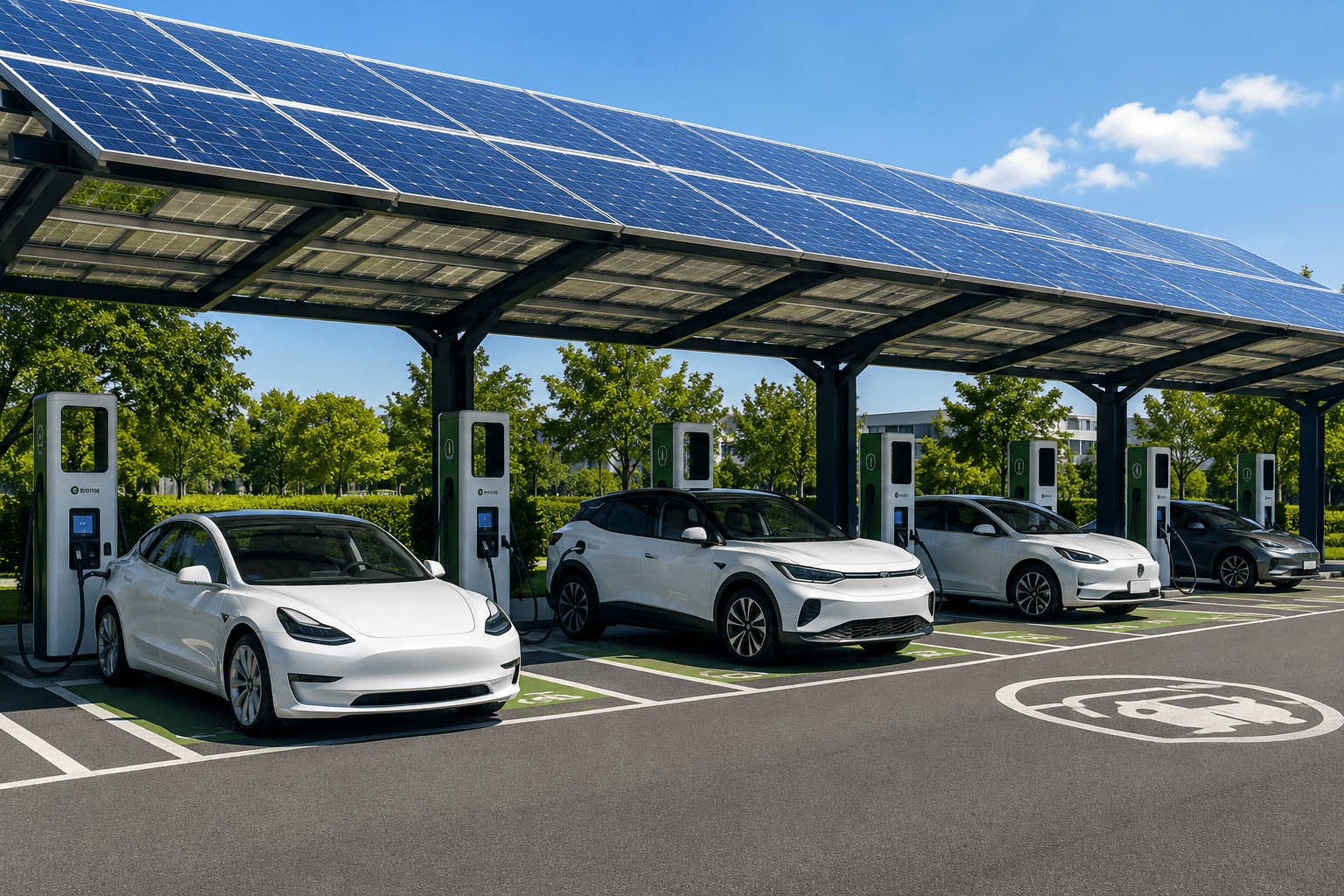
Researchers at the National University of Singapore have developed a coordinated control approach that enables stable ultra-fast EV charging integrated with solar power—without relying on additional battery energy storage systems (BESS), offering a potential breakthrough for next-generation clean mobility infrastructure.
The research, led by Associate Professor Sanjib Kumar Panda from the Department of Electrical and Computer Engineering at the university’s College of Design and Engineering, addresses one of the key challenges facing EV fast-charging stations: balancing fluctuating solar generation, rapidly changing EV charging demand, and grid stability requirements in real time.
Detailed in a paper published in the IEEE Transactions on Consumer Electronics, the team developed a real-time coordinated-control algorithm capable of dynamically distributing power between solar PV systems, EV chargers, and the electricity grid. The system continuously monitors grid ramp-rate limits, solar generation levels through maximum power point tracking (MPPT), vehicle charging capacities, and battery management system constraints.
According to the researchers, the controller intelligently reallocates power among connected EVs during sudden changes in solar irradiance or charging demand while maintaining grid stability. In situations where solar generation exceeds allowable grid limits, the system temporarily curtails solar output to prevent disturbances.
The team validated the technology using a laboratory-scale setup featuring solar emulators, a solid-state transformer, and seven fast-charging ports for different EV types. During testing, the system achieved over 99% solar power extraction efficiency while maintaining grid-side current distortions within permissible limits.
The researchers estimate that eliminating dedicated battery storage could reduce EV charging infrastructure installation costs by up to 10%.
Subscribe to get the latest posts sent to your email.