By
21 min ago 2 min read
Japanese automotive company Mazda has demonstrated an onboard carbon capture, compression, and storage system during vehicle operation.
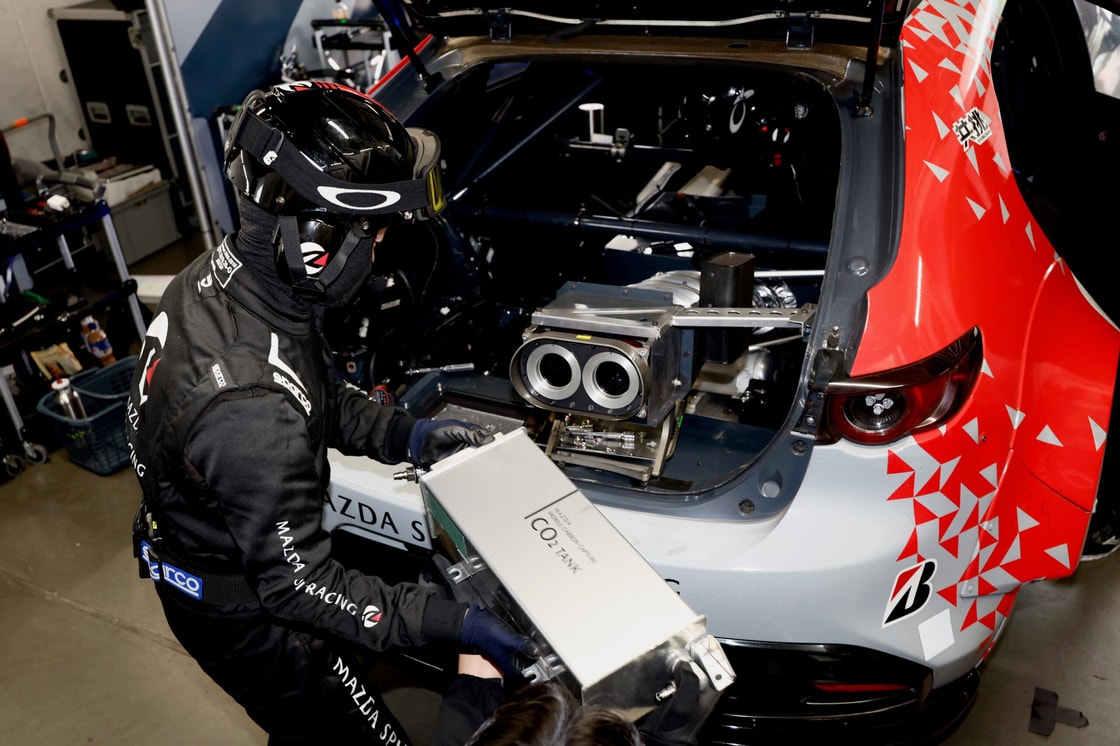
The mobile carbon capture (MCC) technology captures, desorbs, compresses, and stores carbon dioxide (CO2) from vehicle exhaust emissions.
Mazda’s demonstration vehicle captured and stored 804g of carbon dioxide (CO2) during a 24-hour race at Round 3 of the Super Taikyu series, marking the first successful demonstration of the complete capture and storage process.
This compares with 84g of CO2 captured in the initial trial in November 2025, an increase of over nine times.
Mazda said the recovered CO2 could potentially be used in greenhouse crop production or converted into carbon-based materials for industrial applications.
The MCC system uses zeolite, a porous mineral, as an adsorbent to capture CO2 from exhaust emissions. The captured CO2 is then released using exhaust heat, compressed by an electric compressor, and stored in a tank.
Mazda says that, for a limited period, the demonstration vehicle MCC system and use of carbon-neutral hydrotreated vegetable oil (HVO) as fuel confirmed the potential for future carbon-negative automotive operations.
Mazda aims to demonstrate short-term carbon-negative operation in its racing car programme during Round 7 of the Super Taikyu Series in November 2026.