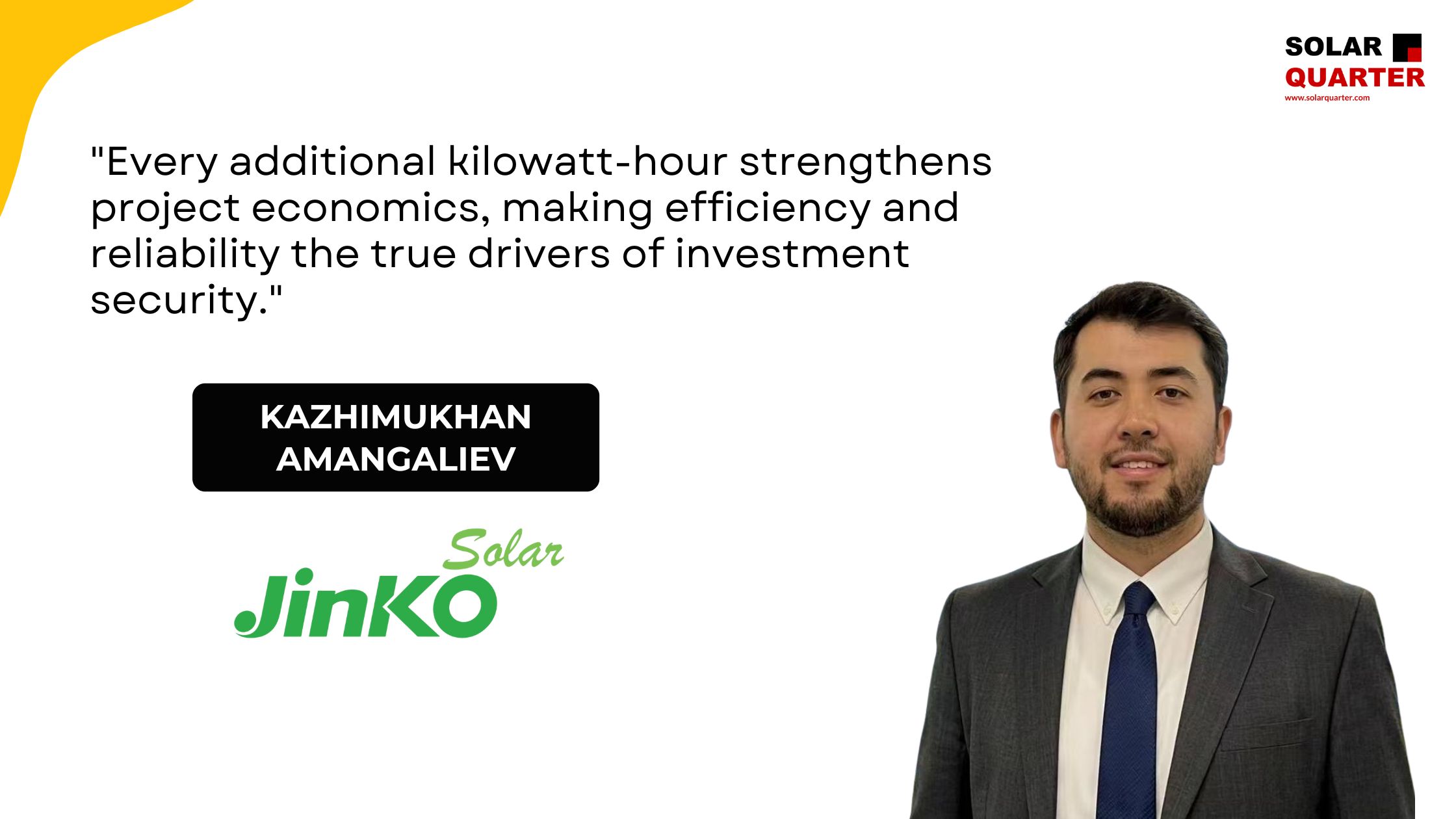
As utility-scale solar projects continue to expand across Central Asia and Africa, developers are increasingly seeking technologies that deliver higher energy yields, lower levelized cost of electricity (LCOE), and long-term reliability under demanding environmental conditions. In this interview, Kazhimukhan Amangaliev, Technical Service Manager, Jinko Solar MEA & Central Asia Region, discusses how the company’s latest Tiger Neo 3.0 modules address these priorities through higher efficiency, enhanced bifacial performance, and robust technical support. He also shares insights into Jinko’s localized service approach and the evolving needs of developers and EPCs across these fast-growing solar markets.
Tiger Neo 3.0 offers up to 670W power, 24.8% efficiency, and 85±5% bifaciality. How do these improvements translate into better returns for developers and EPCs, particularly in cost-sensitive markets like Central Asia and Africa?
From a technical service perspective, the key point is that these upgrades are not just about achieving higher nameplate power. For developers and EPCs, higher module power and efficiency directly improve overall project economics. Fewer modules are required to achieve the same DC capacity, land-use efficiency improves, and savings can be realized in mounting structures, cabling, connectors, installation labor, transportation, and O&M.
At the same time, higher bifaciality and improved energy yield translate into greater energy density, delivering more kWh over the project’s lifetime. For example, in a 100 MW project, even a 1.34%–1.94% increase in energy generation can result in significant additional annual energy output, especially under long-term PPAs or merchant-market conditions.
In Central Asia and Africa, where tariff competitiveness is extremely tight, this differentiation becomes even more important. Developers are not only looking for the lowest module price—they are looking for the lowest LCOE and the highest bankability. Tiger Neo 3.0 helps shift the discussion from module cost per watt to total value per kWh generated over the lifetime of the plant.
How has Tiger Neo 3.0 performed in the harsh climates of Central Asia and Africa, and how does Jinko assure customers of its long-term reliability?
This is a very important question about reliability. Central Asia and Africa present highly demanding environments for PV modules. We regularly encounter high ambient temperatures, intense UV exposure, dust, sandstorms, and significant day-to-night temperature variations. Under these conditions, the improved temperature coefficient of Tiger Neo 3.0 provides a practical advantage because modules operate above standard test conditions for much of their service life.
In real project conditions, the benefits are evident not only during peak irradiation hours but also in the module’s stable performance under thermal stress. A better temperature coefficient means lower power loss as module temperatures rise, which is especially valuable in desert, semi-desert, and other high-irradiation regions.
Reliability is equally important. Strong resistance to UV-induced degradation is critical in these markets because prolonged UV exposure can affect module materials and long-term power retention. We still occasionally see reports raising concerns about TOPCon sensitivity to UV exposure. However, it is important to understand whether the tested cells or modules represent the latest generation of technology. In many cases, older-generation samples or non-optimized designs do not accurately reflect the enhanced UVID resistance of Jinko’s latest TOPCon modules, including Tiger Neo 3.0.
Jinko demonstrates product quality through rigorous qualification, reliability testing, a comprehensive warranty framework, and a strong technical service process—supported by numerous reference projects operating in some of the world’s most challenging environments.
From pre-sales technical reviews to installation training, commissioning support, and after-sales investigations when required, our objective is to give investors confidence that the module is not only high-performing on paper but also reliable in real-world operating conditions.
With its high bifaciality, how has Tiger Neo 3.0 improved energy yield and reduced LCOE in projects across Central Asia and Africa?
Bifacial performance is one of the most important value drivers in many projects across Central Asia and Africa. While a theoretical rear-side gain of 10%–30% is possible, actual performance depends on several site-specific factors, including ground albedo, mounting height, tracker or fixed-tilt design, row spacing, soiling levels, and cleaning strategies.
In regions such as Uzbekistan and parts of Africa, we often see highly favorable conditions for bifacial modules due to desert terrain, gravel surfaces, and high solar irradiation. In such environments, higher bifaciality translates into measurable yield improvements and, consequently, a lower LCOE. The benefits are especially significant when projects are designed from the outset to maximize bifacial performance rather than simply replacing monofacial modules with bifacial ones.
Based on customer discussions, the feedback is clear: developers are increasingly focused on actual energy yield rather than front-side power alone. Tiger Neo 3.0’s high bifaciality gives EPCs and investors greater flexibility to optimize plant design and capture additional rear-side generation, particularly in large utility-scale projects.
How does Tiger Neo 3.0’s low-light performance benefit project economics and grid-challenged markets?
Low-light performance is often underestimated, but it offers significant practical value. In real-world operation, a solar plant does not generate electricity only at noon under ideal sunlight. Early mornings, late afternoons, cloudy conditions, airborne dust, and seasonal irradiation variations all influence the plant’s actual energy profile.
Higher energy generation under low-light conditions extends the plant’s productive operating window. This results in more usable energy during shoulder hours, a smoother daily generation curve, and higher overall energy output. While this does not replace the need for robust grid infrastructure or energy storage, it can improve the reliability and predictability of solar power generation in markets where grid stability remains a challenge.
From a financial perspective, better low-light performance strengthens project economics because every additional kilowatt-hour contributes to increased revenue, improved PPA compliance, or reduced dependence on backup generation. For project owners, this enhances investment security by enabling more consistent performance across varying weather conditions and seasonal patterns.
How does Jinko provide consistent technical support and localized service for customers across Central Asia and Africa?
Supporting customers across Central Asia and Africa requires a comprehensive end-to-end technical service framework. These regions differ significantly in terms of climate, regulations, logistics, grid conditions, and customer expectations, so technical support cannot follow a one-size-fits-all approach.
During the pre-sales stage, we assist customers with module selection, technical documentation, design reviews, bifacial yield analysis, mounting compatibility, electrical configuration, and other project-specific technical clarifications. Throughout delivery and installation, we provide guidance on module handling, storage, installation, cleaning, and commissioning to help EPCs avoid preventable quality issues. After commissioning, our support continues through performance reviews, warranty services, field inspections when required, and close coordination with our headquarters and manufacturing teams for technical analysis.
Localization is equally important. In Central Asia, language, regional standards, and local installation practices play a key role. Across Africa, where market conditions vary significantly by country, we tailor our support to local regulations, logistics, project requirements, and customer expectations. Our objective is to remain close to customers both technically and commercially, ensuring that Jinko is not only a module supplier but also a trusted long-term partner.
For Tiger Neo 3.0, this service framework is especially valuable because the product combines higher efficiency, greater bifaciality, and enhanced reliability. Our role is to help customers translate these technical advantages into tangible project value through higher energy yield, lower LCOE, stronger bankability, and greater confidence throughout the plant’s lifecycle.
Subscribe to get the latest posts sent to your email.