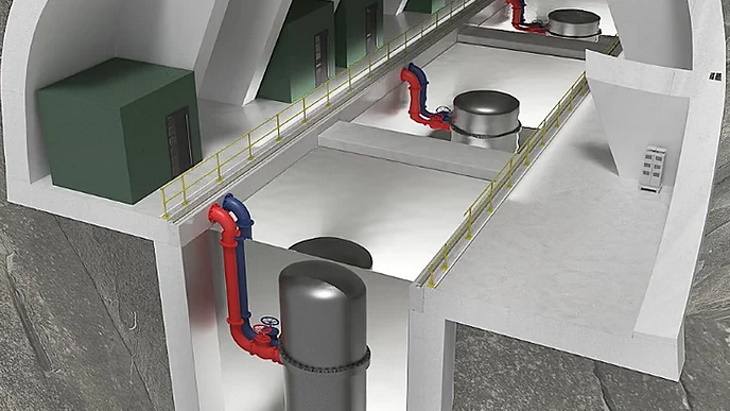
The Finnish Radiation and Nuclear Safety Authority (STUK) conducted a preliminary safety assessment of the LDR-50 last year. In June 2025, STUK said the draft concept assessment for Steady Energy’s LDR-50 found that “nuclear and radiation safety, security arrangements, emergency arrangements and nuclear material safeguards solutions are such that they can be designed to meet safety requirements”. Concept assessment is a procedure proposed in the new Nuclear Energy Act in which STUK assesses whether the power plant could meet safety requirements in general terms. It is separate to the construction permit process for the nuclear power plant. STUK said it used the draft concept as a basis for its assessment.
STUK launched the Joint Early Review of the LDR-50 concept in October 2025 with the nuclear safety authorities of four countries: the Czech State Office for Nuclear Safety (SÚJB), Poland’s National Atomic Energy Agency (PAA), the Swedish Radiation Safety Authority (SSM), and the State Nuclear Regulatory Inspectorate of Ukraine (SNRIU). The review made use of the early assessment of the plant concept completed by STUK.
The review is a voluntary cooperation process in which each authority independently assessed the plant concept based on its national requirements. The review is not part of the licensing procedure and does not produce binding decisions or a joint position on the plant concept. The key objective of the review is to support nuclear facility design at an early stage and to provide non-binding feedback to support the facility design process.
STUK has now published compiling the key observations and experiences related to the plant concept by the nuclear safety authorities. It noted the conclusions drawn by the authorities in different countries were broadly in line with each other.
Several strengths were identified in the safety solutions of the LDR-50 nuclear power plant concept, such as a defence-in-depth safety approach (several successive safety levels that secure each other) and the utilisation of passive safety solutions. In the early planning phase, the concept was considered largely appropriate, but not yet sufficient from a licensing perspective.
None of the authorities involved in the Joint Early Review identified any fundamental obstacles in the areas examined that would prevent the further development of the concept. At the same time, the reviews emphasised that the actual licensing phases require significantly more detailed analyses, justifications and more detailed planning, for example in connection with safety analyses, handling of emergencies and plant-level impacts.
“The work showed that leveraging a national safety assessment in other countries is not straightforward but requires significant preparations and clear approaches,” said Teemu Soukki, inspector responsible for the project at STUK. “Making leverage possible must be taken into consideration already at the point of preparing the national assessment.”
Steady Energy was spun out of Finland’s VTT Technical Research Centre in 2023. The LDR-50 SMR, with a thermal output of 50 MW, is designed to operate at around 150°C. Unlike most SMRs being developed around the world, it is not designed to generate electricity – or electricity and heat. Instead, it is designed to only produce heat and is focused on district heating, as well as industrial steam production and desalination projects.
Welcoming the completion of the Joint Early Review, Steady Energy CEO Tommi Nyman said: “This is a highly encouraging outcome for Steady Energy. Our ambition is to bring the LDR-50 to international markets, and it is a very positive signal that the nuclear safety authorities participating in the review did not identify any fundamental obstacles to implementing the reactor concept in accordance with their national safety requirements.”
The company has already signed agreements for 15 reactors in Finland, with its reactor design currently being assessed by STUK. The aim is for construction of the first plant – to be the clean energy source for a district heating scheme – to begin in 2029.