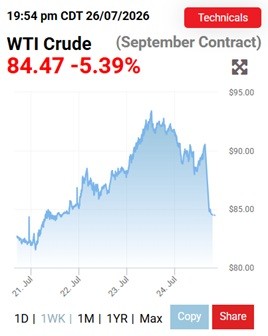
Oil prices plunged by more than 5% in early Asian trade on Monday as the U.S. and Iran halted attacks after two weeks of escalation that had driven Brent above $100.
At the time of writing, WTI crude was trading at $84.47, down 5.39%, while Brent crude had fallen to $91.80, a decline of 5.15%.
The retreat came after Washington signaled on Friday that it would temporarily halt its bombing campaign against Iran. Talking to Face the Nation on Sunday, U.S. Ambassador to the United Nations Mike Waltz said that the pause was “giving diplomacy some space” but added that additional military assets were moving into the region should diplomacy fail.
Iran has indicated that it will also suspend attacks, with foreign ministry spokesperson Esmaeil Baghaei saying talks with the Omani delegation on Friday and Saturday were “constructive” and that some progress had been made. An Iranian official talking to Reuters on condition of anonymity described Iran’s position as “attack for attack”, suggesting that it will halt operations for as long as the U.S. does.
For oil markets, the pause was enough to trigger an aggressive round of profit-taking after weeks of relentless buying, but any sustained downward pressure will require a significant ramp-up in tanker traffic.
Ultimately, until a long-term agreement is reached, tankers will still face the same operational risks that sent freight rates soaring over the past fortnight.
There are external factors that helped bring the latest round of attacks to an end, including the fact that the most recent U.S. bombing campaign had largely exhausted its initial target list while consuming significant quantities of munitions and interceptors.
Domestic political concerns for President Trump will also have helped to drive the pause, with the midterm elections now just 100 days away and the national average price of gasoline in the U.S. above $4 per gallon.
For traders, the coming days in oil markets will likely be defined by volatility driven by headlines from Washington and Tehran. While some of the immediate risk premium has been removed, shipping in both the Strait of Hormuz and the Red Sea will take time and confidence to recover.
By Josh Owens for Oilprice.com
More Top Reads From Oilprice.com
- Saudi Crude Tanker Goes Dark to Slip Through Bab el-Mandeb
- Hormuz Tanker Crossings Sink to Lowest Level Since May as War Risk Spikes
- ADNOC Issues Seventh Crude Tender Since June Despite Hormuz, Red Sea Risks