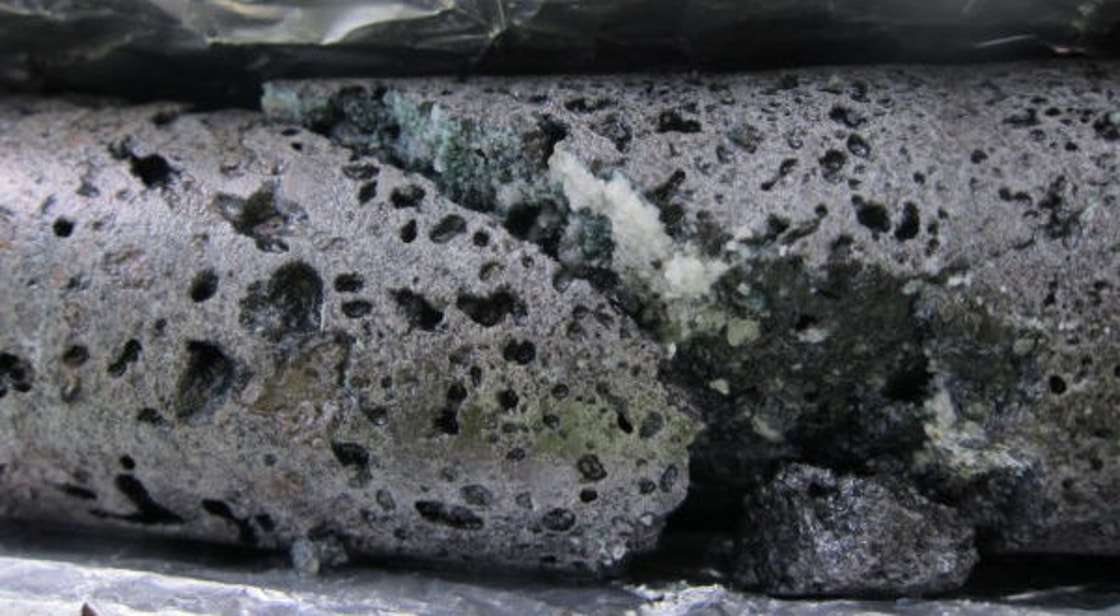
A core sample of basalt, with carbonate mineralisation occurring in the fracture. ©Annette K. Mortensen/University of Southampton
You’ve read 1 of 1 of your free articles this month.
UAE-based industrial gas company Gulf Cryo has partnered with CO2minX to advance carbon dioxide (CO2) mineralisation opportunities – a process that locks CO2 into value-added mineral products.
Headquartered in the Middle East, CO2minX is a climate technology startup that specialises in turning captured CO2 and industrial waste streams into high-value, low-carbon advanced materials.
Under the memorandum of understanding, the partners will combine CO2minX’s technology with Gulf Cryo’s infrastructure and regional market access to develop an integrated carbon mineralisation platform.
“The fit is natural: our mineralisation technology, their CO2 infrastructure, application expertise and regional reach,” wrote Mouadh Addassi, Founder & CEO at CO2minX, on LinkedIn.
CO2minX was spun out of the King Abdullah University of Science and Technology (KAUST) in Saudi Arabia in 2025. The company uses specialised methods to store captured CO2 into stable carbonate minerals using raw inputs like volcanic basalt and desalination brine.
The process can produce high-purity mineral fillers (such as precipitated calcium carbonate) and metallic mineral composites useful for low-carbon cement and construction materials.
Earlier this year, KAUST researchers demonstrated the technology by turning CO2 into solid rock without relying on freshwater.
In a field trial in western Saudi Arabia, 131 tonnes of CO2 was injected into basalt formations. Within 10 months, around 70% had mineralised using recycled subsurface water, according to KAUST.
The trial sought to address one of the biggest challenges facing carbon removal in arid regions, where freshwater is scarce. According to Carbon180, CO2 mineralisation could remove between five and 10 gigatonnes of CO2 annually by 2050.
While injecting dissolved CO2 into basalt formations can permanently lock away carbon within months, mineralisation technologies are also increasingly being developed to convert captured CO2 into commercial products.
The mineralisation of CO2 has seen several major advances through the past year. In March, a group of startups formed a on developing CO2 mineralisation technologies to decarbonise the construction sector.
Two key regulatory milestones were reached when a project led by the Global Centre for Maritime Decarbonisation secured recognition under the EU Emissions Trading System and in-principle approval for carbon mineralisation as a permanent CO2 storage pathway.