The International Thermonuclear Experimental Reactor’s plasma chamber, or vacuum vessel, houses the fusion reactions and acts as a first safety containment barrier. With an interior volume of 1400 cubic metres, it will be formed from nine wedge-shaped steel sectors that measure more than 14 metres in height and weigh 440 tonnes. The ITER vacuum vessel, once assembled, will have an outer diameter of 19.4 metres, a height of 11.4 metres, and weigh approximately 5,200 tonnes. With the subsequent installation of in-vessel components such as the blanket and the divertor, the vacuum vessel will weigh 8,500 tonnes.
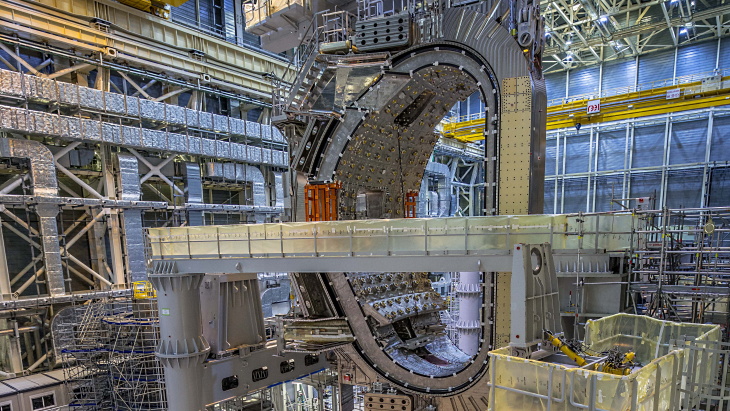
Each sector module is composed of a vacuum vessel sector, two toroidal field coils, thermal shields, and auxiliary components, with lifting equipment and stabilising beams attached for the lift operation.
(Image: ITER Organisation)
The fabrication of the vacuum vessel sectors is shared between Europe (five sectors) and South Korea (four sectors). Initially, South Korea was tasked with producing two vacuum vessel sectors under its agreement with the ITER Organization. However, in 2016, an additional agreement was made to produce two more sectors originally assigned to the EU.
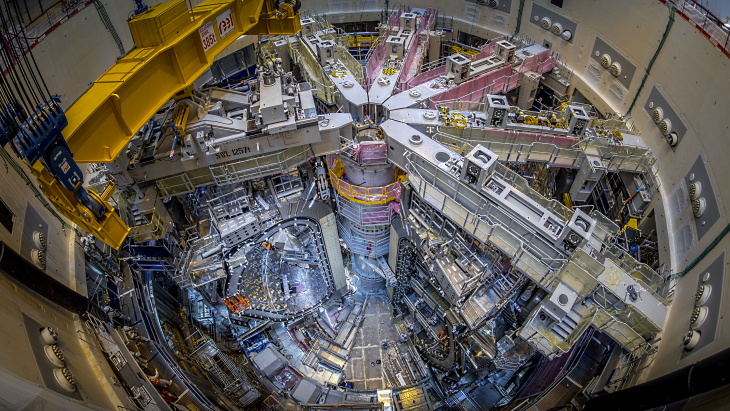
The sector modules that form the ITER machine’s core have progressively been installed within the tokamak pit since April 2025.
The sixth tokamak sector module, #1, weighing about 1,100 tonnes, was transferred from the Assembly Hall and lowered into the pit in a carefully coordinated lifting operation, which took 30 hours and mobilised more than 100 people, and concluded on 28 July. Together with its lifting rig, the suspended load weighed nearly 1,400 tonnes. The latest sector installation brings two-thirds of the machine’s torus-shaped core into place.
(Image: ITER Organisation)
“Experience gained from each successive module assembly and lifting operation has increased the pace, efficiency and predictability of the work,” the ITER Organisation noted. It said it was on track to install the final sector module in mid-2027, “with teams continuing to identify opportunities for further schedule optimisation”.
“This latest achievement is a visible marker of the progress being made through our accelerated approach to machine assembly,” said ITER Director-General Pietro Barabaschi. “The teams have translated lessons learned from each operation into greater efficiency, stronger coordination and a more predictable assembly sequence. With six modules now in place, we are demonstrating that this technical approach is delivering tangible results on the project’s critical path.”
With the transfer of sector module #1 now complete, it joins the five others – #4, #5, #6, #7 and #8 – that are already in the tokamak pit. A seventh sector module is expected to be transferred before the end of the year.
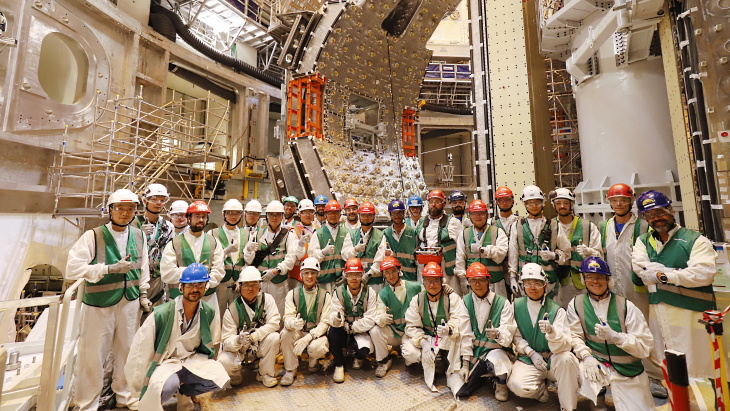
(Image: ITER Organisation)
Once all nine sector modules are positioned in the pit, teams will proceed with the complex work of joining the sectors to complete the torus.
ITER is a major international project to build a tokamak fusion device designed to prove the feasibility of fusion as a large-scale and carbon-free source of energy. The goal of ITER is to operate at 500 MW (for at least 400 seconds continuously) with 50 MW of plasma heating power input. It appears that an additional 300 MWe of electricity input may be required in operation. No electricity will be generated at ITER.
Thirty-five nations are collaborating to build ITER – the European Union is contributing almost half of the cost of its construction, while the other six members (China, India, Japan, South Korea, Russia and the USA) are contributing equally to the rest. Construction began in 2010 and the original 2018 first plasma target date was put back to 2025 by the ITER council in 2016. However, in June 2024, a revamped project plan was announced which aims for “a scientifically and technically robust initial phase of operations, including deuterium-deuterium fusion operation in 2035 followed by full magnetic energy and plasma current operation”.