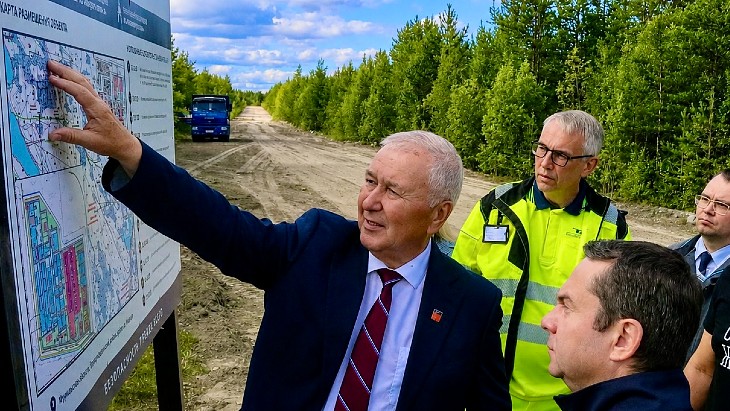
A ceremony to mark the beginning of the works was held on Wednesday, attended by the Governor of Murmansk Andrey Chibis, the management of the Kola plant, and representatives from the general contractor, JSC Titan-2.
Work to prepare a site of a future nuclear power plant does not count as the official start of construction for a nuclear unit, which will follow later. The preparatory work will involve survey work, design and preparation of a construction base and ensuring there are access roads and facilities for the future workforce.
The main construction phase will begin after the design is completed, expert reviews have been completed, and the construction licence received from Rostekhnadzor.
Chibis said: “This is a significant day and a monumental project – not just for a decade, but for the next century. The world’s first nuclear power plant with innovative medium-capacity units will be built in Polyarnye Zori. The construction of Kola NPP-2 will open up opportunities for new industrial projects and will drive the socioeconomic development of Russia’s entire Arctic zone. Implementing such a large-scale project will create over 5,000 new jobs during the construction phase and will require hundreds of highly qualified specialists during operation. For the Murmansk Region, the commissioning of Kola NPP-2 means a guaranteed and uninterrupted power supply to industrial enterprises and social infrastructure. In the future, the new power units will help maintain the region’s energy balance after the decommissioning of existing facilities.”
Vasily Omelchuk, Director of the Kola NPP, said the new plant was a “logical continuation of the development of nuclear energy on the Kola Peninsula. We’re not starting from scratch: our team has many years of experience operating an existing plant, well-established processes, and a high level of professionalism. The personnel issue has also been thoroughly considered: we will train young specialists and, as the existing units are decommissioned, transfer our employees to new capacities”.
Rosatom says that the plan is for the four new units at Kola II to be of the VVER-S design, a 600 MWe water-cooled reactor under development, with the first two to be built between 2027 and 2037. Rosatom says that, if the proposed VVER-S reactors can use a full load of MOX (mixed oxide) fuel, it will cut its use of natural uranium by 50%.
The new units are intended to replace the existing four Kola units as they come to the end of their operating lives. They are VVER-440 reactors; 1 and 2 are V-230 models and 3 and 4 are of the V-213 type. They have a capacity of 411 MWe and were all connected to the grid between 1973 and 1984.
The Kola nuclear power plant was the first to be built in the harsh climatic conditions of the Arctic, providing energy to the northern part of the Republic of Karelia – where most of the region’s major industrial enterprises are located – as well as to more than half of the consumers in the Kola Peninsula.
There have been various plans for new capacity at Kola, with World Nuclear Association saying that in 2012 the replacement plant was due to feature two VVER-TOI units. However, in June 2021, the plant management announced that the plan was for construction to begin in 2028 for two VVER-S 600 MW reactors, with the first to be online in 2034. The ‘S’ signifies spectral shift control, with heavy water in the primary coolant.